


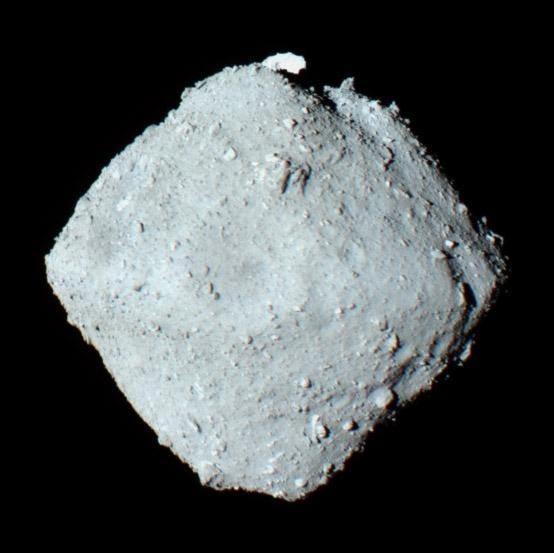
This is a colored view of the C-type asteroid 162173 Ryugu, seen by the ONC-T camera on board of … More
Credit: JAXA Hayabusa 2
How did life here at home get its first building materials? The onset of life here on Earth likely hinged on the delivery of organic material delivered by water- and carbon-rich asteroids. To date, the argument has been that most of the water and the organics that would build life (including amino acids) originated very far out in our early solar system.
But in a paper just published in the journal Nature Communications, lead author, Matthew Genge, a geologist at Imperial College London, and colleagues argue that the building blocks of life had their origins in an intensely turbulent region of space close to our giant planet Jupiter.
The findings are based on evidence from samples of carbon-rich asteroid Ryugu, returned to Earth by the Japan Aerospace Agency Hayabusa 2 mission, Imperial College notes.
We studied microchondrules —- tiny pieces of rock from asteroid Ryugu, which is a really carbon and water rich asteroid, the kind of asteroid that probably delivered all the carbon and water for our planet, Genge told me in his office. In that sample, we discovered evidence for a whole new way of making these types of asteroids, he says. Maybe they formed not just at a great distance, but where the early solar system was turbulent and disturbed, says Genge. It’s in those places that these carbon and water rich particles are concentrated, he says.
The Ryugu specimen that I studied was only one millimeter across, says Genge. To people who study meteorites, that’s tiny, but to me it was a boulder, because I’m used to studying things 10 times smaller, he says.
Using a scanning electron microscope, the team was able to identify a shockingly large number of microchondrules, tiny spheres originally consisting of glass, that had been altered by water formed when ice melted on the asteroid, says Imperial College. The team identified them by virtue of their sulfide-rims, which could be seen in X-ray CT scans of the mm-sized Ryugu sample, the college notes.
Until now, the asteroid Ryugu had been thought to have formed at some 20 to 30 Earth-Sun distances, or out beyond the present-day orbits of Uranus and Neptune.
But new scanning electron microscope images that suggest the building-blocks of life originated near Jupiter in our early solar system, rather than from deep space as currently thought, says the imperial college London.
There was likely intense turbulence just beyond the orbit of Jupiter in the early Solar System, where gas was stirred up by the wake of the giant planet.
Just outside this region was also a pressure bump where mm-sized grains were concentrated by gas flow, Imperial College reports. This Jovian pressure bump was essentially a chondrule factory that concentrated and incorporated this material into asteroids, the college notes.
What Melts These Microchondrules?
It’s still not known but Genge says his favorite hypothesis is that the heat is generated by flash heating caused by random explosive shockwaves that moved through our solar system’s young protoplanetary disk.
These shockwaves could have caused temperatures in the disk of up to 1900 degrees Celsius, which is hot enough to melt steel. And more importantly, it was hot enough to melt these protoplanetary materials into molten droplets of primitive microchondrules.
If you’ve ever watched a movie with an explosion in it, you’ve seen an expanding shockwave, says Genge.
It’s that rapidly moving shell that flash heats the dust to make molten droplets. However, the finest grain dust particles escape most of the heating, so they keep their carbon and water and other organic material.
But due to this material’s proximity to Jupiter, there was locally an intense amount of disk turbulence which caused rapidly turning eddies of gas.
These eddies of gas throw out the big particles and keep the really fine dust, says Genge. Then, if you make an object like an asteroid there, it’s mainly fine grained, he says.
The fine grains contained carbon and water and critical prebiotic molecules such as amino acids. These and the microchondrules subsequently migrated inward towards the inner solar system and likely predate the formation of our own planet.
Yet when Earth did form, the building blocks of life were there waiting to be incorporated into our nascent planet.
Illustration of how microchondrules might have formed early in the solar system
Imperial College London
The Bottom Line?
Earth was likely seeded by building blocks of life from both the cold outer regions of our solar system as well as from near our gas giant planet Jupiter.
As for what’s next?
We’ve now got a really good understanding of where in the solar system these materials come from, says Genge. But over the next twenty years, we’re going to sample more unusual asteroids and learn more about the early solar system, he says.
