


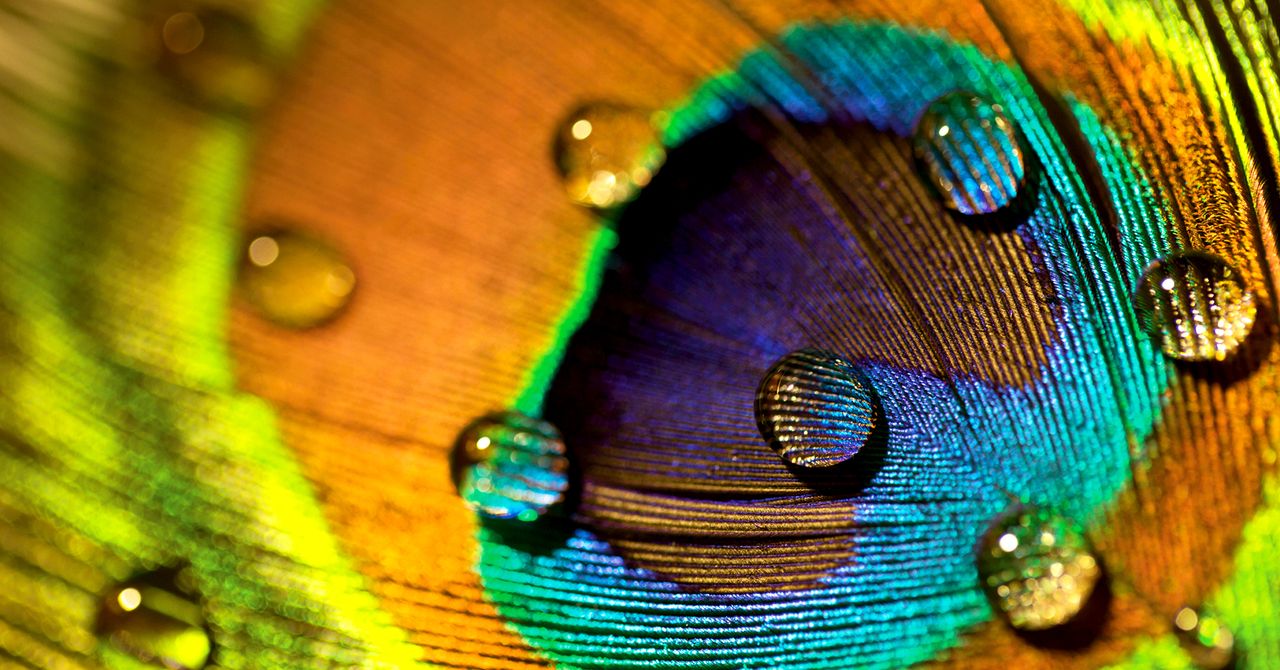
Peacock feathers are greatly admired for their bright iridescent colors, but it turns out they can also emit laser light when dyed multiple times, according to a paper published in the journal Scientific Reports. Per the authors, it’s the first example of a biolaser cavity within the animal kingdom.
As previously reported, the bright iridescent colors in things like peacock feathers and butterfly wings don’t come from any pigment molecules but from how they are structured. The scales of chitin (a polysaccharide common to insects) in butterfly wings, for example, are arranged like roof tiles. Essentially, they form a diffraction grating, except photonic crystals only produce certain colors, or wavelengths, of light, while a diffraction grating will produce the entire spectrum, much like a prism.
In the case of peacock feathers, it’s the regular, periodic nanostructures of the barbules—fiber-like components composed of ordered melanin rods coated in keratin—that produce the iridescent colors. Different colors correspond to different spacing of the barbules.
Both are naturally occurring examples of what physicists call photonic crystals. Also known as photonic bandgap materials, photonic crystals are “tunable,” which means they are precisely ordered in such a way as to block certain wavelengths of light while letting others through. Alter the structure by changing the size of the tiles, and the crystals become sensitive to a different wavelength. (In fact, the rainbow weevil can control both the size of its scales and how much chitin is used to fine-tune those colors as needed.)
Even better (from an applications standpoint), the perception of color doesn’t depend on the viewing angle. And the scales are not just for aesthetics; they help shield the insect from the elements. There are several types of manmade photonic crystals, but gaining a better and more detailed understanding of how these structures grow in nature could help scientists design new materials with similar qualities, such as iridescent windows, self-cleaning surfaces for cars and buildings, or even waterproof textiles. Paper currency could incorporate encrypted iridescent patterns to foil counterfeiters.
There have been prior examples of random laser emissions in everything from stained bovine bones and blue coral skeletons to insect wings, parrot feathers, and human tissue, as well as salmon iridiphores. The authors of this most recent study were interested in whether they could produce similar laser emissions using peacock feathers and hopefully identify the specific mechanism.
It wasn’t difficult to get the peacock feathers, given how popular they are for decorative and arts and crafts purposes, but the authors did make sure none of the feathers used in their experiments contained impurities (like dyes). They cut away any excess lengths of barbs and mounted the feathers on an absorptive substrate. They then infused the feathers with common dyes by pipetting the dye solution directly onto them and letting them dry. The feathers were stained multiple times in some cases. Then they pumped the samples with pulses of light and measured any resulting emissions.
The team observed laser emissions in two distinct wavelengths for all color regions of the feathers’ eyespots, with the green color regions emitting the most intense laser light. However, they did not observe any laser emission from feathers that were only stained once, just in sample feathers that underwent multiple wetting and complete drying cycles. This is likely due to the better diffusion of both dye and solvent into the barbules, as well as a possible loosening of the fibrils in the keratin sheath.
The authors were unable to identify the precise microstructures responsible for the lasing; it does not appear to be due to the keratin-coated melatonin rods. Coauthor Nathan Dawson of Florida Polytechnic University suggested to Science that protein granules or similar small structures inside the feathers might function as a laser cavity. He and his colleague think that one day, their work could lead to the development of biocompatible lasers that could safely be embedded in the human body for sensing, imaging, and therapeutic purposes.
This story originally appeared on Ars Technica.
