

Close Menu
TechurzTechurz
    What's Hot

    Asian AI startups launch Mythos-like models as Anthropic’s export ban drags on

    June 27, 2026

    Corgi, the buzzy Y Combinator-backed insurance tech startup, says it didn’t steal an open source product

    June 26, 2026

    OpenAI poaches Uber India chief to lead its biggest market outside the US

    June 26, 2026
    X (Twitter) Pinterest YouTube LinkedIn WhatsApp
    Tech Pulse
    • Asian AI startups launch Mythos-like models as Anthropic’s export ban drags on
    • Corgi, the buzzy Y Combinator-backed insurance tech startup, says it didn’t steal an open source product
    • OpenAI poaches Uber India chief to lead its biggest market outside the US
    • Early Bird pricing ends tonight for Founder Summit
    • Robotaxis drive miles just to get cleaned and charged; this new startup wants to fix that
    X (Twitter) Pinterest YouTube LinkedIn WhatsApp
    TechurzTechurz
    • Home
    • Tech Pulse
    • Future Tech
    • AI Systems
    • Cyber Reality
    • Disruption Lab
    • Signals
    TechurzTechurz
    Home - Apps - Sandisk reveals monstrous 256TB SSD for AI, skipping cache and raising serious questions about speed under pressure
    Apps

    Sandisk reveals monstrous 256TB SSD for AI, skipping cache and raising serious questions about speed under pressure

    TechurzBy TechurzAugust 9, 2025Updated:May 11, 2026No Comments3 Mins Read
    Share Facebook Twitter Pinterest LinkedIn Tumblr Reddit Telegram Email
    Sandisk 256TB SSD
    Share
    Facebook Twitter LinkedIn Pinterest Email


    • Sandisk’s 256TB SSD skips cache entirely, raising concerns about short-burst workload performance
    • Claims of faster speeds remain unverified without public benchmarks or IOPS performance numbers
    • Direct Write QLC may sacrifice speed in exchange for higher reliability and data integrity

    Sandisk has announced a 256TB SSD, the UltraQLC SN670, which is set to ship in the first half of 2026.

    This model represents the largest SSD ever revealed by the company, marking a bold step toward high-density storage solutions tailored for AI and hyperscale infrastructure.

    Although the company plans to release the 128TB version to testers within weeks, full commercial availability remains months away.


    You may like

    An architecture built for scale, not speed

    At its core, the SN670 is built on a 218-layer BiCS 3D NAND architecture and features a CBA (CMOS directly Bonded to Array) 2Tb die.

    It connects through a PCIe Gen5 NVMe interface and is part of Sandisk’s new UltraQLC platform.

    Unlike conventional SSDs that buffer data through pseudo-SLC caches, this model uses a “Direct Write QLC” approach.

    This simplifies the writing process and makes the drive more power-loss safe, but it also introduces tradeoffs, especially when it comes to performance under heavy or short-burst loads.

    Sign up to the TechRadar Pro newsletter to get all the top news, opinion, features and guidance your business needs to succeed!

    Without an SLC cache, the SN670 may suffer from slower short-burst writes, inconsistent performance under load, and increased controller demands, making it less responsive during intensive or unpredictable workloads.

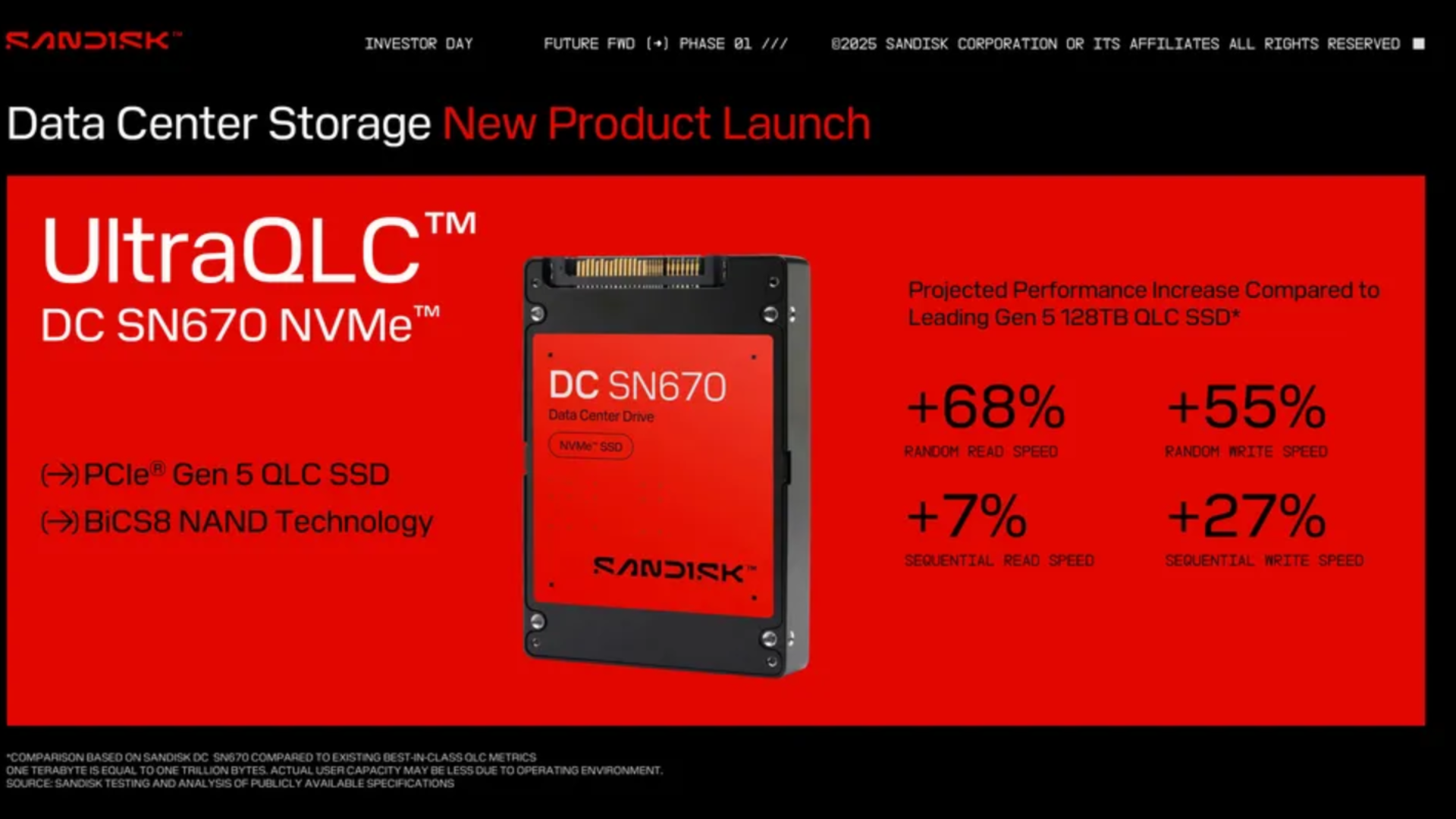
    However, Sandisk claims the SN670 delivers over 68% faster random reads and 55% faster random writes compared to a leading 128 TB Gen 5 QLC SSD.

    The sequential read speeds are over 7% better, while sequential write speeds improve by more than 27% in internal comparisons.

    Sandisk has emphasized benefits like Dynamic Frequency Scaling, which is said to improve performance by up to 10 percent at the same power level

    It also claims the Data Retention profile could reduce recycling wear by as much as 33%.

    Both features are intended to enhance longevity and reduce energy consumption.

    However, none of these claims are backed by disclosed performance data such as read/write speeds or endurance figures.

    Internally, the UltraQLC SN670 is supported by a custom controller and firmware, which Sandisk says enables better latency and bandwidth, but without actual benchmarks or IOPS comparisons, these statements remain marketing-driven projections.

    It is worth noting earlier iterations of Sandisk’s enterprise drives using QLC NAND showed limitations compared to TLC-based models.

    In this case, native QLC programming latencies could reach 800–1200 microseconds, several times slower than SLC-based designs.

    Sandisk may be relying on optimizations like large DRAM buffers or advanced die parallelism, but such architectural details have yet to be confirmed.

    The final product will arrive in U.2 form initially, with more variants expected later in 2026.

    For now, Sandisk’s 256TB drive is a symbolic leap toward future data infrastructure, not a realistic option for mainstream users.

    Via Blocks and Files

    You might also like

    256TB Cache monstrous Pressure Questions raising reveals Sandisk skipping Speed SSD
    Share. Facebook Twitter Pinterest LinkedIn Tumblr Email
    Previous ArticleXConn’s new PCIe Gen 6 switch might shake up AI data centers faster than anyone expected
    Next Article How to use ChatGPT with Siri on iPhone in iOS 18.2
    Techurz
    • Website

    Related Posts

    Opinion

    AI inference startup Baseten reportedly raising $1.5B months after its last mega round

    June 18, 2026
    Opinion

    Zepto’s IPO filing reveals fast growth, bigger losses, and a valuation question nobody’s answered yet

    June 9, 2026
    Opinion

    After Nvidia’s $20B not-acqui-hire, AI chip startup Groq reportedly raising $650M

    May 29, 2026
    Add A Comment
    Latest Tech Pulse

    College social app Fizz expands into grocery delivery

    September 3, 20252,290

    SolarSquare in talks to raise up to $60M as India’s rooftop solar market draws major VC interest

    May 23, 202622

    Future of Digital Privacy and Security: 7 Truths Nobody Tells You

    May 25, 202619
    Stay In Touch
    • YouTube
    • WhatsApp
    • Twitter
    • Pinterest
    • LinkedIn

    Techurz helps readers stay ahead of digital change with clear, practical, future focused technology intelligence written today,searched tomorrow.

    X (Twitter) Pinterest YouTube LinkedIn WhatsApp
    Company
    • About Us
    • Contact Us
    • Our Authors / Editorial Team
    • Write For Us
    • Advertise
    Policy
    • Editorial Policy
    • Privacy Policy
    • Terms and Conditions
    • Affiliate Disclosure
    • Cookie Policy
    • Disclaimer
    • DMCA
    Explore
    • AI Systems
    • Cyber Reality
    • Future Tech
    • Disruption Lab
    • Signals
    • Tech Pulse
    • Sitemap

    Join the Techurz Brief

    The future does not arrive suddenly.
    Stay ahead with fast, sharp tech signals.

    Type above and press Enter to search. Press Esc to cancel.