


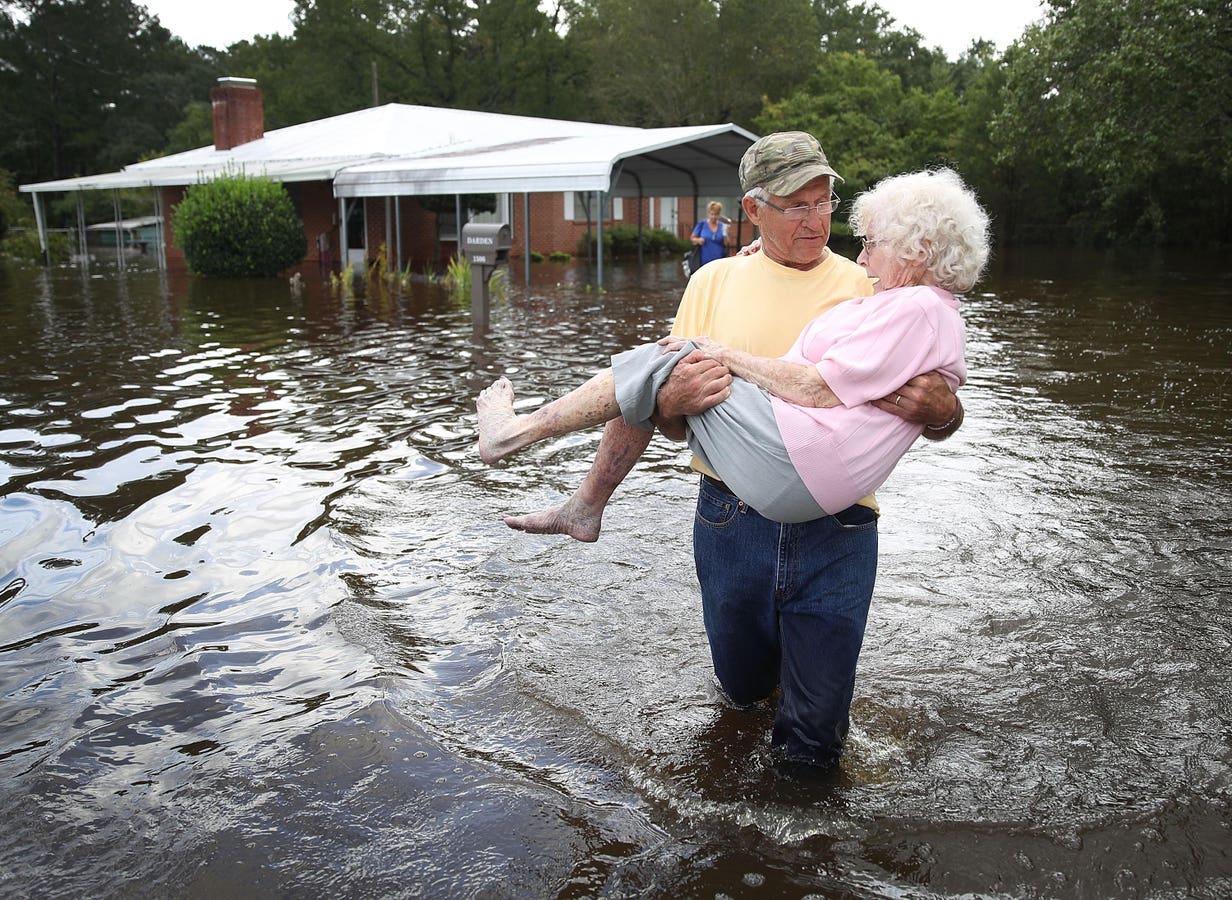
SPRING LAKE, NC – SEPTEMBER 17: Bob Richling carries Iris Darden as water from the Little River starts to seep into her home on September 17, 2018 in Spring Lake, North Carolina. Flood waters from the cresting rivers inundated the area after the passing of Hurricane Florence. (Photo by Joe Raedle/Getty Images)
Getty Images
For the last few years, I have opined about the inadequacy of the Saffir — Simpson scale for conveying the full impacts of hurricanes. Harvey (2017), Milton (2024) and Helene (2024) are examples of hurricanes that altered landscapes and entire regions because of extreme rainfall, storm surge and tornadoes. Yet, the Saffir — Simpson Hurricane Wind Scale was designed to emphasize one hazard, wind. A professor at the University of South Florida and her team think it is time for a new scale.
Dr. Jennifer Collins and her collaborators recently published a paper in the journal Scientific Reports that proposed replacing the Saffir — Simpson Hurricane Wind Scale with something called the Tropical Cyclone Severity Scale. The TCSS accounts for wind, storm surge, and rainfall. Collins, a professor and hurricane researcher in USF’s School of Geosciences, is an international expert versed in the physical and societal aspects of tropical cyclones.
HOUSTON, TX – AUGUST 30: Flooded homes are shown near Lake Houston following Hurricane Harvey August 30, 2017 in Houston, Texas. The city of Houston is still experiencing severe flooding in some areas due to the accumulation of historic levels of rainfall, though the storm has moved to the north and east. (Photo by Win McNamee/Getty Images)
Getty Images
In a USF press release issued in August, she said, “Frequently, people use the storm’s category to decide whether to evacuate, that’s incredibly dangerous because if they hear it’s only a tropical storm or Category 1, too often no alarm bells go off, and they see no cause for concern.” Ah yes, “the it’s only” narrative is a big problem. I often remind people that much of the flooding associated with Hurricane Harvey in southeastern Texas or Hurricane Florence in the Carolinas was when the storms were weaker hurricanes or tropical storms.
Florence killed 55 people but was “only” a Category 1 storm. As we reflect on the 20th anniversary of Hurricane Katrina (2005), the USF press release noted, “Katrina was listed as a Category 3 based on wind speed, but most of the 1,800 deaths and $125 billion in damage were caused by storm surge and rainfall.” We have known for over a decade from a 2014 study by Edward Rappaport, who has since retired from his role as deputy director of the National Hurricane Center, that storm surge and rainfall account for almost ten times more fatalities than wind.
New Orleans, UNITED STATES: A barge sits among flooded homes in New Orleans’ Ninth Ward 26 September 2005. The barge entered the Ninth Ward after a storm surge from hurricane Katrina caused a breach in the Industrial Canal (L) levee. The area was pumped dry just a few days before hurricane Rita hit, causing overtopping of the patched breach and a reflooding of the area. New Orleans opened the gates to residents who fled two hurricanes in four weeks but they were warned the return is “at your own risk”. Mayor Ray Nagin is allowing residents back into other parts of the city, but residents of the Ninth Ward still have no idea if and when they will see their homes again. AFP PHOTO/Robyn BECK (Photo credit should read ROBYN BECK/AFP via Getty Images)
AFP via Getty Images
This new study suggests that people are more likely to evacuate if they have a full understanding of the suite of potential impacts. The public can be lulled into thinking impacts of a hurricane or tropical storm are along dots, lines, and cones seen on maps. The National Weather Service and National Hurricane Center have tried to mitigate such percptions by including watch or warning areas on the cone graphic and issuing impact—based messaging.
The new TCSS scale rates wind, rain, and storm surge hazards to create a cumulative score of severity. The press release went on to say, “If one hazard is worse than the others, the hurricane’s final category is at least that high. For example, if wind and rainfall are rated 2 but storm surge is 4, the final category is at least 4…. If two hazards are rated Category 3 or higher, the final number increases by one. So, if storm surge is 4 but wind and rainfall are 5, the hurricane is predicted as Category 6.” When the researchers evaluated 4000 respondents’ perception to 10 fictional hurricanes, Collins said, “The higher category is important…. many people base their decision to evacuate on that number, not just on the details of the hazard.”
PUNTA GORDA – OCTOBER 10: In this aerial view, Flood waters inundate a neighborhood after Hurricane Milton came ashore on October 10, 2024, in Punta Gorda, Florida. The storm made landfall as a Category 3 hurricane in the Siesta Key area of Florida, causing damage and flooding throughout Central Florida. (Photo by Joe Raedle/Getty Images)
Getty Images
A version of the Saffir — Simpson Hurricane Scale has been around since 1971. That version utilized wind, storm surge, and pressure data. In 2012, it was modified to include only wind, according to the USF press release. Stakeholders are optimistic about the new scale.
Brad Millikin is the director of maritime operations for the humanitarian organization Global Support and Development. Writing on LinkedIn, he affirmed, “The TCSS more accurately reflects the overall hazards associated with storms, with a sharp focus on ‘weaker’ storms that might not be significant wind events but could still devastate a community based on storm surge or total rainfall.”
LAKE LURE, NORTH CAROLINA – SEPTEMBER 28: The Rocky Broad River flows into Lake Lure and overflows the town with debris from Chimney Rock, North Carolina after heavy rains from Hurricane Helene on September 28, 2024, in Lake Lure, North Carolina. Approximately six feet of debris piled on the bridge from Lake Lure to Chimney Rock, blocking access. (Photo by Melissa Sue Gerrits/Getty Images)
Getty Images
To be comprehensive, I should point out that other scholars have advocated for new scales over the years. University of Alabama scholar Jason Senkbeil and colleagues published a comprehensive scale in 2008, but it is rooted in post—landfall classification. A company called StormGeo developed a Hurricane Severity Index that captures wind intensity and the size of the storm. My colleague Andrew Grundstein at the University of Georgia has also explored broader impact scales, and my research group has quantified the rainfall contributions from tropical cyclones.
So, what’s next for the TCSS? Collins reflected, “Change is hard for any institution that’s been doing the same thing for years.” She plans to pitch the scale to the National Hurricane Center. She went on to say, ”But, I’m fairly optimistic that now is the time. We now know many people make decisions based on the category messaging, so we need to ensure that we are communicating with a scale which is more realistic of the severity of the hurricane, considering other hazards which commonly occur, particularly from storm surge and rainfall flooding, which is considered in our scale.”
Dr. Jennifer Collins is a hurricane researcher at the University of South Florida.
Aimee Blodgett/USF
