


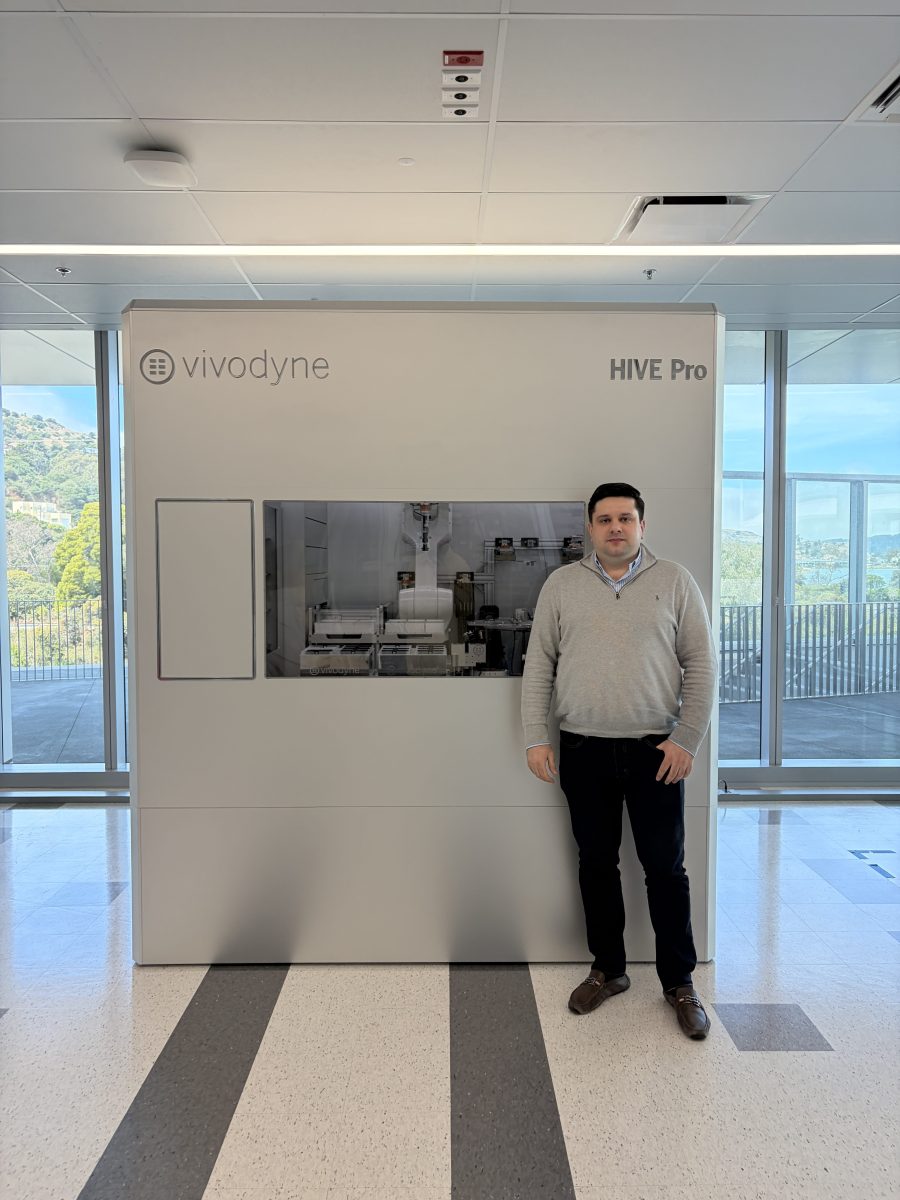
A biotech startup called Vivodyne says the AI drug-discovery industry has a data problem, and that it has built a machine to fix it.
HIVE, modular robotic labs built by the company, can grow 20 kinds of human tissue, then autonomously dose and monitor them, generating the kind of causal biological data that today’s AI models are missing — data that today mostly comes from animal testing, or studies of single cells or proteins, not living tissue.
“Absent human testing, what are these [AI] models going to do?” asks Andrei Georgescu, Vivodyne’s CEO and co-founder. “They’re going to cure cancer in mice.”
Even Anthropic CEO Dario Amodei wrote over the weekend that claims that AI will cure cancer have become more cliché than credible — “the thing that will work is actually curing cancer,” as he put it.
To be fair, the idea that AI will cure cancer is something Amodei himself has tossed out in previous essays; Sam Altman has repeatedly cited curing cancer as a justification for OpenAI’s push toward AGI and ever-larger compute buildouts; and Google DeepMind’s Demis Hassabis said last year that AI could potentially cure all disease within a decade.
The actual results remain tepid. A handful of AI-designed drugs have proceeded into human trials — one as far as Phase III, widespread human testing — but the reality is that the roadblocks aren’t necessarily ones that AI can solve today.
Nobel-prize-winning AlphaFold was a big advance for understanding the building blocks of life, but it has yet to actually produce a new drug. Isomorphic Labs, founded to build on AlphaFold, is expecting its first trials, originally planned for 2025, by the end of this year. In February, the company wrote that true drug discovery will require “highly accurate predictive models, across an expansive range of biochemical properties and interactions.”
Georgescu says the space needs “a sanity check” — that existing models don’t have the data to capture the complexity of human biology. It’s a challenge already facing the pharmaceutical industry, where 90% of drugs that are effective enough in animal testing to enter clinical trials don’t receive regulatory approval for humans.
Vivodyne’s plan is different. Vivodyne was spun out of the University of Pennsylvania in 2021, after Georgescu received a PhD in bioengineering there. The company says its tissues closely match the behavior of real human organs — that its liver cells have 94% predictive accuracy compared to human trials that test for toxicity, its airway tissue matches the behavior of real human tissue 96% of the time, and its bone marrow has achieved 100% concordance in tests of 20 different chemotherapy drugs.
Last week, the company, which has raised just under $80 million across two rounds led by Khosla Ventures, opened what it calls the world’s largest “human data center” just outside of San Francisco, and Georgescu says his team is already achieving twice the throughput of all the animal trials being held in the U.S.
The biolab of the future?Image Credits:Tim Fernholz / TechCrunch / TechCrunch/Tim Fernholz
The idea is to accelerate the path of drug candidates by having a better idea of what will work before going through the expense of a clinical trial, which typically costs tens of millions of dollars. Though it won’t name its partners publicly, Vivodyne says it is working with multiple major pharma companies to solve a problem that Georgescu compares to automotive crash tests: An automaker is typically confident its car will pass NHTSA requirements before testing it, but drugmakers rarely have that same confidence going into a clinical trial, where the vast majority of drugs fail to win FDA approval.
But there is a larger vision: Georgescu sees his autonomous biology labs as key to generating the kind of causal data that can be used to train new models on human biology. He points to studies like this one, published in Nature Methods last month, that find no clear data scaling laws when training generative AI models on existing cellular data.
“All the training is done on static snapshots of these cells, and the models are not conditioned at all by the how a cell got to that state,” Georgescu told TechCrunch. “In other words, the model learns ‘this is cell state A,’ ‘this is cell state B,’ but never ‘cell state B is the effect of inflaming cell state A.’”
Vivodyne’s HIVE machines, however, are tracking hundreds of thousands of ongoing experiments where diseased tissue is exposed to some stimulus, which Georgescu expects to provide the kind of reinforcement learning that will produce AI models that understand human biology enough to make more meaningful progress in healthcare.
Georgescu believes that will be key not just for today’s medicine challenges, but also for a future where complex diseases require drugs that, unlike the majority of those available today, target multiple pathways.
“If we want combination therapies, the space that has to be searched explodes — it can’t be an experimental approach,” he told TechCrunch. “You have to say, ‘I want this effect to happen, so what cause should I invoke?’ Establishing causality in human biology is the basis of all of this.”
When you purchase through links in our articles, we may earn a small commission. This doesn’t affect our editorial independence.
