


Child psychologists tell us that around the age of five or six, children begin to seriously contemplate the world around them. It’s a glorious moment every parent recognizes—when young minds start to grasp the magnificence and mystery of the universe beyond their nurseries and bedrooms.
That wonderment—their very own “aha” moments, and the questions they provoke—are what truly make us human. And this summer, thanks to both the scientific triumphs of astronomers and the creative feats of pop culture, we are reminded once again that curiosity is our most powerful gift.
Remarkably, the profound questions asked by our youngest philosophers continue to echo throughout our lives, returning again and again as the most compelling of all inquiries.
Definitely discoverable, possibly livable
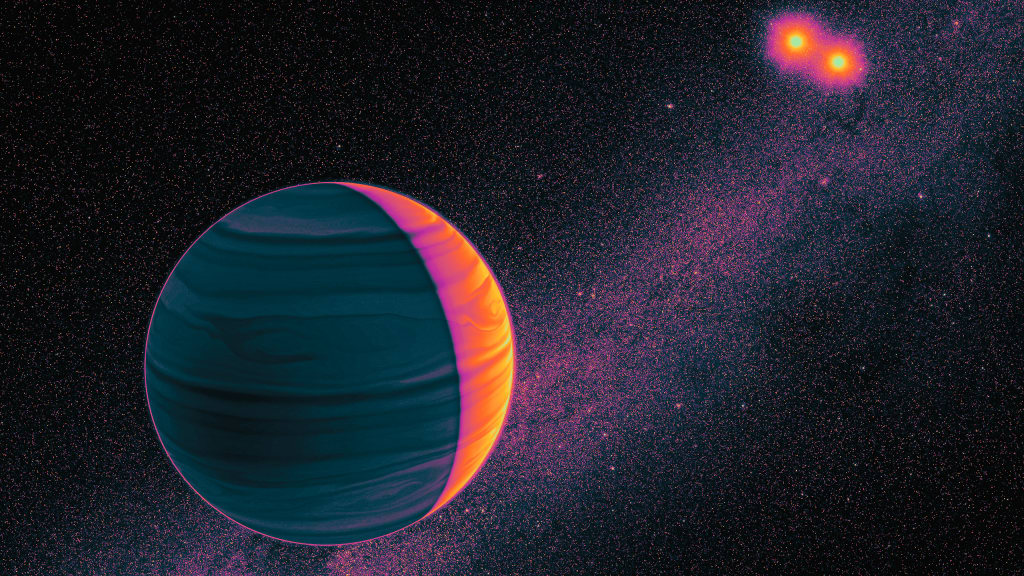
Earlier this summer, the James Webb Space Telescope—launched in 2021 and continually gathering data on planets beyond our solar system—identified a previously unknown exoplanet. What made this discovery particularly groundbreaking is that, unlike earlier exoplanets detected indirectly by observing the dimming of starlight, this one was directly imaged.
Even more exciting: according to NASA, this new exoplanet—named CE Antliae and roughly 100 times the size of Earth—is, based on its average temperature, theoretically capable of sustaining habitable life.
I find this moment thrilling for many reasons.
First, I hold the deepest admiration for the brilliance of NASA scientists—and the researchers whose work they built upon—that made this discovery possible. Second, it serves as a powerful reminder of the essential role government plays in pushing the boundaries of knowledge.
These physical frontiers also invite us to explore existential ones. The possibility of a habitable planet offers a momentary escape from the noise of the daily news cycle, and reopens a question that has captivated us since ancient times: Are we alone? Simply looking up at the night sky—a universal gift—places us in the company of Democritus, Epicurus, and later, the Persians, who speculated about extraterrestrial life as far back as 400 BCE.
It’s one of humanity’s oldest questions, fueled by an innate curiosity that rarely yields immediate answers.
Science has its own schedule
Of course, we’re far from confirming whether this exoplanet has its own version of Uber or inhabitants with built-in AI.
Science operates on its own timeline. To have directly observed an exoplanet only five years after Webb’s launch could be seen as astonishingly fast—or perhaps not, given the advanced tools now at our disposal, from machine learning to quantum computing.
In today’s attention economy, dominated by thumb-scrolling and short-form content, we risk losing sight of the long view that science requires. The rise of generative AI and its future successor, AGI, may well disrupt the pace of discovery. But even then, the scientific process will still demand patience and rigor.
We must remember: it took nearly a century to confirm Einstein’s theory of gravitational waves. The theory of continental drift was proposed in 1912, but not proven until the 1960s. Black holes were hypothesized in the early 1900s, yet the first image didn’t arrive until 2019.
One of the many reasons I advocate so strongly for STEM education is that children need to understand science as a process—a patient, layered accumulation of insight. Humanity’s oldest question—“are we alone in the universe?”—likely won’t be answered quickly. And even if it is, critical thinking and the scientific method remain essential.
Yes, flashes of insight can transform history. But even those leaps must launch from a foundation of conventional wisdom. Science is a continuous journey of discovery—both awe-inspiring and, at times, unsettling.
Pop culture meets the “what’s out there” question
Movies and literature have long reflected our obsession with the unknown—from 2001: A Space Odyssey and Contact to Dune.
This summer, Alien: Earth premieres. Reading about this reimagining of first contact, I couldn’t help but think of CE Antliae and how science and art intersect. The discovery of a potentially habitable planet pushes us to reconsider what we define as “science fiction.”
There are many paths through which humanity seeks to understand its place in the universe. And we need both our most gifted scientists and our most imaginative artists to help us ask—and keep asking—the cosmic questions that first stirred our six-year-old minds and have never let go.
The super-early-rate deadline for Fast Company’s Most Innovative Companies Awards is Friday, July 25, at 11:59 p.m. PT. Apply today.
