


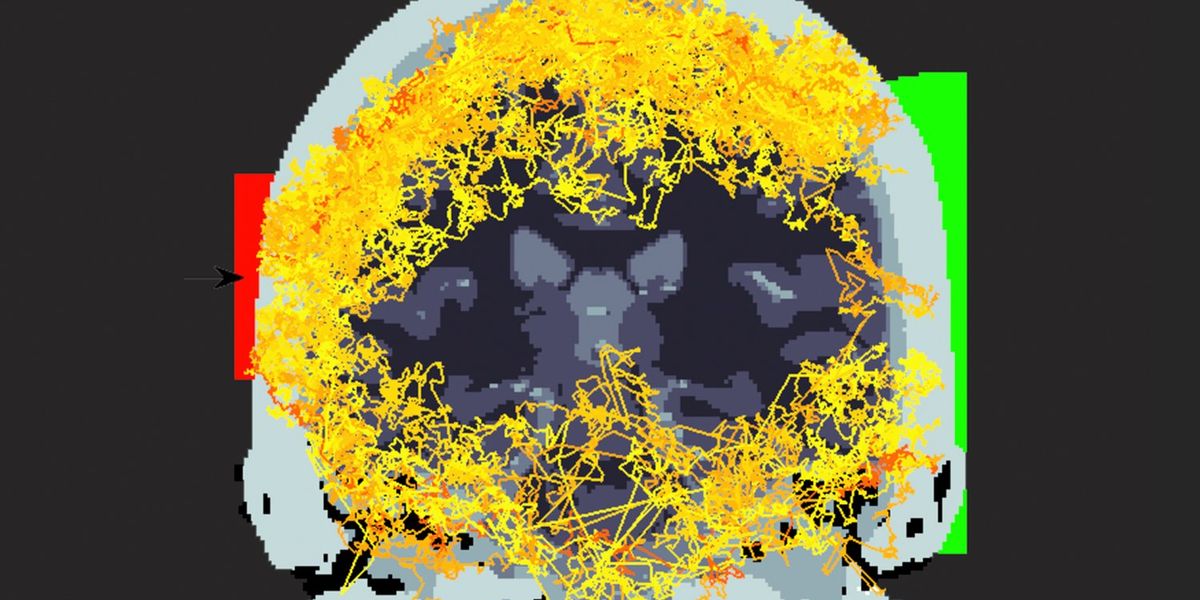
For the most part, anyone who wants to see what’s going on inside someone else’s brain has to make a tradeoff when it comes to which tools to use. The electroencephalograph (EEG) is cheap and portable, but can’t read much past the outer layers of the brain, while the alternative, functional magnetic resonance imaging (fMRI), is expensive and the size of a room, but can go deeper. Now, a research group in Glasgow has come up with a mechanism that could one day provide the depth of fMRI using equipment as affordable and portable as an EEG. The technology will rely on something that previously seemed impossible—shining light all the way through a person’s head.
Obviously, the human head doesn’t let much light through it. For years, brain imaging techniques using light, called optical brain imaging, have struggled against that barrier to becoming widely used in research and clinical practice. Optical brain imaging primarily uses near-infrared light, to which human tissue is relatively transparent. But human heads are so good at blocking even those wavelengths that the Glasgow research group found that only a billionth of a billionth of all near-infrared photons make it through an entire adult human head from one side to the other. Statistics like these had prompted many in the field to conclude that transporting light through the deep brain was impossible, until Daniele Faccio’s group at the University of Glasgow recently did it.
“Sometimes we went through phases of thinking, okay, maybe this is just impossible because we just didn’t see a signal for so many years.” —Jack Radford, University of Glasgow
“There are a lot of optical techniques of monitoring brain activity which have laser detectors that are placed maybe three centimeters apart, maybe five centimeters apart. But nobody had really tried to go all the way through the head,” Jack Radford, the lead author of the study describing the work in Neurophotonics, explains. The team started with a slab of thick, light-scattering material, and found that light could pass through a human head’s width of the material to reach a photodetector. Then they designed an experiment to test the limits of near-infrared light transmission through a volunteer’s head.
The group measured the times that millions of photons took to travel from a 1.2-watt laser emitting 800-nanometer wavelength light into one side of the head to a detector on the other side. Each time represented possible paths that individual photons could take through the subject’s head. They also simulated the travel paths of the photons, and constructed distributions of both the experimental and simulated times. Because the distributions were so similar, they were able to conclude that they weren’t just detecting random photons passing through the room. But it wasn’t just smooth sailing.
It took many iterations of experimental setups to definitively find the one in a billion billion photons that make it through the head.Extreme Light group/University of Glasgow
“What’s not in the paper is the five years of experiments that didn’t really work,” Radford says. One major improvement the team made to the experiment was to reduce background noise. Because so few photons make it all the way through, it’s more likely for photons bouncing around the room to hit the detector than for photons that actually passed through the head to. They made adjustments like draping black cloth over the subject’s head, conducting the entire experiment in a black box, putting the subject in a sleeping-bag-esque arrangement, and fitting another black cover on top of all of that, before seeing good results. They also spent time trying different lasers, adjusting the beam size and wavelength, and inventing new setups to improve their signal, some of which involved bicycle helmets and chinstraps.
“Sometimes we went through phases of thinking, okay, maybe this is just impossible because we just didn’t see a signal for so many years,” says Radford. “But there was always some sort of inclination that we might be able to do something. So that’s kind of what kept the momentum going in the research project.”
Now the possibility of measuring photons that have passed through the deep brain opens up a host of new possibilities for cheaper, more accessible, and deeper penetrating brain imaging technology, he suggests.
Toward Deeper Optical Brain Imaging
“Applications to date pretty much are just focused on the surface of the brain—that’s what current technology can do,” says Roarke Horstmeyer, a professor in Duke University’s Biomedical Engineering Department, who was not involved in the Glasgow research. The research “helps to assess and establish whether or not this optical technology can begin to reach those deeper regions.”
Radford is exploring ways that future deep penetrating optical brain imaging can be applied in clinical and medical settings, particularly to help quantify brain health. For a set of wide-ranging, hard-to-quantify conditions like cognitive decline, neurodegenerative diseases, brain fog, and concussions, hospitals typically use questionnaires to determine brain function. But “[there are] no real biomarkers for how brain health is and how it evolves over time,” says Radford. Optical imaging tools that can reach the deeper brain could provide a more widely accessible and deterministic method of identifying those hard-to-quantify conditions.
Another application Radford is interested in is rapid diagnosis of strokes. Correctly identifying and treating strokes before serious neurological damage occurs currently relies on the ability to obtain a CT scan and MRI within several hours in order to determine the exact cause of the stroke. But such scans are expensive, making that treatment less accessible. Prescribing stroke treatment without knowing the cause, though, could lead to fatal consequences. A bedside brain scanner using optical brain imaging methods could quickly and more cheaply identify the cause of the stroke, leading to rapid diagnosis and treatment.
Radford is excited that the difficult tradeoff of expensive, deeper penetrating imaging equipment versus cheaper but shallower sensors is starting to break down. Physicians and researchers “don’t realize they could be using [brain imaging] because they’ve always thought that using an MRI is out of the question… now that [MRI] isn’t the question, it’s exciting to speak to clinicians and…explore different potential uses of it to help them in their diagnostics and their treatment,” he says.
However, there are hurdles the technology still needs to overcome in order to be successful in a clinical setting. For one, the study itself didn’t image any of the deep brain; it just sent photons through. “The technology still has a long way to go, it’s still in its infancy,” says Horstmeyer. Another obstacle will be variations in the head anatomy of subjects—out of the eight volunteers the experiment conducted trials on, Radford’s group was only able to detect a signal for a participant with fair skin and no hair.
“When you go all the way across the head, you’re at such low light levels that simply the color of your skin or thickness of your skull or the hairstyle that you have can make that difference of being able to detect it or not,” says Horstmeyer.
Radford thinks that there might be a way to overcome variations in human anatomy by changing the power and beam size of the laser, but he admits that those changes might cause problems with spatial resolution. It’s “still an unsolved problem, in my mind,” he says.
Despite these challenges, Radford emphasizes that the purpose of the study was just to show that it is physically possible to transport photons through the entire human head. “The point of measurement is to show that what was thought impossible, we’ve shown to be possible. And hopefully…that could inspire the next generation of these devices,” he says.
From Your Site Articles
Related Articles Around the Web
