


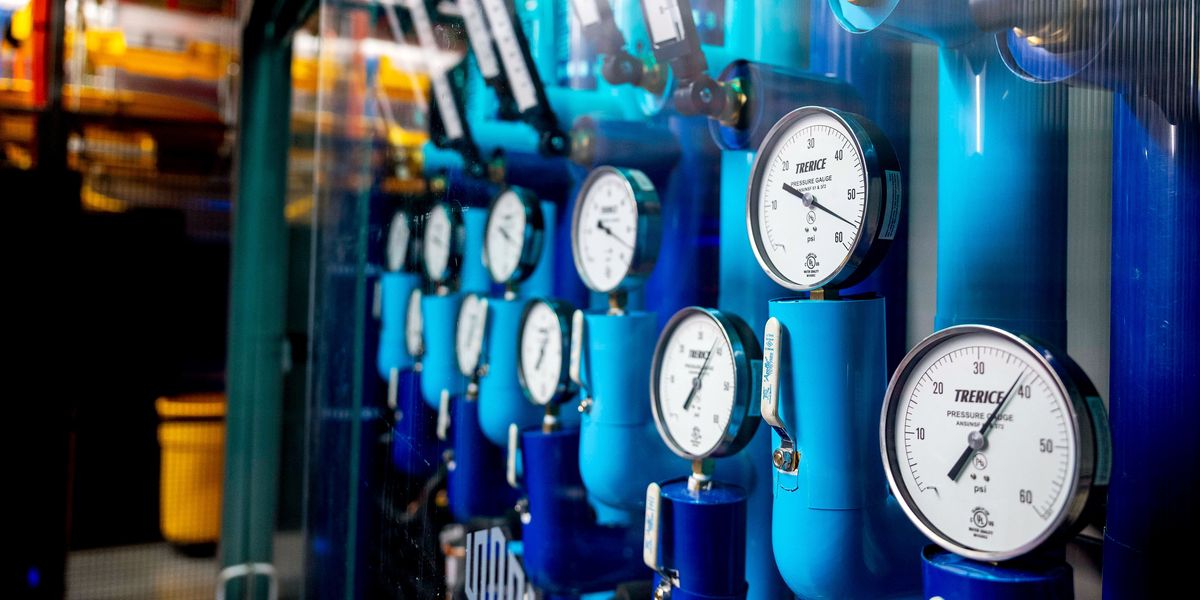
AI is hot, capturing headlines, investments, and users. It also runs hot, literally: The data centers operating artificial intelligence (AI) models use large amounts of electricity and generate enormous heat. To keep servers from overheating, many facilities rely on cooling systems that use water.
AI data centers’ water use comes in two forms. Beyond the water that cools the servers, data centers indirectly contribute to water use through the electricity generation needed to power their operations. That indirect use often makes up 80 percent or more of the overall water use.
Reducing AI’s water footprint means tackling two very different issues—what happens inside the data center walls, and what happens beyond them on the power grid.
Direct Water Use: Local and Sometimes Stressful
Just as human bodies cool themselves by sweating, data centers are often cooled by water evaporation—a process that dissipates heat and results in water being lost to the atmosphere, and thus being counted as “consumed.” In many cases, the water is drawn from the same municipal systems that supply homes and businesses.
While most major tech companies now disclose their direct water use, not all data centers follow suit, making the overall picture unclear. In recent reports, companies have estimated that between 45 percent and 60 percent of withdrawn water is consumed.
According to a recent report by Lawrence Berkeley National Laboratory, the 2023 direct water consumption by data centers in the United States—home to about 40 percent of the world’s data centers—is estimated at roughly 17.5 billion gallons. Assuming a 50 percent consumption ratio, that means 35 billion gallons of water withdrawal, or about 0.3 percent of the total public water supply for the contiguous United States. The same report projects that the U.S. data center direct water consumption could double or even quadruple the 2023 level by 2028.
On the national level, data centers’ water use is relatively modest. But in some regions where data centers are concentrated—and especially in regions already facing shortages—the strain on local water systems can be significant. Bloomberg News reports that about two-thirds of U.S. data centers built since 2022 are in high water-stress areas.
In Newton County, Georgia, some proposed data centers have reportedly requested more water per day than the entire county uses daily. Officials there now face tough choices: reject new projects, require alternative water-efficient cooling systems, invest in costly infrastructure upgrades, or risk imposing water rationing on residents.
The biggest stress may not be total use, but timing. On hot days when residents and businesses need water most, data center water demand spikes too. In Arizona, a data center’s monthly water usage during the summer can be nearly twice its average level.
Indirect Water Use: Thirsty Electricity
The other part of the equation is the electricity that powers data centers. In many places, electricity—whether for training AI models in data centers or turning on a lightbulb in a home—is generated by fossil fuel-based power plants that require cooling water of their own. The U.S. electric power sector withdraws about 11.6 gallons of water and consumes 1.2 gallons for every kilowatt-hour of electricity produced, placing it among the nation’s largest water users. The water used to produce the electricity that powers data centers is considered indirect water use.
The water used by power plants is typically not potable and not drawn from municipal water systems. Still, it can place stress on rivers, aquifers, and ecosystems—especially in water-scarce regions.
For most U.S. data centers, this indirect use is significantly higher than direct onsite water use. One paper estimated that in 2023, using GPT-3 to generate a single text output of 150 to 300 words consumed a total of 16.9 milliliters of water in an average U.S. data center—2.2 ml for onsite cooling and 14.7 ml for electricity generation. It’s likely that efficiency gains in later models have reduced these numbers, but indirect water use still predominates.
How to Minimize Data Centers’ Water Impact
Unlike electricity, data center cooling systems are a design choice. Evaporative cooling is low-cost and efficient, but it can burden local supplies during summer heatwaves, when water is most needed and least available. To manage that peak demand, data centers can build onsite water storage or install thermal energy storage. Upgrading water infrastructure—such as expanding distribution or fixing leaks—can also help local systems better handle demand spikes.
Alternatives to evaporative cooling include air-based and liquid-immersion cooling, using recycled water to cut potable water use, and waste heat reuse to reduce cooling demand. Some advanced designs recycle cooling water in a closed-loop, so no water is consumed; these “zero-water” designs eliminate the need to tap into local drinking water supplies. However, many of these designs raise electricity demand, which in turn can increase indirect water use. Water-cooled data centers consume about 10 percent less energy than air-cooled data centers.
In immersion cooling systems, servers are submerged in a fluid that carries heat away without evaporating water. Jason Alden/Bloomberg/Getty Images
In water-stressed regions, the priority should be low- to zero-water cooling systems to reduce direct use, while investing to add renewables to the local grids to curb indirect water use and minimize carbon emissions from higher electricity demand. In wetter regions with carbon-intensive grids, priority should be given to reducing power use to lower the overall water consumption, even if that means continued use of evaporative cooling with its higher onsite water consumption.
The reality of the intertwined water and electricity systems forces data center operators to navigate tough trade-offs between global climate goals and local water needs. These choices often aren’t simple, but until renewables dominate electricity grids, they may be unavoidable.
The views expressed in this article are those of the authors and do not necessarily reflect the views of their employers or affiliated institutions.
From Your Site Articles
Related Articles Around the Web
