


Global trends have shifted in the past few years and as I’ve already discussed, America will buck the international trend and set its own strategy. Recent developments in energy technologies and markets are worth exploring.
Conservative With Risk
It’s recognized in the new administration’s Department of Energy (DOE) and Environmental Protection Agency’s (EPA) policy goals that Energy Security is recognized as National Security. Dominance in Ai advancement and supporting “Gold Standard Science” are just as integral to the assured prosperity of our nation, and the President doesn’t intend to compromise on these standards. While the hesitancy to accept solar power has been disheartening to those concerned about climate change, the American Nuclear Renaissance for which we will all be grateful provides context.
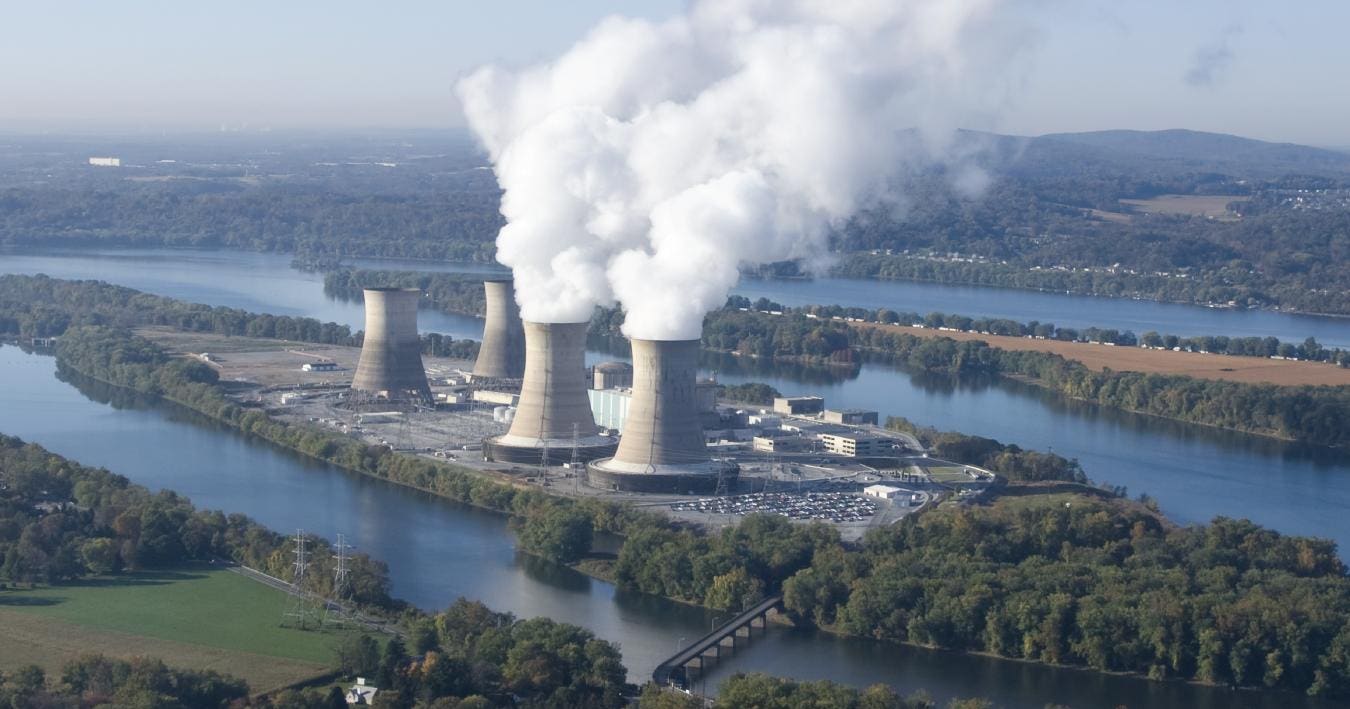
Three Mile Island Nuclear Power Plant. No one died from the incident at Three Mile Island.
Department of Energy
Clean, Exciting, But Still Emerging
As the new head of the DOE has stated, the intermittency of Variable Renewable Energy (VRE) gives policy makers pause to widely adopt solar and wind. It hasn’t been proven at scale as a primary source of energy production, and until the complimentary batteries and grid expansions can occur, we must be pragmatic when viewing Energy Policy. Its first goal is to provide Americans with reliable and affordable energy. Adventurism into emerging (which is to say unproven, in the eyes of some) technologies is a luxury for private investors or small-scale pilot programs, not civilization-wide transitions on a whim. I don’t think I need to say this, but I feel compelled: I disagree with some of these premises and the conclusions drawn from them, but I am not being consulted on domestic energy policy by the United States government, so for now my thoughts are immaterial to this explanation of recent events.
The seeming stubbornness with which fossil fuels are clung-to baffles observers. Some hypothesize that pure greed is a motivation, with policy makers having stake in, or constituents who are part of these industries. A less cynical thought could consider energy strategy. Coal and oil are Victorian and biblical-age technologies. We have moved past them: we’re all about to have Nuclear. But importantly, we don’t have it yet.
Until the transition to clean energy can happen at scale, we will still need electricity and as observed, we can’t be at the mercy of the sunshine and wind while trying to achieve Artificial General Intelligence before the Chinese. No one wants polluted air and water, but no American wants to live in a second-rate nation. Some may say that coal is outdated, while others can look at the same long history and call it tried-and-true. Hence, those who don’t trust VREs can use a different set of tactics to secure energy dependence, national security, and technological dominance: expand any sort of energy production that’s viable for now, while pursuing full-throttle the most promising methods of energy production that we have available for the future. This is why climate change deniers can still be some of the most ardent supporters of nuclear power; it’s proven, it’s scalable, and the more research that we do, we find even more efficient AND SAFE ways to go implement it.
Data Centers are proliferating and draw huge amounts of electricity. Do we want to power them with … More
The Washington Post via Getty Images
China’s Maneuvering
If you were to think that this is all pessimistic and that surely all policy makers who support natural gas and coal are getting kickbacks, you’d do well to consider that China is doing something similar. The connections between technological advancement, energy security and national security are understood in China the same as in America. The need to look to the future and plan for it now, while keeping the present free of deprivation, is a duty of political leadership the world over. This might explain why China, our nearest peer-competitor, has a plan that’s generally similar to ours.
From first principles: Ai is the future; dominance in Ai is strategically important. Ai will need large data centers that will need lots of electricity. It’s not a choice to pursue Ai as geopolitics demands it; technological dominance yields power.
China sets records for both coal and clean energy. They’re securing strategic coal imports at low global prices, and still building coal power plants. Of every four tons of coal burned for electricity generation, one of those is burned in China. Another way to say, 62% of their electricity still comes from coal. This provides perspective while concurrently considering that they’re expanding solar power at record breaking rates. What do we see here? A similar idea to the Americans: VRE can be promising, but we aren’t there yet. The point of difference is to what degree the countries will rely on solar or wind while expanding nuclear power, but the path forward looks similar. All roads lead to nuclear.
Fusion, Thorium, and Small Modular Reactors
Taken as a group, these are the nuclear power technologies of the future. Small Modular Reactors (SMRs) use the established fission method, but at a smaller scale which makes them more versatile than large reactors. They can be produced in an assembly line fashion and deployed wherever they’re needed like individual data centers. This may sound excessive, but Amazon is currently trying to plug straight into a reactor in Pennsylvania, while their sister company X-energy builds SMRs. Jeff Bezos has been investing in nuclear fusion since 2011. The need is real and recognized by people who plan to profit from and shape the future. Amazon is one example; if I were to give an overview of the household names that are investing in nuclear power, that would be its own article. That said, Google, Sam Altman, and Rolls Royce are on the list. Microsoft is reopening Three Mile Island, as they should.
Thorium was pioneered in America decades ago, but has been taken up by China to great success. They’re actively getting closer to commercially viable Thorium Power; they’ve had a breakthrough this year with refueling that solidifies their global edge.
No serious observer doubts that the future is nuclear. Everyone is working towards it differently, but everyone is working towards it.
NEWPORT NEWS, Va. (Nov. 1, 2012) The Virginia-class attack submarine Minnesota (SSN 783) is under … More
U.S. Navy
Critical Minerals Beyond Energy Production
Everyone has been talking about critical minerals this year, and I don’t need to repeat what we all know. They’re critical to the energy transition and China dominates the market.
Energy security is national security, and rare earths are critical for both. In yet another direct way, they’re indispensable to national security; as reported by the Center for Strategic and International Studies: the F-35 fighter jet contains over 900 pounds of Rare Earth Elements (REEs). An Arleigh Burke-class DDG-51 destroyer requires approximately 5,200 pounds, while a Virginia-class submarine uses around 9,200 pounds. No matter how you look at it, critical minerals are critical, and strategic planning must recognize this. If America can’t immediately secure its supply chains, then while it works to do so it will still need electricity. This brings us back to the strategic value of coal and oil.
The Global Critical Minerals Outlook 2025 show’s China’s dominance over critical minerals. They’re … More
International Energy Agency
The high-level goals are similar, but the implementations are different. This comes to a matter of philosophy, with the Americans more hesitant than the Chinese to rely on variable renewable power. The common aims that the government leaders share is to ensure the prosperity of their peoples. Without getting lost in detail, the world’s two largest economies agree on the goal to provide a prosperous and peaceful future to their peoples. Great minds think alike.
