


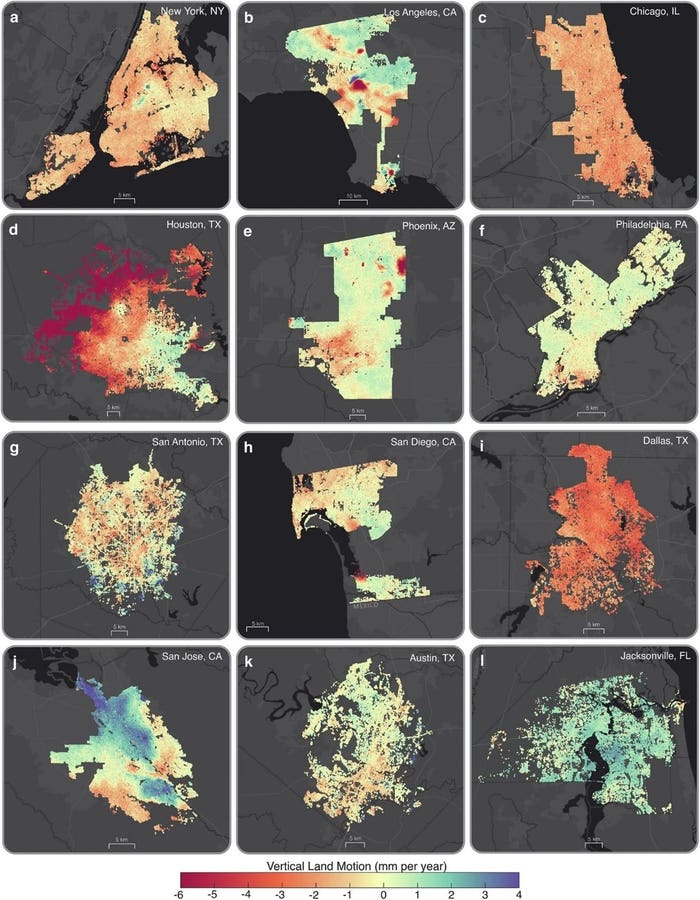
We’ve taken water for granted, and because of this, our cities are sinking. The overuse of groundwater leads to the depletion of aquifers, the emptied earth leading to compaction. When we add weight to the surface by building sprawling metropolises, the earth’s surface will sink. This phenomena, subsidence, is actively happening across every major American city. Of the 28 cities recently studied, on average 20% of each is slowly sinking. There are differences between different cities, and within them, but the consistent finding is that our most populated American urban areas are sinking. This increases the risk of flooding and infrastructure damage, with Houston having the most exposed area and New York having the highest at-risk population.
Vertical Land Motion measures the amount of subsidence or uplift.
Nature Cities
If part of the city sinks or rises a few millimeters each year, it’s not just this change in depth that may hurt a building. If one side is sinking and the other doesn’t, this will weaken the building and put people in danger. Less than one percent of the buildings surveyed were said to be in danger, which leaves 29,000 buildings as high risk or very high risk. Not all incidences of subsidence or uplift are directly attributable solely to groundwater overextraction, but in confined aquifers there was a significant correlation.
If we don’t want our cities to sink, or for us to run out of groundwater, we should immediately address the causes of aquifer depletion. Our demand exceeds supply, which is to say that if we continue to use more water, which we will, then we need to do so more efficiently. Irrigation, industry, and power generation account for the majority of water use in America so we’ll need high level change. Personally choosing to use less water is a nice start, but grander actions will be needed to effectively address the interrelated issues that drive the overuse of water. Turning off the tap while you brush your teeth is sweet, but ultimately futile. We’ll have 10 billion people by 2050 with 55% more water consumption than today.
Why is this happening?
Populations have increased. More people need more water to drink and food to eat, which requires water to grow. Agriculture, Industry and our need for electricity account for most of our water use, with outdated methods and poor governance that haven’t adapted to the changing world.
Destroying forests in one part of the world affects other regions.
Science
Destroying Forests Destroys the Source of Water
The best strategy to save water access is to stop deforestation. If we cut down the forests then we destroy the source of rainfall, destabilize the air currents, and affect the climate of the wider region.
Without forests to serve this regulatory function, we’d instead have droughts and floods over hardpack, lifeless earth. In the absence of the tree roots, there is nothing to guide the rainfall down into the aquifers.
Destroying forests creates deserts, sandstorms, dry riverbeds and arid croplands. Deforestation isn’t a local problem. We live in an interconnected world with a global hydrological cycle; clear-cutting densely canopied forests in one part of the world will affect another. The Tropical Belt is under the most serious threat.
Irrigation and Agriculture
For growing crops, drip irrigation is the way to go. Flood irrigation is still used in some places, and continues to be proven inefficient when compared with modern techniques. Drip irrigation reduces water use significantly with estimates ranging from 20-60%, as the water goes directly to the plants’ root systems rather than saturating a whole field.
In California’s agricultural regions, policies are such that if a farmer doesn’t use all of their allotment, they might lose it next year. This compels unnecessary, wasteful use. Reforming laws like these would save large quantities of water.
Given that we live in modern times of remote sensing, and that you can’t stop hearing about AI, let’s put it to good use. Newer irrigation systems consist of sensors to monitor soil moisture content, and smart controllers to release water as needed. Technology can help us address our modern issues if we embrace innovation.
Agrivoltaics and Floatovoltaics
The practice of installing solar panels over crops has seen global success.
France just announced their era of “Agrivoltaics 2.0”. They’ve adopted Agrivoltaics as national policy; with 52% of French land classified as agricultural, they’ve approved plans to add 2 GW of Agrivoltaic solar per year, by 2026. Goji Berries in China, grape growers in France, and herders in America, have seen at the least comparable results with this method.
Floating solar panels on reservoirs or installing them over canals saves land and makes the panels operate more efficiently. The solar panels are cooled by the evaporating water (same as in Agrivoltaics), and the solar panels reduce the water lost to evaporation.
For hydropower dams, there are further benefits beyond reducing water loss by up to 90%. On a sunny day we can use the solar panels to generate electricity, which saves the need for hydropower. This saves water while still generating electricity. As they already have the infrastructure to transmit electricity, we can take advantage of the existing transmission wires, and save the cost of building all that out again. (picture)
From supplying electricity to fish farms to potentially powering submerged data centers, floating solar has investment potential. Deloitte are among the Westerners to have endorsed Floatovoltaics (floating solar panels), releasing this report in 2021 recognizing the approach as commercially viable. Asia has already been on this, and several nations are currently operating or constructing giga-watt scale floating solar farms. Americans have reservoirs and water that we’d like to conserve, we could do this too.
Why wait?
Herders in the Sahel are clashing with farmers. The herders follow the changing rain patterns, which brings them into conflict with the sedentary farmers. Mexican farmers seized a dam to protest the water that was being sent to America under outdated treaty obligations. California has set a good example with massive fines for water theft, but our global problem will require broad action. The need to address the problem of water scarcity grows every year, as temperatures and populations increase, and exacerbate societal tensions. Our limited time, and water, are dwindling.
