


After watching writer / director Eliza McNitt’s new short film Ancestra, I can see why a number of Hollywood studios are interested in generative AI. A number of the shots were made and refined solely with prompts, in collaboration with Google’s DeepMind team. It’s obvious what Darren Aronofsky’s AI-focused Primordial Soup production house and Google stand to gain from the normalization of this kind of creative workflow. But when you sit down to listen to McNitt and Aronofsky talk about how the short came together, it is hard not to think about generative AI’s potential to usher in a new era of “content” that feels like it was cooked up in a lab — and put scores of filmmakers out of work in the process.
Inspired by the story of McNitt’s own complicated birth, Ancestra zooms in on the life of an expectant mother (Audrey Corsa) as she prays for her soon-to-be-born baby’s heart defect to miraculously heal. Though the short features a number of real actors performing on practical sets, Google’s Gemini, Imagen, and Veo models were used to develop Ancestra’s shots of what’s racing through the mother’s mind and the tiny, dangerous hole inside of the baby’s heart. Inside the mother’s womb, we’re shown Blonde-esque close-ups of the baby, whose heartbeat gradually becomes part of the film’s soundtrack. And the woman’s ruminations on what it means to be a mother are visualized as a series of very short clips of other women with children, volcanic explosions, and stars being born after the Big Bang — all of which have a very stock-footage-by-way-of-gen-AI feel to them.
It’s all very sentimental, but the message being conveyed about the power of a mother’s love is cliched, particularly when it’s juxtaposed with what is essentially a montage of computer-generated nature footage. Visually Ancestra feels like a project that is trying to prove how all of the AI slop videos flooding the internet are actually something to be excited about. The film is so lacking in fascinating narrative substance, though, that it feels like a rather weak argument in favor of Hollywood’s rush to get to the slop trough while it’s hot.
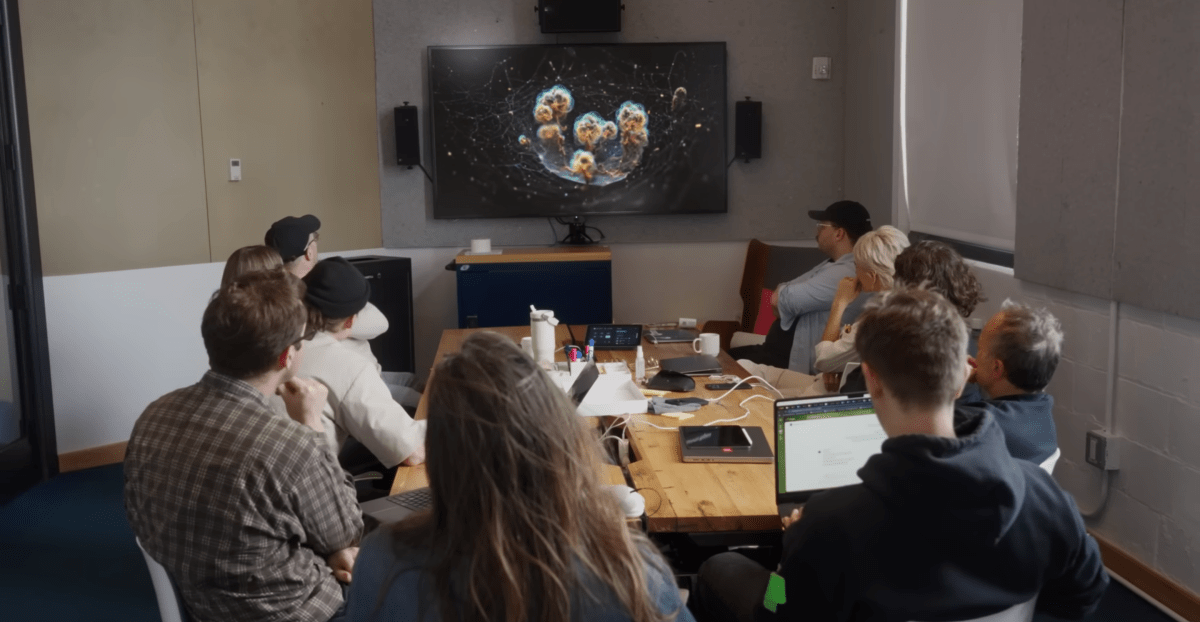
As McNitt smash cuts to quick shots of different kinds of animals nurturing their young and close-ups of holes being filled in by microscopic organisms, you can tell that those visuals account for a large chunk of the film’s AI underpinnings. They each feel like another example of text-to-video models’ ability to churn out uncanny-looking, decontextualized footage that would be difficult to incorporate into fully produced film. But in the behind-the-scenes making-of video that Google shared in its announcement last week, McNitt speaks at length about how, when faced with the difficult prospect of having to cast a real baby, it made much more sense to her to create a fake one with Google’s models.
“There’s just nothing like a human performance and the kind of emotion that an actor can evoke,” McNitt explains. “But when I wrote that there would be a newborn baby, I did not know the solution of how we would [shoot] that because you can’t get a baby to act.”
Filmmaking with infants poses all kinds of production challenges that simply aren’t an issue with CGI babies and doll props. But going the gen AI route also presented McNitt with the opportunity to make her film even more personal by using old photos of herself as a newborn to serve as the basis for the fake baby’s face.
With a bit of fine-tuning, Ancestra’s production team was able to combine shots of Corsa and the fake baby to create scenes in which they almost, but not quite, appear to be interacting as if both were real actors. If you look closely in wider shots, you can see that the mother’s hand seems to be hovering just above her child because the baby isn’t really there. But the scene moves by so quickly that it doesn’t immediately stand out, and it’s far less “AI-looking” than the film’s more fantastical shots meant to represent the hole in the baby’s heart being healed by the mother’s will.
Though McNitt notes how “hundreds of people” were involved in the process of creating Ancestra, one of the behind-the-scenes video’s biggest takeaways is how relatively small the project’s production team was compared to what you might see on a more traditional short film telling the same story. Hiring more artists to conceptualize and then craft Ancestra’s visuals would have undoubtedly made the film more expensive and time-consuming to finish. Especially for indie filmmakers and up-and-coming creatives who don’t have unlimited resources at their disposal, those are the sorts of challenges that can be exceedingly difficult to overcome.
Image: Google
But Ancestra also feels like a case study in how generative AI stands to eliminate jobs that once would have gone to people. The argument is often that AI is a tool, and that jobs will shift rather than be replaced. Yet it’s hard to imagine studio executives genuinely believing in a future where today’s VFX specialists, concept artists, and storyboarders have transitioned into jobs as prompt writers who are compensated well enough to sustain their livelihoods. This was a huge part of what drove Hollywood’s film / TV actors and writers to strike in 2023. It’s also why video game performers have been on strike for the better part of the past year, and it feels irresponsible to dismiss these concerns as people simply being afraid of innovation or resistant to change.
In the making-of video, Aronofsky points out that cutting-edge technology has always played an integral role in the filmmaking business. You would be hard-pressed today to find a modern film or series that wasn’t produced with the use of powerful digital tools that didn’t exist a few decades ago. There are things about Ancestra’s use of generative AI that definitely make it seem like a demonstration of how Google’s models could, theoretically and with enough high-quality training data, become sophisticated enough to create footage that people would actually want to watch in a theater. But the way Aronofsky goes stony-faced and responds “not good” when one of Google’s DeepMind researchers explains that Veo can only generate eight-second-long clips says a lot about where generative AI is right now and Ancestra as a creative endeavor.
It feels like McNitt is telling on herself a bit when she talks about how the generative models’ output influenced the way she wrote Ancestra. She says “both things really informed each other,” but that sounds like a very positive way of spinning the fact that Veo’s technical limitations required her to write dialogue that could be matched to a series of clips vaguely tied to the concepts of motherhood and childbirth. This all makes it seem like McNitt’s core authorial intent, at times, had to be deprioritized in favor of working with whatever the AI models spat out. Had it been the other way around, Ancestra might have wound up telling a much more interesting story.But there’s very little about Ancestra’s narrative or, to be honest, its visuals that is so groundbreaking that it feels like an example of why Hollywood should be rushing to embrace this technology whole cloth.
Films produced with more generative AI might be cheaper and faster to make, but the technology as it exists now doesn’t really seem capable of producing art that would put butts in movie theaters or push people to sign up for another streaming service. And it’s important to bear in mind that, at the end of the day, Ancestra is really just an ad meant to drum up hype for Google, which is something none of us should be rushing to do.
