

Close Menu
TechurzTechurz
    What's Hot

    Asian AI startups launch Mythos-like models as Anthropic’s export ban drags on

    June 27, 2026

    Corgi, the buzzy Y Combinator-backed insurance tech startup, says it didn’t steal an open source product

    June 26, 2026

    OpenAI poaches Uber India chief to lead its biggest market outside the US

    June 26, 2026
    X (Twitter) Pinterest YouTube LinkedIn WhatsApp
    Tech Pulse
    • Asian AI startups launch Mythos-like models as Anthropic’s export ban drags on
    • Corgi, the buzzy Y Combinator-backed insurance tech startup, says it didn’t steal an open source product
    • OpenAI poaches Uber India chief to lead its biggest market outside the US
    • Early Bird pricing ends tonight for Founder Summit
    • Robotaxis drive miles just to get cleaned and charged; this new startup wants to fix that
    X (Twitter) Pinterest YouTube LinkedIn WhatsApp
    TechurzTechurz
    • Home
    • Tech Pulse
    • Future Tech
    • AI Systems
    • Cyber Reality
    • Disruption Lab
    • Signals
    TechurzTechurz
    Home - AI - Google DeepMind’s new AI can help historians understand ancient Latin inscriptions
    AI

    Google DeepMind’s new AI can help historians understand ancient Latin inscriptions

    TechurzBy TechurzJuly 23, 2025Updated:May 10, 2026No Comments3 Mins Read
    Share Facebook Twitter Pinterest LinkedIn Tumblr Reddit Telegram Email
    Google DeepMind’s new AI can help historians understand ancient Latin inscriptions
    Share
    Facebook Twitter LinkedIn Pinterest Email

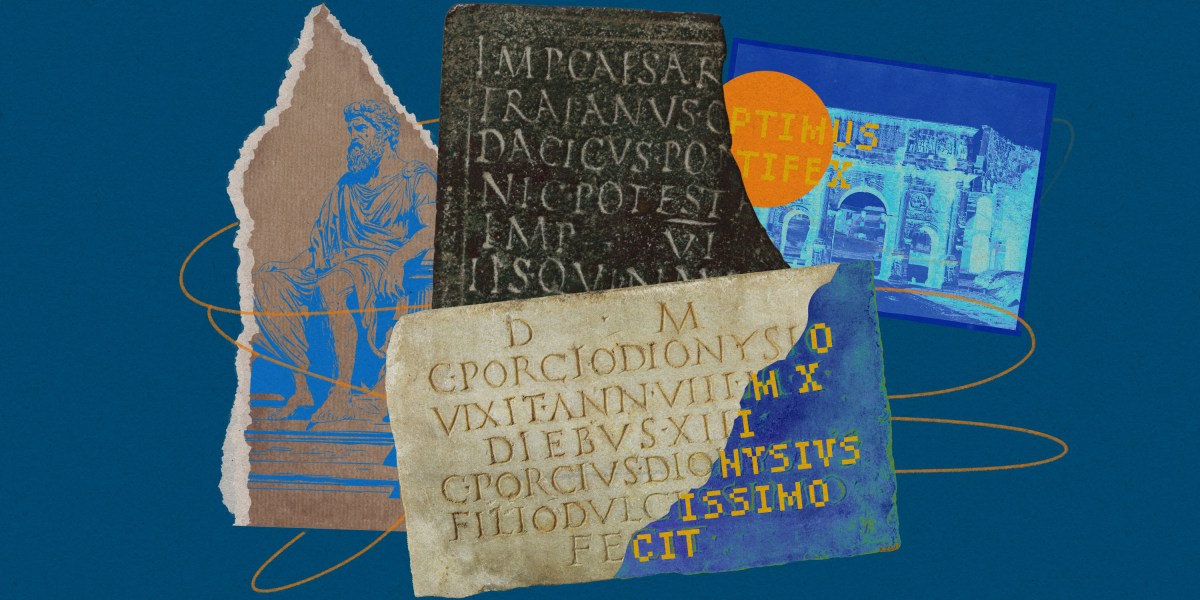
    To do this, Aeneas takes in partial transcriptions of an inscription alongside a scanned image of it. Using these, it gives possible dates and places of origins for the engraving, along with potential fill-ins for any missing text. For example, a slab damaged at the start and continuing with … us populusque Romanus would likely prompt Aeneas to guess that Senat comes before us to create the phrase Senatus populusque Romanus, “The Senate and the people of Rome.” 

    This is similar to how Ithaca works. But Aeneas also cross-references the text with a stored database of almost 150,000 inscriptions, which originated everywhere from modern-day Britain to modern-day Iraq, to give possible parallels—other catalogued Latin engravings that feature similar words, phrases, and analogies. 

    This database, alongside a few thousand images of inscriptions, makes up the training set for Aeneas’s deep neural network. While it may seem like a good number of samples, it pales in comparison to the billions of documents used to train general-purpose large language models like Google’s Gemini. There simply aren’t enough high-quality scans of inscriptions to train a language model to learn this kind of task. That’s why specialized solutions like Aeneas are needed. 

    The Aeneas team believes it could help researchers “connect the past,” said Yannis Assael, a researcher at Google DeepMind who worked on the project. Rather than seeking to automate epigraphy—the research field dealing with deciphering and understanding inscriptions—he and his colleagues are interested in “crafting a tool that will integrate with the workflow of a historian,” Assael said in a press briefing. 

    Their goal is to give researchers trying to analyze a specific inscription many hypotheses to work from, saving them the effort of sifting through records by hand. To validate the system, the team presented 23 historians with inscriptions that had been previously dated and tested their workflows both with and without Aeneas. The findings, which were published today in Nature, showed that Aeneas helped spur research ideas among the historians for 90% of inscriptions and that it led to more accurate determinations of where and when the inscriptions originated.

    In addition to this study, the researchers tested Aeneas on the Monumentum Ancyranum, a famous inscription carved into the walls of a temple in Ankara, Turkey. Here, Aeneas managed to give estimates and parallels that reflected existing historical analysis of the work, and in its attention to detail, the paper claims, it closely matched how a trained historian would approach the problem. “That was jaw-dropping,” Thea Sommerschield, an epigrapher at the University of Nottingham who also worked on Aeneas, said in the press briefing. 

    However, much remains to be seen about Aeneas’s capabilities in the real world. It doesn’t guess the meaning of texts, so it can’t interpret newly found engravings on its own, and it’s not clear yet how useful it will be to historians’ workflows in the long term, according to Kathleen Coleman, a professor of classics at Harvard. The Monumentum Ancyranum is considered to be one of the best-known and most well-studied inscriptions in epigraphy, raising the question of how Aeneas will fare on more obscure samples. 

    Ancient DeepMinds Google historians inscriptions Latin understand
    Share. Facebook Twitter Pinterest LinkedIn Tumblr Email
    Previous ArticleI’m taking my favorite portable vinyl player on all my summer trips, and it’s on sale right now
    Next Article New vivo (or IQOO) incoming with a massive 8000mAh battery and Dimensity 9400+
    Techurz
    • Website

    Related Posts

    AI Systems

    The Future of AI Systems: 7 Architectural Shifts Driving the AI Revolution

    June 13, 2026
    Opinion

    Lovable signs multiyear deal with Google Cloud to up usage 5x, source says

    June 3, 2026
    Opinion

    Google, Accel India accelerator choses 5 startups and none are ‘AI wrappers’

    March 16, 2026
    Add A Comment
    Latest Tech Pulse

    College social app Fizz expands into grocery delivery

    September 3, 20252,290

    SolarSquare in talks to raise up to $60M as India’s rooftop solar market draws major VC interest

    May 23, 202622

    Future of Digital Privacy and Security: 7 Truths Nobody Tells You

    May 25, 202619
    Stay In Touch
    • YouTube
    • WhatsApp
    • Twitter
    • Pinterest
    • LinkedIn

    Techurz helps readers stay ahead of digital change with clear, practical, future focused technology intelligence written today,searched tomorrow.

    X (Twitter) Pinterest YouTube LinkedIn WhatsApp
    Company
    • About Us
    • Contact Us
    • Our Authors / Editorial Team
    • Write For Us
    • Advertise
    Policy
    • Editorial Policy
    • Privacy Policy
    • Terms and Conditions
    • Affiliate Disclosure
    • Cookie Policy
    • Disclaimer
    • DMCA
    Explore
    • AI Systems
    • Cyber Reality
    • Future Tech
    • Disruption Lab
    • Signals
    • Tech Pulse
    • Sitemap

    Join the Techurz Brief

    The future does not arrive suddenly.
    Stay ahead with fast, sharp tech signals.

    Type above and press Enter to search. Press Esc to cancel.