


In April, Mark Zuckerberg, as tech billionaires are so fond of doing these days, pontificated at punishing length on a podcast. In the interview, he addressed America’s loneliness epidemic: “The average American has—I think it’s fewer than three friends. And the average person has demand for meaningfully more. I think it’s like 15 friends or something, right?”
Before you’ve had a moment to register the ominous way in which he frames human connection in such bleak economic terms, he offers his solution to the loneliness epidemic: AI friends. Ideally AI friends his company generates.
“It’s like I’m not even me anymore.”
—Angela Bennett, The Net (1995)
Thirty years ago, Irwin Winkler’s proto–cyber thriller, The Net, was released. It was 1995, commonly regarded as the year Hollywood discovered the internet. Sandra Bullock played a social recluse and computer nerd for hire named Angela Bennett, who unwittingly uncovers a sinister computer security conspiracy. She soon finds her life turned upside down as the conspiracists begin systematically destroying her credibility and reputation. Her job, home, finances, and very identity are seemingly erased with some judicial tweaks to key computer records.
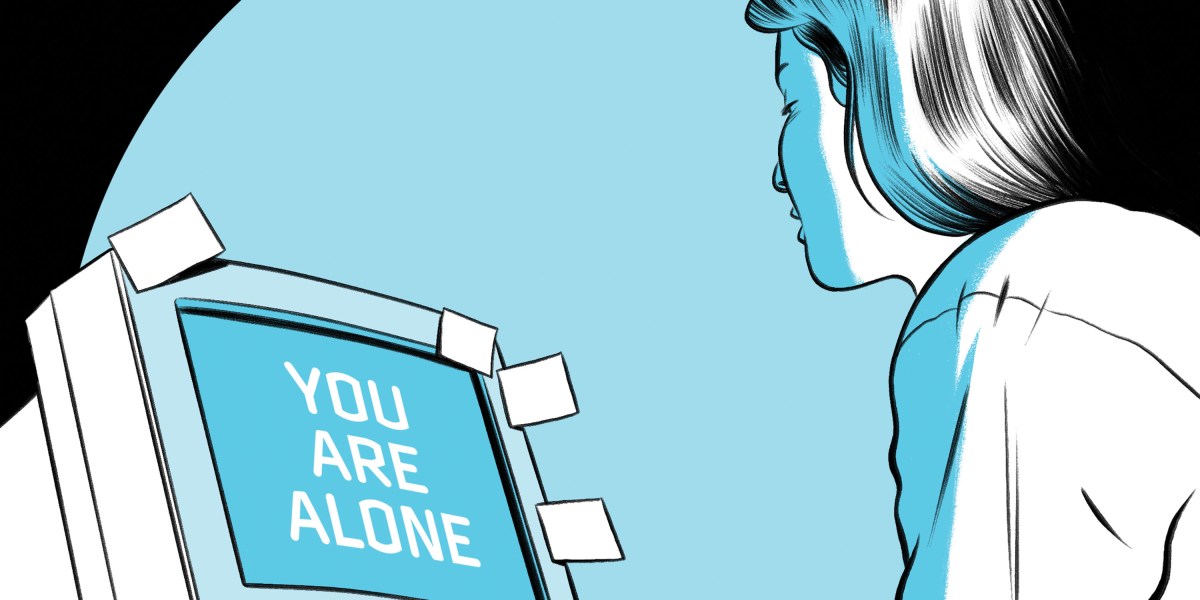
Bennett is uniquely—conveniently, perhaps—well positioned for this identity annihilation. Her mother, in the throes of dementia, no longer recognizes her; she works from home for clients who have never met her; her social circle is limited to an online chat room; she orders takeout from Pizza.net; her neighbors don’t even know what she looks like. Her most reliable companion is the screen in front of her. A wild, unimaginable scenario that I’m sure none of us can relate to.
“Just think about it. Our whole world is sitting there on a computer. It’s in the computer, everything: your DMV records, your Social Security, your credit cards, your medical records. It’s all right there. Everyone is stored in there. It’s like this little electronic shadow on each and every one of us, just begging for someone to screw with, and you know what? They’ve done it to me, and you know what? They’re gonna do it to you.”
—Angela Bennett, The Net
While the villain of The Net is ultimately a nefarious cybersecurity software company, the film’s preoccupying fear is much more fundamental: If all of our data is digitized, what happens if the people with access to that information tamper with it? Or weaponize it against us?
This period of Hollywood’s flirtation with the internet is often referred to as the era of the technophobic thriller, but that’s a surface-level misreading. Techno-skeptic might be more accurate. These films were broadly positive and excited about new technology; it almost always played a role in how the hero saved the day. Their bigger concern was with the humans who had ultimate control of these tools, and what oversight and restrictions we should place on them.
In 2025, however, the most prescient part of The Net is Angela Bennett’s digital alienation. What was originally a series of plausible enough contrivances to make the theft of her identity more believable is now just part of our everyday lives. We all bank, shop, eat, work, and socialize without necessarily seeing another human being in person. And we’ve all been through covid lockdowns where that isolation was actively encouraged. For a whole generation of young people who lived through that, socializing face to face is not second nature. In 2023, the World Health Organization declared loneliness to be a pressing global health threat, estimating that one in four older adults experience social isolation and between 5% and 15% of adolescents experience loneliness. In the US, social isolation may threaten public health more seriously than obesity.
The Net appeared at a time when the internet was only faintly understood as the new Wild West … In that sense, it remains a fascinating time capsule of a moment when the possibilities to come felt endless, the outlook cautiously optimistic.
We also spend increasing amounts of time looking at our phones, where finely tuned algorithms aggressively lobby for more and more of our ad-revenue-generating attention. As Bennett warns: “Our whole lives are on the computer, and they knew that I could be vanished. They knew that nobody would care, that nobody would understand.” In this sense, in 2025 we are all Angela Bennett. As Bennett’s digital alienation makes her more vulnerable to pernicious actors, so too are we increasingly at risk from those who don’t have, and have never had, our best interests at heart.
To blame technology entirely for a rise in loneliness—as many policymakers are doing—would be a mistake. While it is unquestionably playing a part in exacerbating the problem, its outsize role in our lives has always reflected larger underlying factors. In Multitudes: How Crowds Made the Modern World (2024), the journalist Dan Hancox examines the ways in which crowds have been demonized and othered by those in power and suggests that our alienation is much more structural: “Whether through government cuts or concessions to the expansive ambitions of private enterprise, a key reason we have all become a bit more crowd-shy in recent decades is the prolonged, top-down assault on public space and the wider public realm—what are sometimes called the urban commons. From properly funded libraries to pleasant, open parks and squares, free or affordable sports and leisure facilities, safe, accessible and cheap public transport, comfortable street furniture and free public toilets, and a vibrant, varied, uncommodified social and cultural life—all the best things about city life fall under the heading of the public realm, and all of them facilitate and support happy crowds rather than sad, alienated, stay-at-home loners.”
Nearly half a century ago Margaret Thatcher laid out the neoliberal consensus that would frame the next decades of individualism: “There’s no such thing as society. There are individual men and women and there are families. And no government can do anything except through people, and people must look after themselves first.”
TOM HUMBERSTONE
In keeping with that philosophy, social connectivity has been outsourced to tech companies for which the attention economy is paramount. “The Algo” is our new, capricious god. If your livelihood depends on engagement, the temptation is to stop thinking about human connection when you post, and to think more about what will satisfy The Algo to ensure a good harvest.
How much will you trust an AI chatbot powered by Meta to be your friend? Answers to this may vary. Even if you won’t, other people are already making close connections with “AI companions” or “falling in love” with ChatGPT. The rise of “cognitive offloading”—of people asking AI to do their critical thinking for them—is already well underway, with many high school and college students admitting to a deep reliance on the technology.
Beyond the obvious concern that AI “friends” are hallucinating, unthinking, obsequious algorithms that will never challenge you in the way a real friend might, it’s also worth remembering who AI actually works for. Recently Elon Musk’s own AI chatbot, Grok, was given new edicts that caused it to cast doubt on the Holocaust and talk about “white genocide” in response to unrelated prompts—a reminder, if we needed it, that these systems are never neutral, never apolitical, and always at the command of those with their hands on the code.
I’m fairly lucky. I live with my partner and have a decent community of friends. But I work from home and can spend the majority of the day not talking to anyone. I’m not immune to feeling isolated, anxious, and powerless as I stare unblinking at my news feed. I think we all feel it. We are all Angela Bennett. Weaponizing that alienation, as the antagonists of The Net do, can of course be used for identity theft. But it can also have much more deleterious applications: Our loneliness can be manipulated to make us consume more, work longer, turn against ourselves and each other. AI “friendships,” if engaged with uncritically, are only going to supercharge this disaffection and the ways in which it can be abused.
It doesn’t have to be this way. We can withhold our attention, practice healthier screen routines, limit our exposure to doomscrolling, refuse to engage with energy-guzzling AI, delete our accounts. But, crucially, we can also organize collectively IRL: join a union or a local club, ask our friends if they need to talk. Hopelessness is what those in power want us to feel, so resist it.
The Net appeared at a time when the internet was only faintly understood as the new Wild West. Before the dot-com boom and bust, before Web 2.0, before the walled gardens and the theory of a “dead internet.” In that sense, it remains a fascinating time capsule of a moment when the possibilities to come felt endless, the outlook cautiously optimistic.
We can also see The Net’s influence in modern screen-life films like Searching, Host, Unfriended, and The Den. But perhaps—hopefully—its most enduring legacy will be inviting us to go outside, touch grass, talk to another human being, and organize.
“Find the others.”
—Douglas Rushkoff, Team Human (2019)
Tom Humberstone is a comic artist and illustrator based in Edinburgh.
