


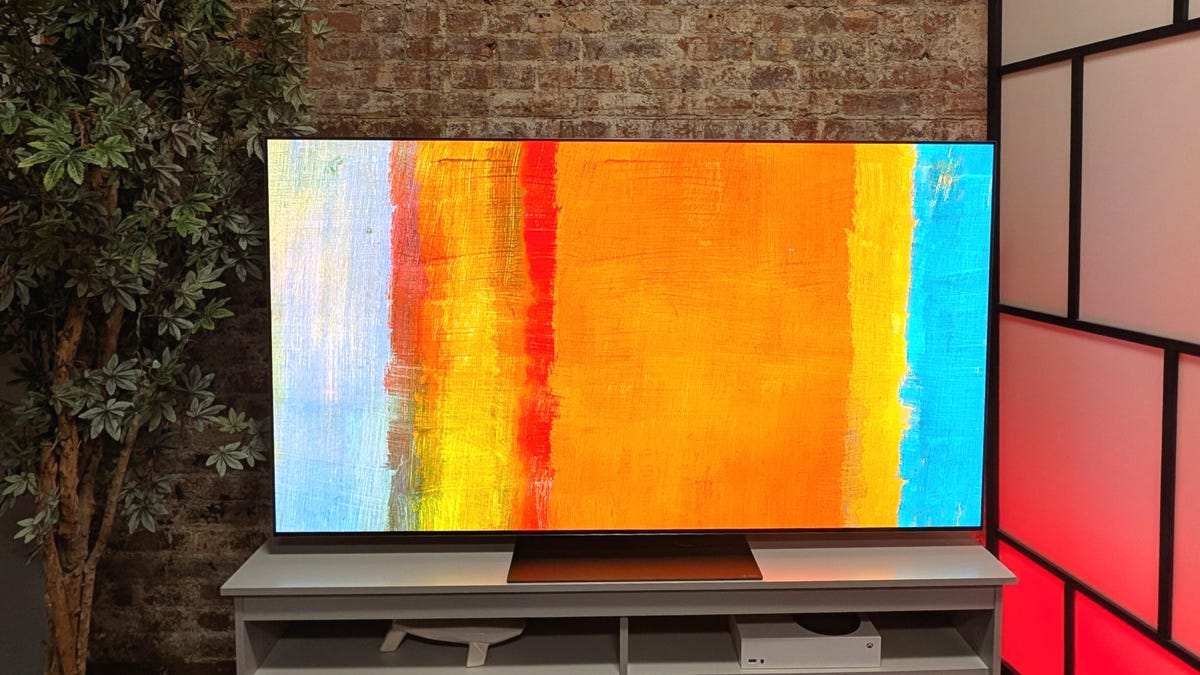
Like razors and hamburgers, the key to better OLED seems to be more stacks. Layers of OLED stacked on other layers of OLED can result in brighter and brighter displays. OLED screens on TVs, monitors, laptops and phones already deliver the best image quality of any display tech, and with two new technologies, they’re poised to get even better.
LG’s latest high-end OLED TV, the G5, features a four-stack design that results in the brightest OLED picture CNET has tested to date — more than 30% brighter than any other OLED TV we’ve tested. That’s quite a jump in performance for what are already some of the best TVs ever.
New advances in phosphorescent materials to supplement OLED’s typically luminescent material are potentially just as interesting. This new tech will likely improve brightness even more or make for more efficient displays for portable devices. Are these advances just hype? Probably not. This seems like a serious jump in OLED performance. Here’s why.
Stacks on stacks
LG’s third-gen OLEDs, like previous generations, used blue OLED material with yellow or yellow-green OLED, plus color filters, to create red, green and blue light. The new design uses separate red and green OLED materials, a rarity in TV OLED designs.
To understand why this new design is noteworthy, first let’s take a moment to talk about previous generations of OLED and how they worked. Prior to popular opinion, modern OLED TVs do not have red, green and blue OLED materials creating light. Samsung experimented with RGB OLED in the early days but couldn’t get it to work cost-effectively. LG, instead, has long done some version of blue OLED plus a yellow, or yellow-green OLED material. This “white” light would pass through color filters to create the red, green and blue that make up an image. They’d throw in an additional white sub-pixel to improve brightness.
We’ve talked about this before, and while it seemed weird at first, it looked great at the time, and it’s only been improved over the years. Samsung took a different approach when it finally re-entered the OLED market with its QD-OLED design. This used only a blue OLED material and added red and green quantum dots to create the rainbow of fruit flavors.
The problem, from a tech side, is that you can push OLED only so hard. There are a variety of reasons for this, not least of which is longevity. The candle that burns twice as bright burns half as long, essentially. What engineers found is that, if you stack OLED layers on top of each other, together they can create a brighter image while not running any individual layer particularly hard. As in, “33+33+33=~100” has advantages over “100=100.” There is more to it than all that, but that’s how we got here.
Not just more stacks, but different stacks
So with that in mind, I’m sure you see how it’s logical to just add another layer (“33+33+33+33=Profit!”). While basically true, there’s another change here that, as someone who has written about OLED from its early days, I find particularly fascinating: LG has gone RGB.
LG calls its new fourth-gen tech “Primary RGB Tandem.” It has two stacks of blue OLED, and swaps out the yellow-green layer for separate green and red layers. (RGB OLED returns!) The biggest advantage here is better color performance at higher brightness levels. There are obvious efficiency advantages to not using yellow-green materials to create green and red. Blue, long the problem child for OLED, is still doubled up in the new design for brightness and longevity reasons.
In CNET’s tests of the G5 OLED, we measured around 2,800 nits, which is 31% brighter than the other OLED TV we’ve reviewed, the Samsung S95D, and a jump of around 40% in brightness over the previous-gen LG G4. Even though our tests didn’t match LG Display’s claims of 4,000 nits, that’s still a significant jump in performance after many years of relatively modest improvements.
Phosphorescence
A blue phosphor in a Universal Display Corp lab.
LG also recently announced a different OLED breakthrough that’s not quite ready for TV “prime time” but is no less interesting, at least if you’re a nerd like me. The blue OLED materials used in TVs have thus far been luminescent. This means, basically, that when you give them energy, they light up, and when you turn it off, they go dark. Phosphorescence works a little differently. Supply energy to phosphorescent materials, and they glow. How long they glow varies, but what makes it interesting is that phosphorescent materials tend to be far more efficient than luminescent ones. They “hold onto” the energy for a moment, releasing more of it as light than the “instant” conversion of luminescent materials.
Phosphorescent blue OLED has been a bit of a white whale in OLED design, and LG, together with Universal Display Corp, has finally cracked it (having been working on it for a long time). They’re combining a fluorescent blue layer with a phosphorescent blue layer, currently paired with a yellow-green layer. LG says this combines “the stability of fluorescent materials with the power efficiency of phosphorescent materials, resulting in approximately 15% lower power consumption.”
Right now, LG intends to use this tech in displays that require high brightness and efficiency, namely smartphone and tablet screens. Could the four-stack design in LG’s new TVs be modified to use a phosphorescent layer for even more brightness and energy efficiency? I would assume so, at least eventually.
The new king, for now?
The next-gen TV tech with many names: QD-EL, EL-QD, NanoLED, QED; aka direct-view, electroluminescent quantum dots.
It’d be logical for one’s eyes to drift toward Samsung to see what its response will be. However, I’m not sure if they need one. At least, not right now. Its QD-OLED tech is quite new and very good. Quantum dots are pretty remarkable and are nearly 100% efficient in turning one color of light into another. QD-OLED doesn’t have the same potential limitations with color saturation at high brightness levels as LG’s older designs. So if Samsung adds even more stacks (somewhere between possible and likely), it could theoretically get even greater brightness while maintaining color saturation. If the company switches to a phosphorescent blue material, it could see brightness and efficiency improvements, just like what LG is claiming. We shall see.
What we can also imagine, on the horizon, is something that might potentially replace OLED. QD-EL, aka NanoLED, aka direct-view quantum dots, uses electroluminescent quantum dots to create an image, no OLED or LEDs needed. After several years of restricted-access tech demos, TCL had a prototype just sitting in its booth at CES 2025 for everyone (at least, all who noticed) to see. At the Society for Information Display’s Display Week, Samsung showed off a 400-nit QD-EL prototype. As far as this tech goes, that’s big and bright. (We like big and bright.) It’s going to be an interesting few years for display tech, that’s for sure.
In addition to covering cameras and display tech, Geoff does photo tours of cool museums and locations around the world, including nuclear submarines, aircraft carriers, medieval castles, epic 10,000-mile road trips and more.
Also, check out Budget Travel for Dummies, his travel book, and his bestselling sci-fi novel about city-sized submarines. You can follow him on Instagram and YouTube.
