


OLED and mini-LED are the two leading display technologies, with both offering improved picture quality over standard LED TVs.
Most of the best TVs use these two technologies, but deciding which one is more suitable for you can depend on several factors. Previously, OLED was the go-to option for better black levels and contrast, while Mini-LED was better for brightness. While this remains partially the case, the differences between what each panel tech can offer have changed somewhat.
Some of the best OLED TVs, such as the LG G5, are now hitting over 2,000 nits peak brightness, which is enough to compete with mini-LED TVs. And some of the best mini-LED TVs now have significantly improved local dimming, allowing for deeper and more OLED-like blacks.
You may like
I’ve been testing the TCL C7K mini-LED TV, the mid-range model in TCL’s 2025 UK TV lineup, and decided to put it up against our reference Panasonic MZ1500 OLED TV (from 2023) to see how much the gap between the two technologies has been closed.
A quick note: these two TVs are only available in the UK, but for our US readers, the closest equivalents would be the TCL QM7K mini-LED and either the Panasonic Z85A OLED from 2024 or the LG C5 OLED from 2025.
OLED vs mini-LED: color
Image 1 of 2
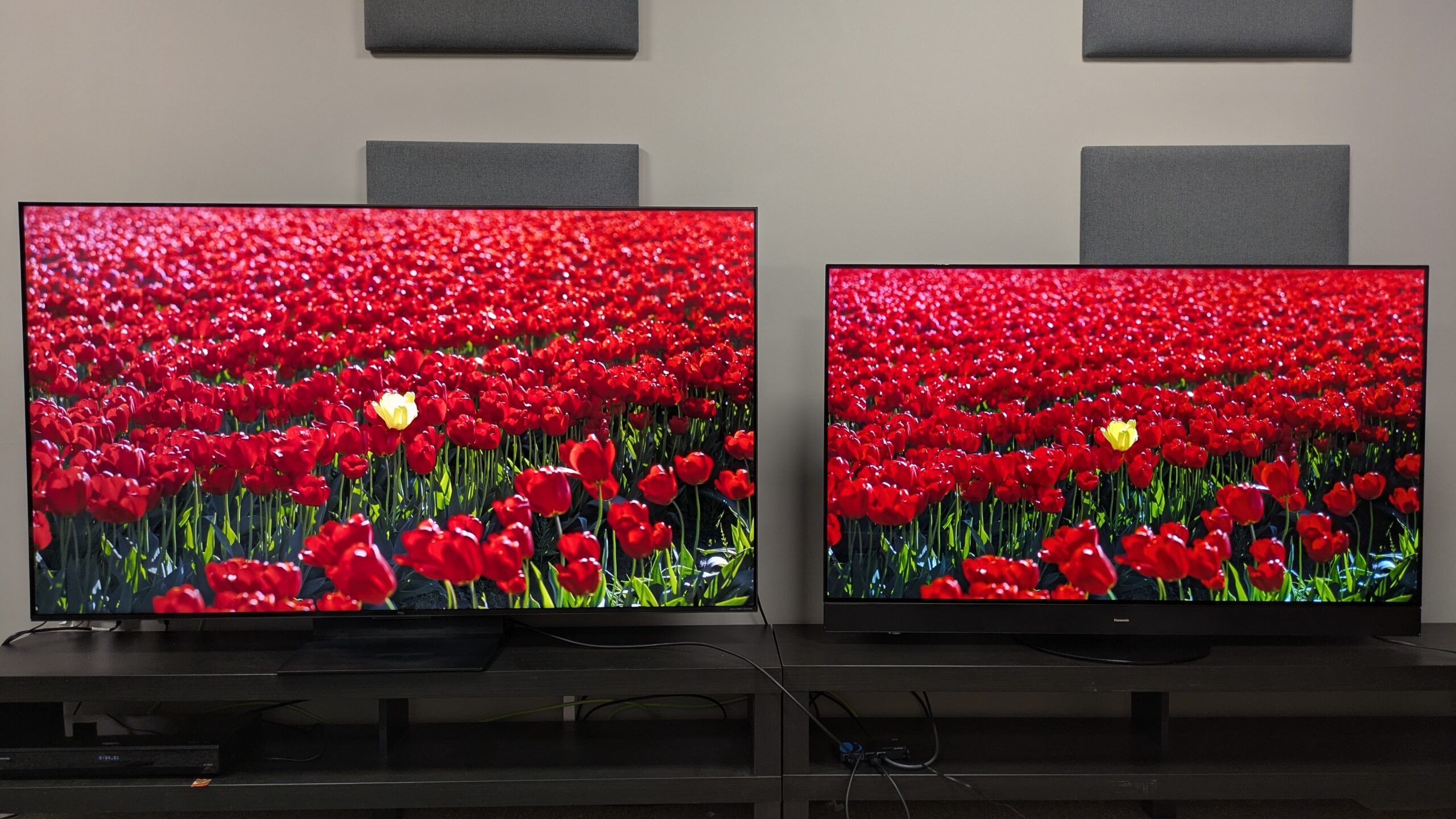
The TCL C7K (left) showed bright, punchy colors compared to the Panasonic MZ1500 (right), which showed richer, more detailed colors(Image credit: Future)(Image credit: Future)
Both OLED and mini-LED have their advantages when it comes to color. With Mini-LED TVs, colors tend to be brighter and punchier, while colors on OLED TVs tend to look more saturated and have greater depth due to OLED tech’s inherently high contrast. However, this wasn’t completely the case with the C7K and MZ1500.
Watching a 4K Blu-ray of Wicked with both TVs in their Dolby Vision Dark picture mode, the TCL C7K’s colors had a surprising amount of depth while still showcasing the punch mini-LED TVs get from their high peak brightness. The pink flowers around Elphaba during the ‘Wizard & I’ scene looked vibrant on both TVs, but I couldn’t help but be more drawn to the C7K.
The MZ1500 still showed the advantages of OLED’s self-emitting pixels vs the C7K’s local dimming backlight, with Elphaba’s green skin and the blue details in a design on the wall revealing better contrast, but the C7K was no slouch here.
It was also no slouch when viewing demo footage in HDR10 format on the Spears & Munsil UHD Benchmark 4K Blu-ray. With both TVs set to Filmmaker Mode, the yellows and greens in a butterfly’s wings were brighter and seemed more natural as compared to the MZ1500’s bolder, deeper display.
OLED vs mini-LED: black levels, contrast, and detail
Image 1 of 2
The TCL C7K (left) demonstrated surprisingly strong black levels and contrast compared to the Panasonic MZ1500 (right), shown here in Alien: Romulus (image 1) and on The Batman (image 2). (Image credit: Future)(Image credit: Future)
One area where the C7K impressed in my comparison was black levels. Throughout Alien: Romulus, in any scene in a dark hallway or tunnel, the C7K’s black levels looked deeper and richer than I’d anticipated. Yes, the MZ1500 was better here, but it was still an excellent demonstration of the C7K’s local dimming prowess.
The same was true when watching The Batman. Shadow detail on both TVs was excellent in the opening crime scene sequence, and the C7K showed vastly improved black levels compared to some mini-LEDs I’d tested in the past.
Contrast was another area where competition was closer than expected. The C7K displayed a great balance between light and dark tones in the bright lights punctuating gloomy surroundings in both Alien: Romulus and The Batman, holding itself up well against the MZ1500.
As with color, the MZ1500 OLED gave textures greater perceived depth and detail, creating a more 3D-like quality. But the same textures, such as skin and facial features, were displayed with a lifelike quality on the C7K as well.
OLED vs mini-LED: screen uniformity
Image 1 of 2
Black & white scenes from Oppenheimer (pictured) ultimately showed the TCL C7K’s (left) sub-par screen uniformity compared to the Panasonic MZ1500 (right): where OLED really shines. (Image credit: Future)(Image credit: Future)
The C7K had impressed me during my comparison so far, but there’s one area where the Panasonic OLED triumphed: screen uniformity.
Screen uniformity refers to a TV’s ability to evenly display large areas of the same color, such as black. OLED panels use self-emitting pixels instead of a backlight and, as a result, they can deliver uniform tones across all areas of the screen. But as mini-LED TVs use backlights to produce light, insufficient control of backlight local dimming zones can create uniformity issues.
Watching black and white scenes from Oppenheimer, the C7K did a great job of accurately displaying black and white tones, along with a good range of grays, but I also noticed streaks of brown underneath the black letterbox bars in these widescreen scenes – a sign of sub-par screen uniformity. This wasn’t an issue on the MZ1500 OLED.
OLED vs mini-LED: conclusion
The TCL C7K (left) ultimately isn’t as good as the Panasonic MZ1500 (right), but it’s brighter, significantly cheaper and does a great job for the money. (Image credit: Future)
Ultimately, the MZ1500 OLED had the superior picture in my comparison, thanks to its self-emitting pixels. But, there’s a key thing to remember here: price.
For a 65-inch C7K at launch, you’d be paying £1,399 ($1,499 for the QM7K in the US, and roughly AU$2,326) whereas the MZ1500 65-inch at launch in 2023 was £2,900 (roughly $3,700 / AU$5,400).
Panasonic’s OLEDs are notoriously pricey, but even a new mid-range OLED such as the LG C5 costs $2,699.99 / £2,699.99 / AU$4,299. That is one heck of a price gap.
So yes, while the MZ1500 does come out on top, the C7K (and the QM7K, which earned four and a half out of five stars in our review) demonstrates the solid level of performance you can now expect from a mini-LED TV, along with its comparatively high value when pitted against an OLED TV.
