


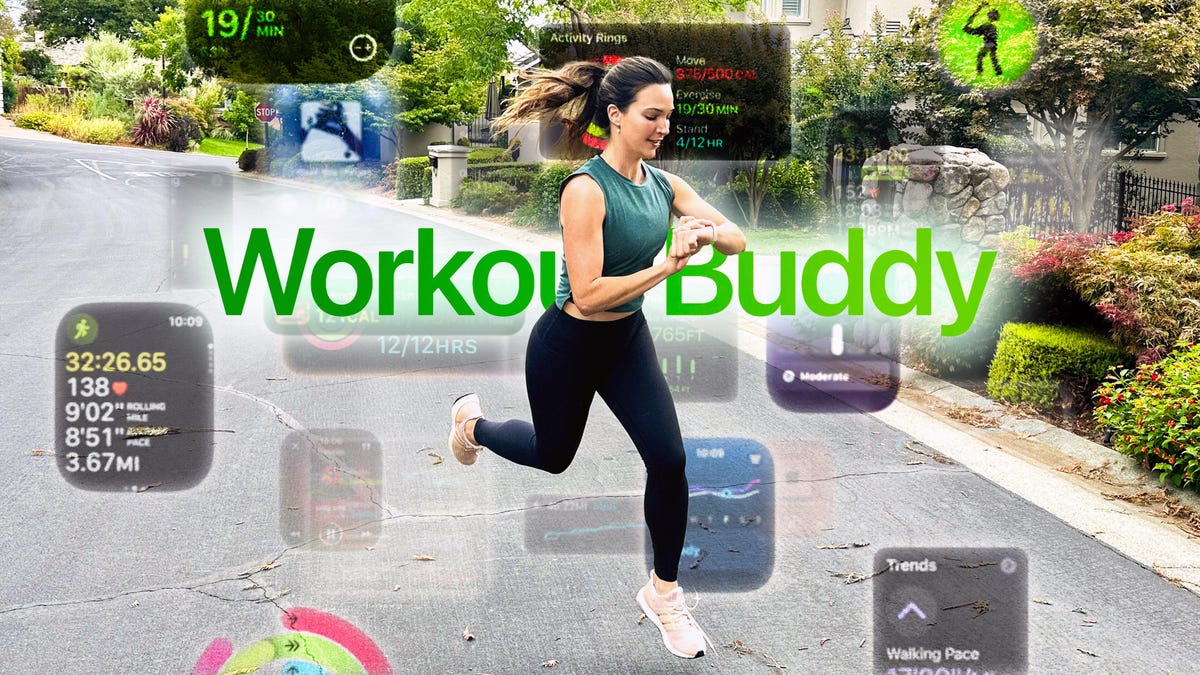
I didn’t think I needed a “buddy” to cheer me on during a workout when Apple first announced its new Workout Buddy feature in WatchOS 26. Despite it being an AI-powered voice that extols you with positive feedback as you run (or as you do any number of activities), I was envisioning a non-nonsense trainer that would push me out of my comfort zone and into peak performance. But after testing it myself and talking in-depth with Apple about how it works, I’m starting to think the company undersold it on purpose. Workout Buddy is much more than just a hype man, and it represents a crucial turning point in Apple’s health journey.
Workout Buddy turns your Apple Watch into a friendly voice that lauds your achievements during workouts. The WatchOS 26 feature isn’t a full-blown fitness coach that can guide your training plan, but that doesn’t mean Apple isn’t headed there. In fact, Workout Buddy may be the clearest signal yet that Apple is laying the groundwork for something much bigger in terms of fitness tools and AI.
At a time when investors and enthusiasts are critical about the company’s AI efforts, especially compared to competitors like Samsung and Google, Apple has a chance with Workout Buddy to show how its approach is different in a meaningful way. After the lukewarm debut of Apple Intelligence on the iPhone, Workout Buddy is the first time we’re seeing what Apple can do with AI on the watch.
The public beta version of WatchOS 26 is out. I recently tested Workout Buddy in the developer beta of WatchOS 26 and was genuinely surprised by how it made me feel after a walk. I spoke with Jay Blahnik, Apple’s vice president of fitness technologies, and Deidre Caldbeck, senior director of Apple Watch product marketing, to get more clarity around the feature, and unpack the tech and philosophy behind it. And the sense that I got from them is that Apple’s marathon toward personalized, intelligent coaching is only getting started.
Don’t call it a coach… yet
When Apple introduced Workout Buddy at WWDC in June, many Apple Watch fans (including myself) were quick to critique Workout Buddy for being more of a hype man/woman, than a trainer. Compared to competitors such as Fitbit, Garmin and recently Samsung, all of which already offer some form of AI-powered adaptive coaching plan, Workout Buddy with its real-time feedback, is more like a cheerleader than a strategist.
It’s easy to overlook what Apple set in motion, by focusing on what Workout Buddy isn’t. The feature is designed to be a motivating presence during your workout, not a drill sergeant. It delivers contextual, personalized encouragement that’s dynamically generated in real time across eight supported workout types: indoor/outdoor walks and runs, outdoor cycling, HIIT, Functional Strength Training and Traditional Strength Training.
“We didn’t want it to be just a pro tool,” Blahnik told me. “We wanted it to be accessible to as many people as possible.”
Workout Buddy requires you wear headphones. I’m a no-frills runner, who’d rather use 2 extra minutes to work out than spend them searching for a headset and choosing the perfect playlist (WatchOS 26 will soon take care of this too). So I wasn’t sold on the idea of using Workout Buddy rather than just tracking my regular pace and heart rate alerts on the wrist with my Apple Watch. And while I’m still not fully onboard with the whole audio gear requirement, I didn’t mind having the Workout Buddy version of my alerts in my ear reminding me that I’d reached my cruising range (that is, my target training zone).
Enabling Workout Buddy in the developer’s beta of watchOS 26.
When I launched my first walk workout, I toggled Workout Buddy on and was greeted with a quick summary of my week so far. “This is your fourth walk this week,” it reminded me, and framed it in the context of how close I was to closing my rings. It wasn’t groundbreaking, but it was surprisingly helpful to have that context delivered in a conversational tone, rather than buried in a graph somewhere.
“It’s not a coach, but it is designed to take your data and try to deliver it to you at the right time,” explained Blaknik, “in a way that inspires you and doesn’t get in the way.”
My Workout Buddy did start to get a little too chatty though when I hit some hills during my walk and my heart rate started spiking. Because my HR was constantly teetering above and dipping below my target, the alerts were hitting my ear every few seconds. Luckily, you can tweak or disable HR alerts entirely for each individual workout. My personal sweet spot just involved removing the high HR alert.
A decade of sweat equity and a team of trainers
Workout Buddy was not just Apple’s whimsical creation made to prove that the company can do AI for health and workouts. It’s the result of a decade of fitness data, an inspiring team of Fitness Plus trainers, and the technical lift of Apple Intelligence, Caldbeck told me.
“This was such a great time for it to happen because three things came together,” Caldbeck said. “Ten years of sweat equity, your personal fitness data. Our Fitness Plus trainers. And Apple Intelligence, which gave us the technical capabilities to push it forward.”
I could feel all three in the final product. The voice I heard isn’t just some generic audio prompt, which is what I was used to from these types of features on other devices. It’s a generative model trained on the voices of 28 actual Fitness Plus trainers. The tone, energy, and phrasing feels intentional and personal.
“It’s not a recording,” Caldbeck emphasized. “There was no script. It’s generated in the moment using your workout data and the voice model, and it will sound different every time.”
When I first set up Workout Buddy on my Apple Watch Series 10, I was prompted to choose from one of three distinct voices. They weren’t the tough-love trainer I’d envisioned would whip me into the best shape of my life, but they did sound like someone I’d trust to help me get there. Authoritative, energetic and strangely human. A far cry from the telemarketer-style robo-coach voices I’ve encountered in other programs.
There was a moment when Workout Buddy tipped its hand as something being less than human. It came during a mile-mark check-in, right after I’d crested what I considered a steep hill. It reported my stats: “One mile in, 230 feet of elevation gain.” Then it paused and declared, “That’s a mild elevation gain!” The tone was so emphatic, you’d think I’d just scaled Everest. It wasn’t the message that stood out; it was the delivery. A real person would’ve said “mild” matter of factly. But this was delivered with such over-the-top cheer that it almost felt like sarcasm. But the mismatch between tone and achievement made it sound like my wrist was gently roasting me for doing the bare minimum.
Personalization, with privacy at the core
The personalization isn’t just about your data, it’s about how it’s delivered. Workout Buddy can adapt to your habits, preferences, and even time of day.
“There’s something really remarkable about knowing that whatever they’re saying is unique to that moment, and that you’re not just going to trigger that same sentence on your run again the next day, even if you’ve done the same thing.” said Blahnik.
At the end of the walk, Workout Buddy summarized my stats, distance and calories. And it shared one meaningful nugget: My walk was my fastest pace in four weeks. That hit me harder than I expected. I’ve been coming off a knee injury that’s kept me from running for five weeks, and hearing that small gain was the moment I realized I might be on the mend. It was the kind of contextual insight I’d usually have to dig out on my own, in this case surfaced in my ear without having to think about it.
Under the hood, Apple is balancing Workout Buddy’s intimacy with its long-standing privacy approach. The feature uses a combination of on-device processing (on both your watch and iPhone) and private cloud computation to generate responses in real time. None of your personal fitness data is shared externally.
“We know this is your most personal data,” said Caldbeck. “So we wanted to treat it appropriately, but still give you powerful insights.”
This cautious approach matters. Trust will be the foundation for any future health coaching Apple delivers through AI.
Apple’s got a new AI-powered training partner for you.
A vision that’s just at the starting line
While Workout Buddy is only available to those with Apple Intelligence-supported iPhones, all Apple Watch users will still benefit from other updates in WatchOS 26. The limitation isn’t about exclusivity, it’s about processing power. Generating real-time, personalized voice feedback requires the kind of on-device performance that current Apple Watch hardware alone can’t handle. At least not yet.
The Apple Watch’s Workout app has the biggest navigation overhaul since it launched in 2015. Core features like interval training and pace alerts, previously buried in menus, are now front and center. Media integration also improved, with dynamic Apple Music suggestions based on your typical workouts that will play as soon as you start your workout.
“We kept our focus on making these features as personal and easy to use as possible,” Blahnik said. “Pushing the workout app further than it’s ever been.”
That framing; focused on simplicity, accessibility, and personalization, is key to understanding Apple’s strategy. While other companies rush to launch full-blown AI fitness coaches, Apple is taking a more deliberate path: It’s building the infrastructure to handle your data and translate it into meaningful, real-time guidance.
Apple’s been here before with adding native sleep tracking to the Apple Watch. The company waited until it had a clinical reason and subsequently a trustworthy implementation with Sleep Apnea alerts, even while competitors had long offered basic sleep tracking features.
“We almost always start our features to be really welcoming and inclusive and simple to use. We think that there’s a really bright future for where this can go as well,” Blahnik told me.
Apple’s long game
Of course Apple will never tell us where its sights are set next, but you don’t have to be a rocket scientist to draw the connections of where this is all headed.
“When we think about the future, all the ways with which we can push this feature to be even more personalized, we think its really, really exciting,” Blahnik noted.
Workout Buddy may seem lightweight now, but it proves that real time data analysis is already a possibility on the Apple Watch, and it can deliver them in a way that feels motivating and deeply personal. More importantly, it’s testing the waters. It’s accessible, friendly, and non-threatening; something even a beginner might be inclined to use.
It’s setting the stage for what could be next: an AI-powered coach that helps you make sense of all your data beyond just the Workout app to help motivate you and lead you to build healthier habits that will lead to measurable improvements. If Apple plays this right, the long game may actually pay off. Because building trust, delivering real insights, and meeting people where they are is how you win the marathon.
