


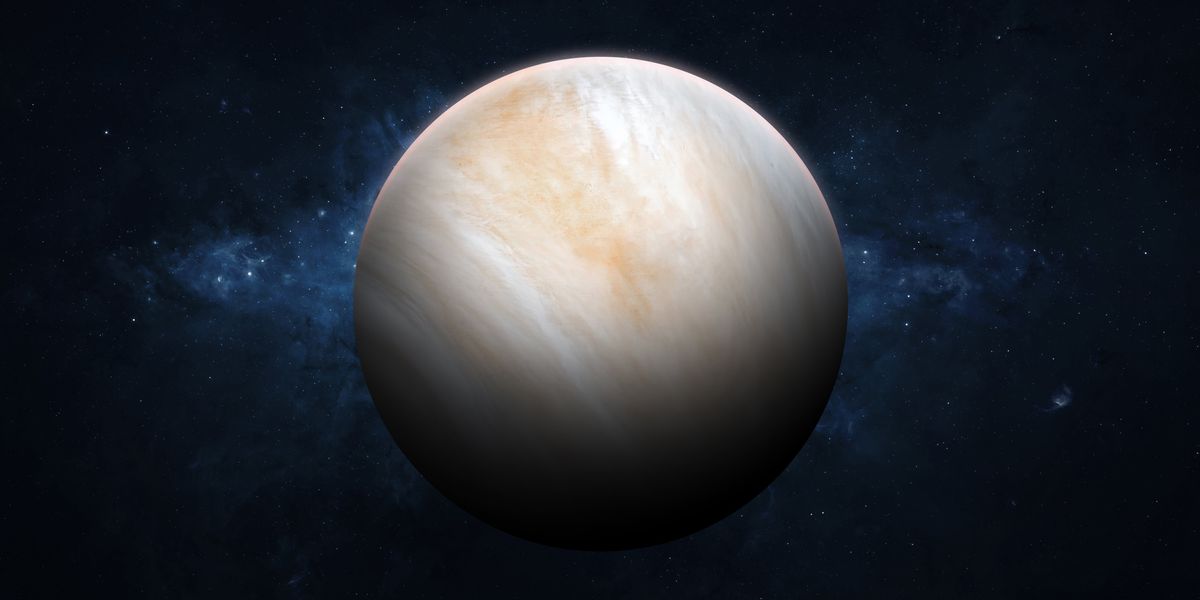
Venus has always seemed like the last place you’d expect to find life. With surface temperatures hot enough to melt lead and crushing atmospheric pressure, our neighboring planet appears utterly hostile. But high in its clouds, where conditions are surprisingly Earth-like, scientists have discovered something extraordinary: mysterious gases that shouldn’t exist, unless something is alive up there…perhaps!
Over the past five years, researchers have detected phosphine and ammonia in Venus’s atmosphere, two gases that on Earth are produced almost exclusively by biological processes or industrial activity. Since Venus has no factories, the discovery has sparked one of the most intriguing questions in astrobiology: Could microbial life be floating in the planet’s clouds?
Now, a U.K.-backed mission plans to answer that question once and for all. Jane Greaves, a professor of astronomy at Cardiff University, and her team have unveiled VERVE (Venus Explorer for Reduced Vapours in the Environment), an ambitious probe that would hitch a ride to Venus with the European Space Agency’s EnVision mission, scheduled for 2031.
Phosphine Discovery Sparks Debate
The story began in 2020 when Greaves and colleagues first detected phosphine in Venus’s clouds using the James Clerk Maxwell Telescope in Hawaii. The announcement sent shockwaves through the scientific community. On Earth, phosphine is primarily produced by anaerobic bacteria, microbes that thrive in oxygen free environments like swamps and in the guts of animals. Finding it on Venus suggested the tantalizing possibility of aerial life.
However, the discovery proved controversial. Follow up observations by other teams failed to replicate the findings, leading to heated scientific debates. But Greaves’ team didn’t give up. Through persistent monitoring, they discovered something crucial: The phosphine signal appeared to follow Venus’s day-night cycle, being destroyed by sunlight and varying with time and location across the planet.
The plot thickened when the team announced the tentative detection of ammonia in Venus’s clouds. Like phosphine, ammonia on Earth is primarily produced by biological activity and industrial processes. But there are no known atmospheric or geological phenomena that can explain its presence on Venus.
VERVE Mission Targets Venus’s Clouds
The proposed VERVE mission would cost £43 million (nearly US $58 million), a fraction of typical planetary missions, and would search for and map these gases along with other hydrogen rich compounds that shouldn’t exist on Venus. The CubeSat-sized probe would detach from EnVision upon arrival and conduct an independent survey while the main mission studies Venus’s surface and interior.
The target zone for potential life lies about 50 kilometers above the Venusian surface, where temperatures range from a comfortable 30 °C to 70 °C and atmospheric pressure resembles Earth’s surface conditions. In this “Goldilocks zone” of the atmosphere, extremophile microbes (organisms that thrive in harsh conditions) could theoretically survive.
These organisms could be remnants from Venus’s more temperate past. Billions of years ago, it might have had liquid water oceans and Earth like conditions. As the planet’s runaway greenhouse effect took hold, any life that existed might have retreated to the more hospitable cloud layers, evolving to survive in this aerial niche.
The only way to resolve the mystery once and for all is direct investigation and, if successful, the mission could mark one of the most significant discoveries in human history: Proof that life exists beyond Earth
From Your Site Articles
Related Articles Around the Web
