


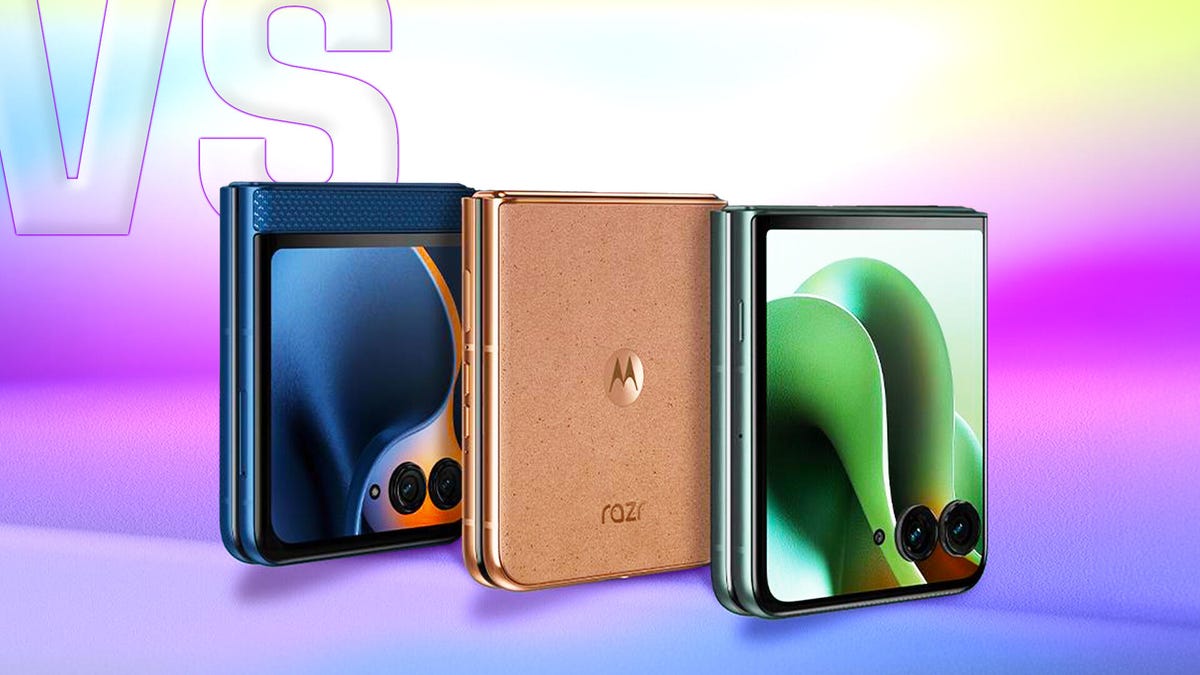
Motorola has unveiled three new Razr foldable phones that range in price and features: the $700 Motorola Razr, the $1,000 Razr Plus and the $1,300 Razr Ultra, which are all available now. But what are the key differences between these modern flip phones?
The newest addition to the lineup, the Razr Ultra, levels up the capabilities you’ll find in the baseline Razr and the Razr Plus — and appears poised to give the $1,100 Samsung Galaxy Z Flip 6 a run for its money. The Razr Ultra packs 50-megapixel wide and ultrawide cameras, a 4,700-mAh battery and 68-watt charging. But read on to see how it compares to its less pricey Razr counterparts and if nabbing the top-of-the-line device is worth the extra money.
But first, here are some commonalities across the three phones. They all run Android 15, have a side fingerprint sensor, boast an IP48 rating for dust and water resistance and lack a headphone jack and expandable storage.
Each phone is equipped with Moto AI features that can be activated with a dedicated button, or by looking and speaking directly at the phone. Motorola has integrated services from Perplexity, Microsoft Copilot, Meta’s Llama and Google Gemini to handle tasks like transcriptions, brainstorming and serving up suggestions based on what’s on your screen.
One thing to note is how Motorola’s Android support comes up short compared to the competition. You’ll only get three years of major software upgrades and four years of security updates on the phones, compared to the seven years Samsung and Google offer on their phones.
Now, onto what separates the 2025 Motorola Razr, Razr Plus and Razr Ultra.
Watch this: Motorola’s New 2025 Razr Line Gets a High-End $1,300 Ultra Phone
04:22
Razr 2025 vs. Razr Plus vs. Razr Ultra screen size(s)
The most noticeable difference when looking at the three phones is the nearly half-inch bezel on the baseline Razr’s cover screen, which shrinks down that display to 3.6 inches, versus the 4-inch cover displays on the Razr Plus and Razr Ultra. Another key difference is that the baseline Razr’s cover screen has a 90Hz variable refresh rate, while the two pricier phones go up to 165Hz. All three cover screens are pOLED displays.
Moving to the internal displays, the Razr has a 6.9-inch FHD+ AMOLED display with a 120Hz variable refresh rate, while the Razr Plus has a 6.9-inch FHD+ pOLED display with a 165Hz variable refresh rate. The Razr Ultra, meanwhile, has a 7-inch Super HD AMOLED display with a 165Hz variable refresh rate.
Razr 2025 vs. Razr Plus vs. Razr Ultra cameras
Camera capabilities could be a determining factor when choosing one of these three phones. The baseline Razr has a 50-megapixel wide and 13-megapixel ultrawide camera. The Razr Plus has a 50-megapixel wide and 50-megapixel telephoto camera. And the Razr Ultra packs a 50-megapixel wide and 50-megapixel ultrawide camera.
Flipping to the internal screens, you’ll get a 32-megapixel selfie camera on the baseline Razr and the Razr Plus, and a 50-megapixel one on the Razr Ultra. Megapixels aren’t everything for camera and photo quality, but these specs definitely make the Ultra sound like a triple threat. Stay tuned for CNET’s reviews to see how these cameras perform in the real world.
Razr 2025 vs. Razr Plus vs. Razr Ultra batteries
Interestingly, the baseline Razr has a 4,500 mAh battery, higher than the 4,000 mAh you’ll get on the pricier Razr Plus. But the Razr Ultra tops them all with a 4,700 mAh battery. We’ll be sure to incorporate our battery test and observations into upcoming reviews of the phones to better understand how they perform day to day.
The Razr supports 30-watt wired charging and 15-watt wireless charging. Meanwhile, the Razr Plus supports 45-watt wired charging and 15-watt wireless charging, as well as 5-watt reverse charging, which can be handy if you have another device to charge and essentially want to turn your phone into a power bank. The Razr Ultra tops them all with 68-watt wired charging, 30-watt wireless charging and 5-watt reverse charging.
Razr 2025 vs. Razr Plus vs. Razr Ultra processor and storage
The baseline Razr is powered by a MediaTek Dimensity 7400X chipset, while the Razr Plus has a Snapdragon 8s Gen 3 chipset and the Razr Ultra packs a Snapdragon 8 Elite processor.
You’ll get 8GB of RAM and 256GB of storage on the baseline Razr, 12GB of RAM and 256GB of storage on the Razr Plus and 16GB of RAM with either 512GB or 1TB of storage on the Razr UItra. That can make the upcharge on the priciest Razr worth your money, if you’re inclined to use your phone for gaming or want to take loads of pictures without worrying about running out of storage space.
Should you upgrade from an older Razr?
On paper, there aren’t any huge differences between this year’s Razr and Razr Plus and last year’s models. The newer phones share the same screen sizes, pixel densities, general dimensions and camera specs as their predecessors. This year, Motorola added some features like dust resistance and new AI capabilities, but it’s probably not worth upgrading if you can hang onto your 2024 device a bit longer.
If you have an older phone like the 2023 Razr and Razr Plus or earlier, you might be more enticed to upgrade to take advantage of faster charging, more powerful RAM and processors and, of course, new AI features. And especially with just three years of software updates, you might feel the clock ticking before it’s time for your next upgrade.
Check out the spec chart below for a side-by-side breakdown and comparison of the three phones.
Motorola Razr (2025) vs. Razr Plus (2025) vs. Razr Ultra (2025)
Motorola Razr (2025)Motorola Razr Plus (2025)Motorola Razr Ultra (2025) Cover display size, tech, resolution, refresh rate 3.6-inch pOLED; up to 90Hz variable refresh rate4-inch pOLED; 1272 x 1080 pixels; up to 165Hz variable refresh rate4-inch pOLED; up to 165Hz variable refresh rateInternal display size, tech, resolution, refresh rate 6.9-inch AMOLED; FHD+; up to 120Hz variable refresh rate6.9-inch pOLED; FHD+; 2640 x 1080 pixels; up to 165Hz variable refresh rate7-inch AMOLED; super HD; up to 165Hz variable refresh ratePixel density Cover: 413 ppi; Internal: 413 ppiCover: 417 ppi; Internal: 413 ppiCover: 417 ppi; 464 ppiDimensions (inches) Open: 2.91 x 6.74 x 0.29 inches Closed: 2.91 x 3.47 x 0.62 inchesOpen: 2.91 x 6.75 x 0.28 inches Closed: 2.91 x 3.47 x 0.6 inchesOpen: 2.91 x 6.75 x 0.28 inches Closed: 2.91 x 3.47 x 0.62 inchesDimensions (millimeters) Open: 73.99 x 171.30 x 7.25mm Closed: 73.99 x 88.08 x 15.85mmOpen: 73.99 x 171.42 x 7.09mm Closed: 73.99 x 88.09 x 15.32mmOpen: 73.99 x 171.48 x 7.19mm Closed: 73.99 x 88.12 x 15.69mmWeight (grams, ounces) 188g (6.63 oz)189g (6.67 oz)199g (7 oz)Mobile software Android 15Android 15Android 15Cameras 50-megapixel (wide), 13-megapixel (ultrawide)50-megapixel (wide), 50-megapixel telephoto50-megapixel (wide), 50-megapixel (ultrawide) Internal screen camera 32-megapixel32-megapixel50-megapixelVideo capture 4K4K4K Processor MediaTek Dimensity 7400XSnapdragon 8s Gen 3Snapdragon 8 EliteRAM/storage 8GB + 256GB12GB + 256GB16GB + 512GB, 1TBExpandable storage NoneNoneNoneBattery 4,500 mAh4,000 mAh4,700m AhFingerprint sensor SideSideSideConnector USB-CUSB-CUSB-CHeadphone jack NoneNoneNoneSpecial features IP48 rating, dual stereo speakers, 30-watt wired charging, 15-watt wireless charging, 1,700 nit peak brightness on cover display, 3,000 nit peak brightness on main display, 5G.IP48 rating, Corning Gorilla Glass Victus on front, titanium-reinforced hinge, 2,400 peak brightness on cover display; 3,000 nit peak brightness on main display, 5G, Wi-Fi 6/6E, Wi-Fi 7, 45-watt wired charging, 15-watt wireless charging, 5-watt reverse charging.IP48 rating, 68-watt wired charging, 30-watt wireless charging, 5-watt reverse charging, dual stereo speakers, Corning Gorilla Glass Ceramic cover dispaly, 3,000 nits peak brightness on cover display, 4,500 nits peak brightness on main display, 5G. US price starts at $700$1,000$1,300
