


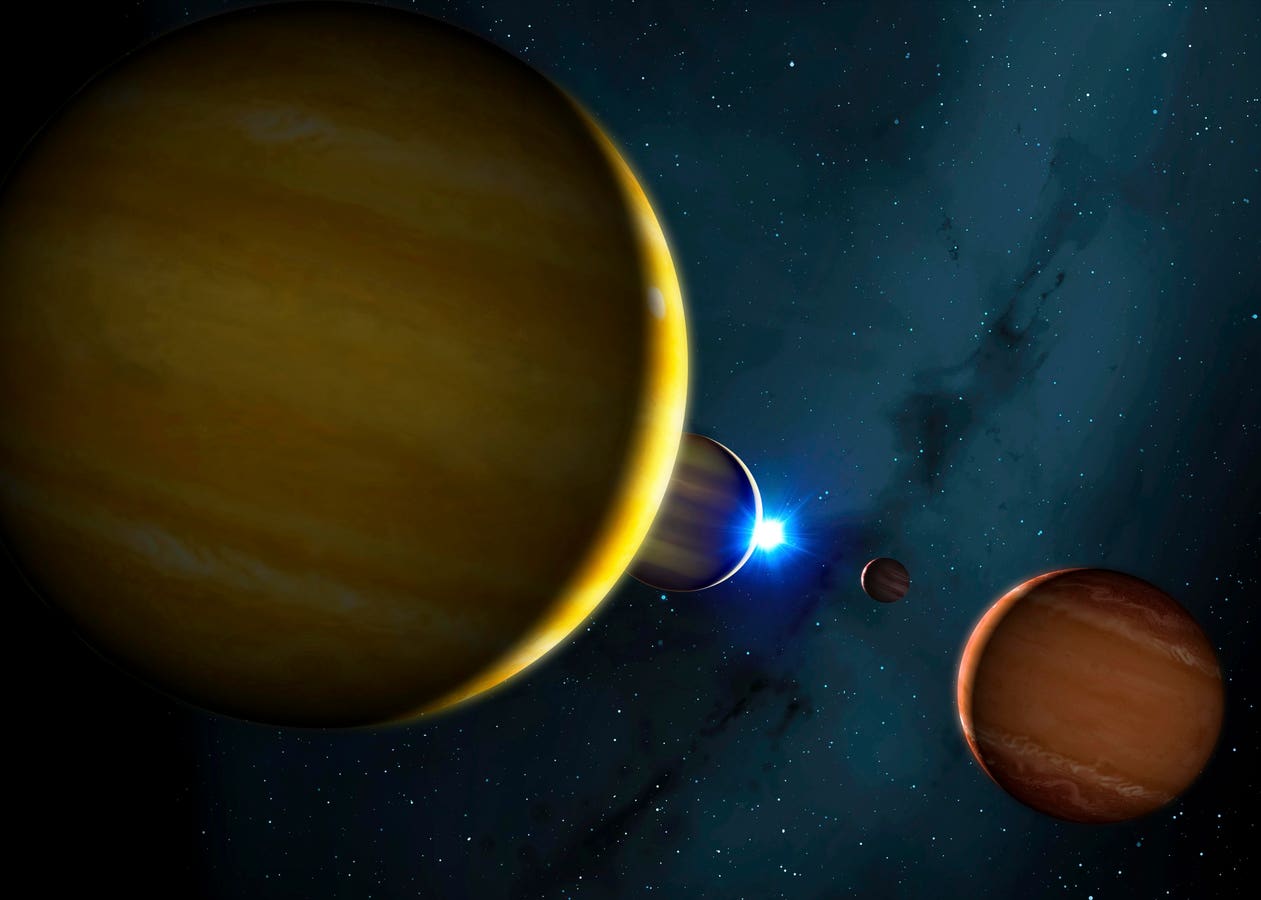
Four planets locked in a perfect rhythm around a nearby star (HR 8799) are destined to be pinballed around their solar system when their sun eventually dies, according to a study led by the University of Warwick that peers into its future. Astronomers have modelled how the change in gravitational forces in the system as a result of the star becoming a white dwarf will cause its planets to fly loose from their orbits and bounce off each other’s gravity, like balls bouncing off a bumper in a game of pinball.
getty
NASA reports that its official tally of extrasolar planets has hit the 6,000 mark. This thirty-year milestone has been in the works since two little known Swiss astronomers, Michel Mayor and Didiez Queloz, first detected 51 Pegasi b.
The first of the so-called “hot Jupiters” to be detected, “51 Peg” is a gas giant planet half the mass of our own Jupiter on a crazily short 4.2-day orbit around its parent star, 51 Pegasus, some 50 light years away. In contrast, our planet Mercury, which is scorchingly hot itself, orbits the sun in just under 88 days.
Confirmed planets are added to the count on a rolling basis by scientists from around the world, so no single planet is considered the 6,000th entry, NASA says. The number is monitored by NASA’s Exoplanet Science Institute in Pasadena, with 8,000 more awaiting confirmation, notes the space agency.
The most important thing that exoplanets bring to the planetary science table is vast numbers, Stephen Kane, a planetary geophysicist at the University of California in Riverside, tells me via email. This enables a statistical analysis of planetary properties across various axes, such as planet mass, size, composition, age, and formation processes, Kane tells me.
Planetary Context
In-situ data from the solar system, combined with the statistical power of exoplanets, creates a perfect partnership between these two fields, says Kane. This partnership is crucial when trying to understand how, for example, Venus and Mars have evolved through time, he says.
Fewer Than 100 exoplanets have been directly imaged, says NASA. But the rate of exoplanet discoveries has accelerated in recent years (the database reached 5,000 confirmed exoplanets just three years ago), and this trend seems likely to continue, NASA notes.
Scientists have found thousands of exoplanets (planets outside our solar system) throughout the galaxy. Most can be studied only indirectly, but scientists know they vary widely, as depicted in this artist’s concept, from small, rocky worlds and gas giants to water-rich planets and those as hot as stars.
NASA’s Goddard Space Flight Center
As I write in my 2001 book, “Distant Wanderers: The Search for Planets Beyond the Solar System”: “Over the span of the twentieth century, … Astronomers greatly benefited from the development of both larger-aperture optical telescopes and the power of computer processing to crunch their newly acquired data. …radio astronomy after World War II allowed for the combination of signals from more than one radio telescope. This technique of signal combination was later incorporated into optical telescopes and is a key part of present and future planet-detection technologies.”
The Future
At NASA, the future of exoplanet science will emphasize finding rocky planets similar to Earth and studying their atmospheres for biosignatures — any characteristic, element, molecule, substance, or feature that can be used as evidence of past or present life, says the space agency. The James Webb Space Telescope has already analyzed the chemistry of over 100 exoplanet atmospheres, NASA notes.
But to place these exoplanetary discoveries in context, we first need to better understand our own solar system, particularly our sister planet Venus.
The future Venus missions, including NASA’s DAVINCI and VERITAS, are still happening until we’re told they are not, says Kane.
NASA is also a partner with the European Space Agency on ENVISION, a third Venus mission.
Budget Battles
We are of course extremely concerned that a hammer will fall on those missions on Oct. 1st, the beginning of the new fiscal year, says Kane. If Congress does not approve a spending bill before then, we go into a continuing resolution, which means that the President’s Budget Request may take effect until the Congressional bill passes, says Kane.
But this week’s 6,000 exoplanet milestone merits celebration.
While researching my book, astronomer Geoff Marcy, a co-discoverer of several of the first hot Jupiters, quipped that in 30 years-time his own role in exoplanet hunting would seem obsolete.
Although Marcy’s prediction has come true, planetary theorists are still at a loss as to why there appear to be so few solar systems with the same kind of planetary architecture as our own. That is, with Venus and earth-like planets at habitable distances from their stars as well as gas giants orbiting at Jupiter-like distances (which in our solar system’s case is 5 astronomical units), or five times the average distance between the Earth and sun.
Until we figure all this out, we are likely to remain in the dark about some of the most important issues in planetary science.
As for whether any of these planets might harbor intelligent life, Marcy summed it up quite succinctly in “Distant Wanderers.”
“To me the most profound and puzzling question is whether Darwinian evolution, which certainly leads to survival among the life forms, necessarily vectors toward intelligence, Marcy tells me in “Distant Wanderers.” “You might end up with a lot of cockroaches and woodpeckers, and maybe a few whales, but it’s not clear that the galaxy is teeming with intelligent life,” he tells me in the book.
