


When Hannan Happi started thinking about how to solve the AI power crisis, he kept one figure in mind: one cent per kilowatt-hour.
“We went through all sorts of configurations and designs,” Happi, co-founder and CEO of Exowatt, told TechCrunch. “They all look different from each other. We tried to learn from every one of them: How do I reduce structural costs? How do I reduce maintenance costs? How do I optimize for this?”
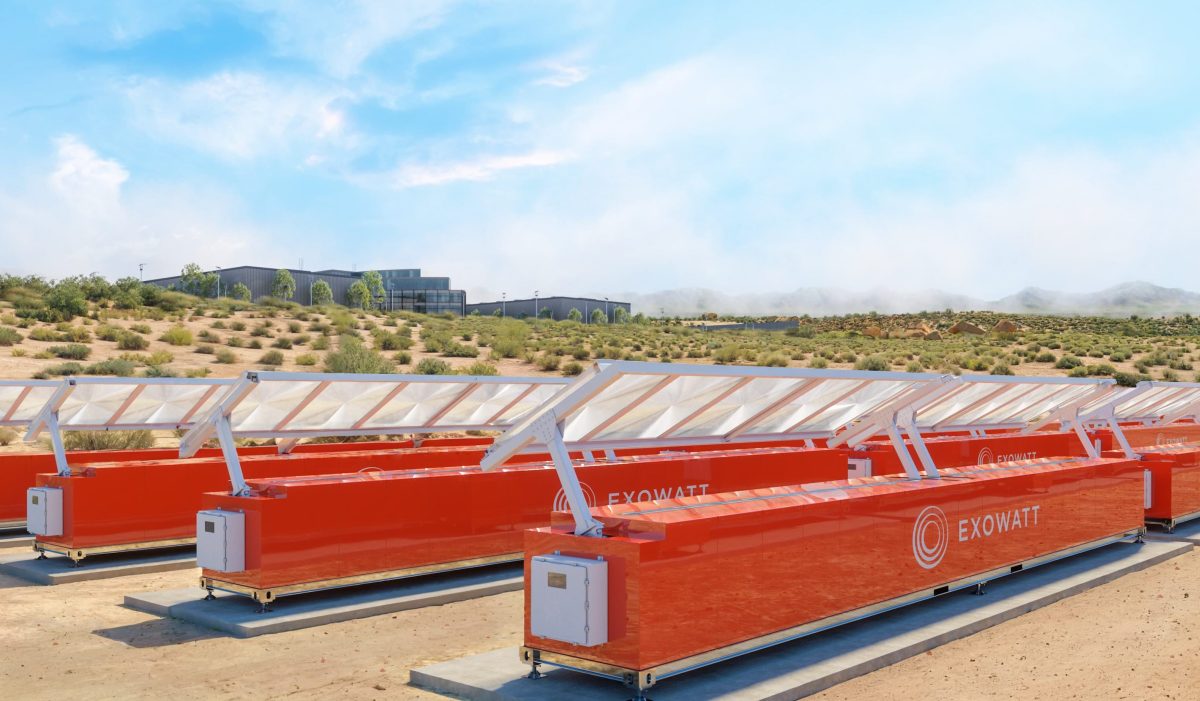
After years of brainstorming and building, Exowatt’s first step toward that goal is a simple box the size of a shipping container topped with a clear awning. Inside is similarly simple. If Exowatt can deliver on its promise of delivering cheap solar power that generates electricity 24-7, it could upend the data center market and broader energy world, delivering round-the-clock power at very low cost.
To scale production in pursuit of the one-cent per kWh target, Exowatt has raised an additional $50 million in an extension to its $70 million Series A round that closed in April, TechCrunch has exclusively learned.
The extension was led by MVP Ventures and 8090 Industries with participation from Atomic, BAM, Bay Bridge Ventures, DeepWork Capital, Dragon Global, the Florida Opportunity Fund, Massive VC, New Atlas Capital, Overmatch, Protagonist, and StepStone. Previous investors include Andreessen Horowitz and Sam Altman.
Happi said that Exowatt wasn’t looking to raise additional capital after the April round, but “strong momentum we saw in the market” and “strong investor interest” encouraged him to take the new money at a higher valuation.
Exowatt’s backlog is currently about 10 million P3 units representing 90 gigawatt-hours of capacity, he said. “The goal is to scale as fast as possible to the millions and ultimately billions of units,” he said. The company should hit its one-cent target when production hits around 1 million units per year, Happi said.
Techcrunch event
San Francisco
|
October 13-15, 2026
Exowatt is basically repackaging a technology that’s been around for decades. Known as concentrated solar power or thermal solar power, it uses the sun’s energy to heat materials that are good at storing or transporting thermal energy. In cases where that thermal energy is stored for an extended period of time, those materials tend to be derived from or resemble rocks — hence the technology’s nickname of “rocks in a box.”
Each P3 device consists of a metal box topped with lenses that focus the sunlight into a tight beam. That beam then heats a special brick inside the shipping container. A fan blows air over the brick to carry the heat to another box which contains a Stirling engine (a piston-driven device that converts heat to mechanical energy) and a generator. To store more power, developers would install more P3 boxes. “Everything is designed to be extremely simple,” Happi said.
Each thermal battery can retain heat for up to five days, ensuring continuous operation, and Exowatt will string several together to feed a single generator unit. How many depends on how quickly and how much electricity a customer wants to generate. The system’s efficiency is on par with photovoltaic solar panels, and slightly better than PV paired with lithium-ion batteries, Happi said.
Other companies have built various approaches to the same technology, though most have failed to compete with photovoltaic solar and lithium-ion batteries, both of which have surprised experts with how quickly they’ve come down in cost.
Happi argued that the P3’s small size and Exowatt’s iterative approach sets it apart. There are just over 100 solar thermal or concentrated solar power projects that are planned, built, or decommissioned around the world, he said. “If you compare that to the fact that we produce 1.5 billion solar panels per year, you can see the learning curve effects are very, very far apart from each other.
“What Exowatt is about is taking a modular system that we know in principle works, and really scaling the manufacturing of that and then applying the learning curves of manufacturing.”
Exowatt is unlikely to be cost-effective everywhere, and the number of P3 units needed to power a data center could require massive amounts of land. Plus, it works best in the sunniest regions, which could limit its broader impact.
But Happi counters that there’s a “high overlap” between where Exowatt’s P3 excels and where new data centers are being built. “We’re not running short of any projects to do,” he said.
