


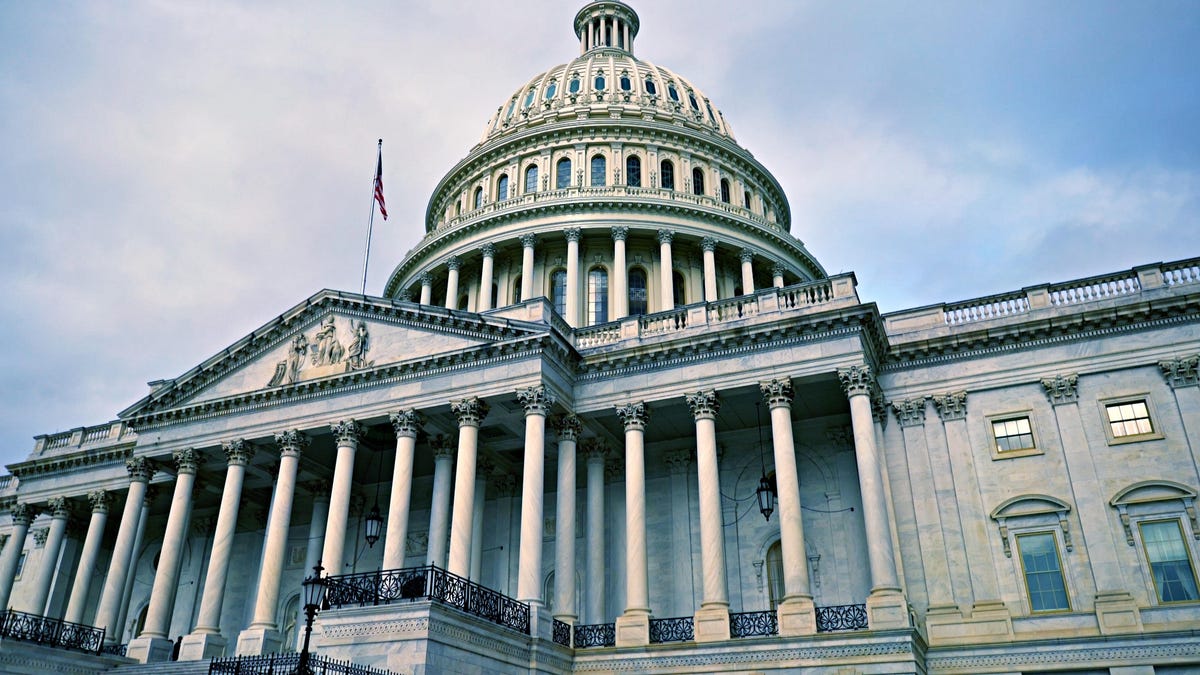
Jarmo Piironen/Getty Images
Until now, the Trump administration’s tax bill — also called its “big, beautiful bill,” which passed in the Senate on Tuesday — included a rule that would prevent states from enforcing their own AI legislation for five years, and would withhold up to $500 million in funding for AI infrastructure if states don’t comply.
On Tuesday, a day into a “vote-o-rama” that began Monday in an effort to pass Trump’s tax bill before the July 4 holiday, the Senate voted 99 to one to remove the proposed moratorium on states’ ability to regulate AI. The vote came just days after senators had amended the original proposal of a 10-year ban on enforcement to five years and added exemptions for state laws targeting unfair or deceptive practices and child sexual abuse material (CSAM).
Also: OpenAI wants to trade gov’t access to AI models for fewer regulations
The initial version of the rule also made $42 billion in broadband internet funding dependent on states’ compliance with the 10-year ban. The amended version only held $500 million in AI funding for ransom if states disobeyed.
The proposed moratorium
If passed, the rule would have prohibited states from enforcing AI legislation for five years and simultaneously put AI funding for states in limbo. It wouldn’t have only affected in-progress legislation; laws that states had already passed would stay intact in writing but would effectively be rendered useless, lest states want to put their AI funding on the line.
In practice, this would create a patchwork imbalance across the country: Some states would have thorough legislation but no funding to advance AI safely, while others have no regulation but plenty of funding to keep up in the race.
Also: What ‘OpenAI for Government’ means for US AI policy
“State and local governments should have the right to protect their residents against harmful technology and hold the companies responsible to account,” said Jonathan Walter, a senior policy adviser at The Leadership Conference’s Center for Civil Rights and Technology.
Many advocates fought to get the ban removed from the tax bill and celebrated the news on Tuesday, including Adam Billen, vice president of public policy at Encode, a Washington, D.C.-based responsible AI organization.
“40 state AGs, 14 governors. 260 state lawmakers from all 50 states, multiple 140+ org coalition letters we rallied, thousands of calls and emails from parents and constituents, and a few key Congressional champions later, and we have it nearly completely killed,” he said in a LinkedIn post. “Even the provision’s primary sponsors voted to strip it in the end.”
Federal AI policy remains unclear
The administration is due to release its AI policy on July 22. In the meantime, the country is effectively flying blind, which has prompted several states to introduce their own AI bills. Under the Biden administration, which took some steps to regulate AI, states were already introducing AI legislation as the technology evolved rapidly into the unknown.
Walter added that the vagueness of the ban’s language could have block states’ oversight of non-AI-powered automation as well, including “insurance algorithms, autonomous vehicle systems, and models that determine how much residents pay for their utilities.”
“The main issue here is that there are already real, concrete harms from AI, and this legislation [would] take the brakes away from states without replacing it with anything at all,” said Chas Ballew, CEO of AI agent provider Conveyor and a former Pentagon regulatory attorney.
By preventing states from enforcing individual AI policy when federal regulation is still a big question mark, the Trump administration would have opened the door for AI companies to accelerate without any checks or balances — what Ballew called a “dangerous regulatory vacuum” that would give companies “a decade-long free pass to deploy potentially harmful AI systems without oversight.”
President Trump’s second term thus far doesn’t suggest AI safety is a priority for federal regulation. Since January, the Trump administration has overridden safety initiatives and testing partnerships put in place by the Biden administration, shrunken and renamed the US AI Safety Institute the “pro-innovation, pro-science” US Center for AI Standards and Innovation, and cut funding for AI research.
Also: AI leaders must take a tight grip on regulatory, geopolitical, and interpersonal concerns
“Even if President Trump met his own deadline for a comprehensive AI policy, it’s unlikely that it will seriously address harms from faulty and discriminatory AI systems,” Walter said. AI systems used for HR tech, hiring, and financial applications like determining mortgage rates have been shown to act with bias toward marginalized groups and can display racism.
Why states want their own AI regulation
Understandably, AI companies have expressed a preference for federal regulation over individual state laws, which would make maintaining compliant models and products easier than trying to abide by patchwork legislation. But in some cases, states may need to set their own regulations for AI, even with a federal foundation in place.
“The differences between states with respect to AI regulation reflect the different approaches states have to the underlying issues, like employment law, consumer protection laws, privacy laws, and civil rights,” Ballew points out. “AI regulation needs to be incorporated into these existing legal schemes.”
Also: Anthropic’s new AI models for classified info are already in use by US gov
He added that it’s wise for states to have “a diversity of regulatory schemes,” as it “promotes accountability, because state and local officials are closest to the people affected by these laws.”
Previous proposals withheld internet funds
Broadband Equity, Access, and Deployment (BEAD) is a $42-billion program run by the National Telecommunications and Information Administration (NTIA) that helps states build infrastructure to expand high-speed internet access. Before it was revised, the Senate rule would have made all of that money, plus $500 million in new funding, contingent on states backing off their own AI laws.
Get the morning’s top stories in your inbox each day with our Tech Today newsletter.
