


As mobile phone use continues to be a leading cause of vehicle accidents, a range of technologies has emerged designed to combat distracted driving. From mobile apps to hardware-integrated systems, these tools aim to limit phone use behind the wheel. But a closer look reveals significant differences in how effectively they prevent distractions—especially in fleet vehicles.
While apps like AT&T’s DriveMode and Apple’s built-in Do Not Disturb While Driving offer basic protections, they rely heavily on driver cooperation. Many can be bypassed with a swipe or a second phone, limiting their effectiveness when liability and safety are paramount.
“We think technologies that reduce visual-manual interaction with phones are obviously a good thing,” Ian Reagan, a senior research scientist at the Insurance Institute for Highway Safety told IEEE Spectrum. “But most are opt-in. We’d like to see them as opt-out by default.”
“Mobile use while driving is an addiction. We needed a system that prevents distraction without waiting for the driver to choose safety. That’s what we built.” –Ori Gilboa, SaferOne
Now, a new generation of anti-distraction technology is shifting from soft nudges to hard enforcement. And for companies managing fleets of drivers, the stakes—and the solutions—are getting more serious.
The Need for Enforceable Solutions
“There’s a difference between tools that monitor and tools that prevent,” says Ori Gilboa, CEO of SaverOne, a Tel Aviv–area startup leading a new wave of hardware-integrated solutions that make driver cooperation a non-issue. “That distinction matters when lives are on the line.”
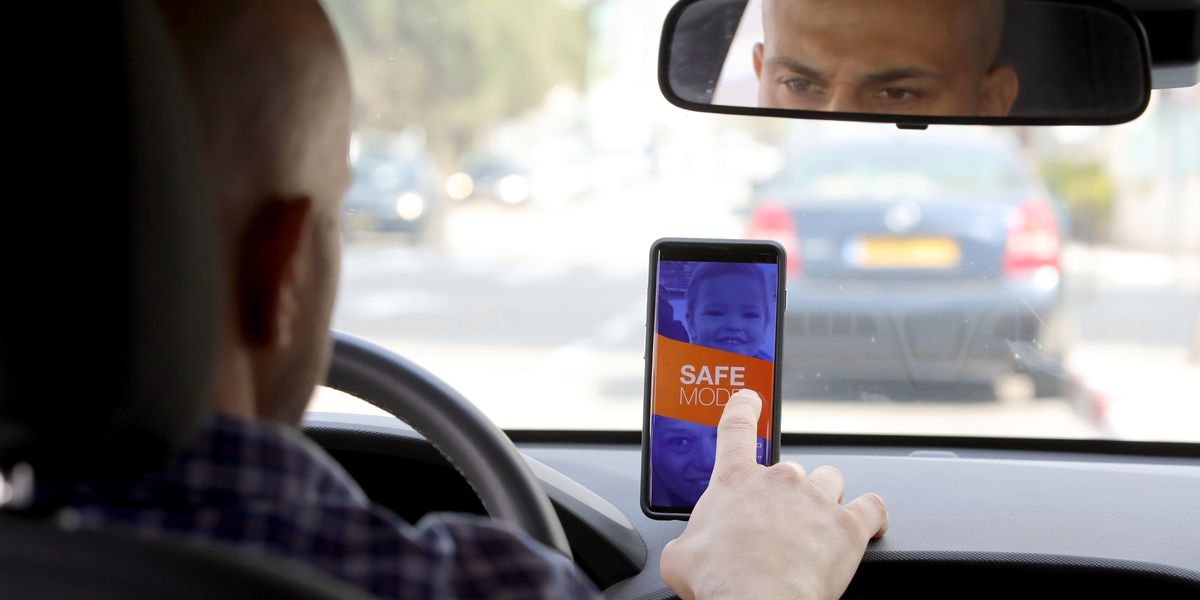
SaverOne’s system uses a passive sensor network to scan the vehicle cabin for phones, identify the driver’s device, and place it into “safe mode”—automatically blocking risky apps while allowing essential functions like navigation and pre-approved voice calls. Crucially, the system works even if the driver tries to cheat by disabling Bluetooth or bringing a second phone.
Designed to Be Driver-proof
The system consists of four small hidden sensors and a central receiver—about the size of an iPhone—installed inside the vehicle. It can pinpoint mobile devices within centimeters and distinguishes between driver and passenger phones. If the driver’s phone is active and doesn’t connect to SaverOne’s app, a buzzer sounds until the issue is resolved.
“What sets us apart is our prevention-first approach,” says Gilboa. “Most systems focus on what went wrong after the fact. We stop the distraction before it happens.”
Gilboa said the system’s design respects driver usability, preserving tools like turn-by-turn navigation and voice calls to approved contacts. “We want drivers to be reachable—but not distracted,” he adds.
Global Expansion, Measurable Impact
Since launching its second-generation product in 2022, SaverOne has rapidly expanded. After early pilot deployments with Israeli fleet operators such as Bynet Data Communications, Israel Electric Corporation, and ice cream purveyor Froneri, the company gained traction, securing deals with a broader array of Israeli companies. By mid-2023, Cemex Israel, the global cement giant’s local subsidiary, had agreed to deploy the driver distraction prevention system on its 380-vehicle fleet. In January 2024, following a successful trial with 17 trucks, Strauss Group, one of Israel’s largest food and beverage companies, decided to install the SaverOne system on its fleet of 80 food delivery trucks. Though smaller than the Cemex Israel contract, that agreement proved significant because Strauss accumulated data demonstrating a statistically significant reduction in accident rates among the equipped vehicles. That news has helped SaverOne in its bid to go global. CEMEX has since outfitted trucks in fleets across Europe. In the U.S., SaverOne is now being adopted by FedEx contractors in North Carolina and Philadelphia, says Gilboa.
Some fleet operators report as much as a 60 percent reduction in accident rates post-installation. While those figures are difficult to verify independently, a more concrete metric is phone interaction. Fleet managers have observed a dramatic drop—from drivers checking their phones ten times per hour to near-zero.
“The system educates through behavior,” says Gilboa. “It’s not about punishment—it’s about making the right choice automatic.”
But Reagan cautions that long-term behavioral change remains unproven, comparing it to early intelligent speed assistance trials in Europe using systems that detected vehicles’ locations, used digital maps to keep track of local speed limits, and reduced engine power to prevent the vehicles from exceeding the legal limit “When the limiter was on,” Reagan says, “people obeyed the posted speed limits. When it was turned off, they sped again. Whether tech like this [driver distraction prevention system] creates lasting change—well, we just don’t know yet.”
Could Regulation Be the Tipping Point?
Despite promising results, broader adoption—particularly in the consumer market—may hinge on regulation. IIHS’s Reagan notes that although distracted driving officially accounts for about 10 percent of crash fatalities, or roughly 3,500 deaths per year, the real figure is likely far higher. Despite the undercount,the urgency is still hard to ignore. As Reagan put it, “Phones let you mentally escape the car, even when you’re barreling down the highway at 115 kilometers per hour [about 70 mph]. That’s the real danger.”
He adds that government regulation requiring carmakers to install systems like SaverOne’s could be a game changer. “The tech exists,” Reagan said. “What we need is the political will to mandate it.”
SaverOne is still focused on fleet customers, but the company is in discussions with insurers exploring offering discounts to young or high-risk drivers who use distraction-prevention systems, Gilboa says.
“Mobile use while driving is an addiction,” he says. “We needed a system that prevents distraction without waiting for the driver to choose safety. That’s what we built.”
From Your Site Articles
Related Articles Around the Web
