


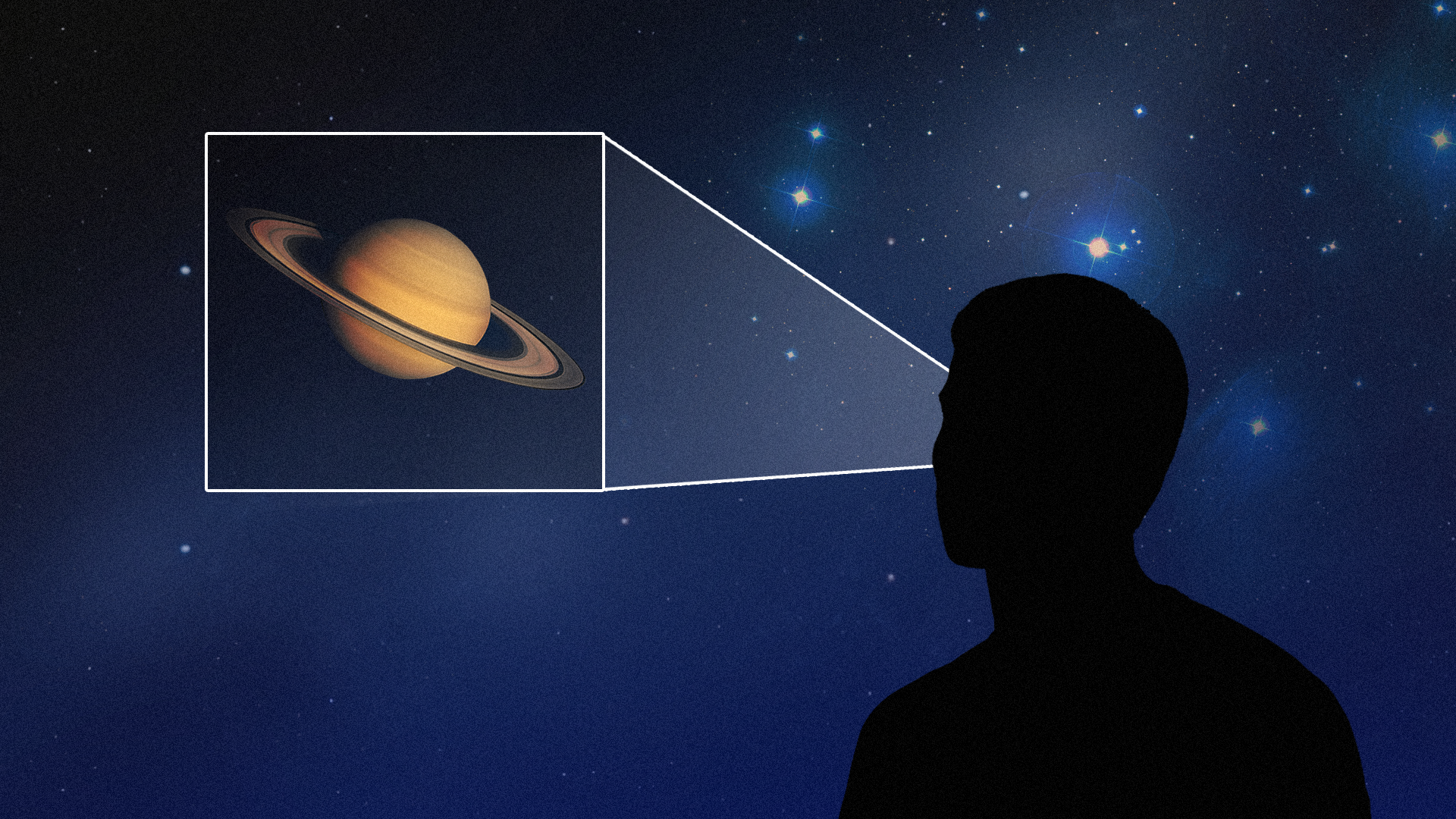
Though you won’t get the same views with your eyes as you do with instruments like Hubble, JWST, or even a backyard telescope, there are still plenty of cool things to look at in the night sky with just your eyes. Here are some of my favorites.
5
The Planets
Most of the planets in our solar system can actually be viewed with the unaided eye (except Neptune) though you usually need to know where you’re looking to find them.
These 5 Neptune Facts Blew My Mind
There is more to the enigmatic ice giant than meets the eye.
Venus
To the unaided eye, I think Venus is the most impressive. Only visible at sunrise and sunset, Venus is exceptionally bright and glows a yellowish color. It is also extremely easy to spot, since it is the third-brightest thing in the sky, behind only the Moon and the Sun. If you see something bright and star-like in the western sky in the evening, or in the eastern sky in the morning, you’re almost definitely looking at Venus.
Nick Lewis/How-To Geek
Jupiter
The other planets are harder to pick out, but they’re still rewarding. Jupiter, much like Venus, is quite bright. In fact, Jupiter is the fourth-brightest object in the sky and is a distinct yellow color. Jupiter can be visible at any hour depending on the orbital positions of Earth and Jupiter, so you can’t rely on the time of day to clue you in, but if you see something bright that isn’t Venus, you’re probably looking at Jupiter.
Nick Lewis/How-To Geek
Because Jupiter is so bright, if you catch it on a night with a new Moon and no light pollution, it can even cast shadows.
It is also theoretically possible to see a few of the moons of Jupiter without binoculars or a telescope, though you’ll need impeccable vision and an incredibly steady hand. Jupiter is so bright that it drowns out the comparatively dim moons.
If you want to try to see them, find something very thin and hold it out so that it just covers Jupiter. If your eyes are sharp enough, you may be able to see the moons on either side of the planet. A friend swears he managed this on a camping trip, though I’ve never been able to see them myself.
Mars
The most distinctive feature about Mars is the color: it is red. If you’re just scanning the sky, there is a good chance that you’d pick out Mars solely because of the color. It isn’t especially bright, though. On rare occasions, Mars experiences violent dust storms that encompass the entire planet.
NASA/JPL-Caltech/MSSS
When that happens, you can’t resolve surface details even with a telescope, but the planet does appear marginally brighter in the night sky.
5 Wild Facts You Probably Don’t Know About Mars
Mars has many strings to its bow.
Both Saturn and Uranus are also visible, but there isn’t all that much to see. Saturn looks like a yellowish, medium-brightness star—you can’t see the rings.
Uranus is even more difficult to pick out. Unless you have ideal viewing conditions, sharp vision, and know precisely where to look, you won’t be able to spot it.
4
Open Clusters
If you’re looking to see something more distant than a planet, open clusters are a great place to start. Composed of anywhere from a hundred to many thousands of stars, open clusters aren’t as tightly bound as other types of star clusters, like young massive clusters or globular clusters.
The Pleaides Cluster, otherwise known as The Seven Sisters, is the most famous open cluster. Located some 440 light years from Earth, the Pleaides cluster actually contains more than 3000 stars, though most of them aren’t visible to the naked eye.
The Pleaides is bright enough that you can look directly at it in moderate viewing conditions, though looking slightly to the side will get you a better view.
Nick Lewis/How-To Geek
To locate the Pleaides in the sky, first find Orion’s Belt (the famous three stars in a row), and roughly follow the line they make past his bow. From there, it’ll be hard to miss the Pleaides. It is easier to spot in the Winter months, when Pleaides will be visible throughout the entire night. However, you can spot it in the Eastern sky in the late summer months if you get up before sunrise.
Besides the Pleaides, the Beehive cluster, Caldwell 14, and Collinder 50 are all open clusters visible to the naked eye. If you’re trying to spot them, pay attention to your peripheral vision—it is better for spotting dim objects.
These Are My Top Tips for Seeing More in the Night Sky
The best stargazing only requires a little preparation.
3
Galaxies Near and Far
Besides our own galaxy, the Milky Way, the brightest galaxy in the night sky is the Andromeda galaxy, some 2.5 million light years away.
In good conditions, you’ll be able to readily pick out the galactic center, since it appears like a coin-sized hazy smudge.
Look just below Casseopeia (which looks like a big W) to see it. I’ve always found it helpful to think that part of the W forms an arrow that points towards Andromeda.
Nick Lewis/How-To Geek
If you’re in the Southern Hemisphere (or just above the equator in the Northern Hemisphere), you can also see the Large and Small Magellanic Clouds, two smaller galaxies in our local cluster.
Like the Andromeda Galaxy, they’re both seen as faint smudges in the sky, though most any camera can bring out some of the detail if you take a long-exposure shot.
ESO/S. Brunier
There are also a few others, but they’re challenging even for people that know exactly where they are, what they’re looking for, and have ideal skies.
2
Seasonal Meteor Showers
Meteor showers are a ton of fun, and luckily, there are several each year.
The best are probably the Perseids and the Geminids. The Perseids are most active in early to mid-August, and the Geminids peak in the first two weeks of December.
Because many meteors are fairly dim, your view of them tends to be subject to the whims of nature. Fog and clouds will block them completely, and even high humidity can cause a haze that will obscure dimmer meteors. The Moon can also obscure your viewing.
Know the Differences Between Meteors, Meteoroids, Meteorites, Comets, and Asteroids
Become a walking astronomy encyclopedia!
1
Rare or Unpredictable Comets
Comets are large chunks of rock that come hurtling in from the outer solar system, losing ice and dust as they get closer and closer to the Sun.
Sometimes, when we’re very lucky, the lost material is brilliantly illuminated by light from the Sun, forming a tail bright enough to be seen from Earth.
Some comets appear on a predictable cycle, like Halley’s comet, but most are pretty much random, and they’re difficult to predict more than a few months in advance. Even if scientists see one coming, it often isn’t possible to know for sure just how bright it will get.
However, when they do show up, they’re pretty spectacular.
Nick Lewis/How-To Geek
Modern phones are also pretty fantastic if you want to take pictures of open clusters or galaxies. All you need to do is activate astrophotography mode, set your phone on something sturdy, and tap the button.
It is a great way to spot other interesting objects in the night sky you might otherwise miss.
