


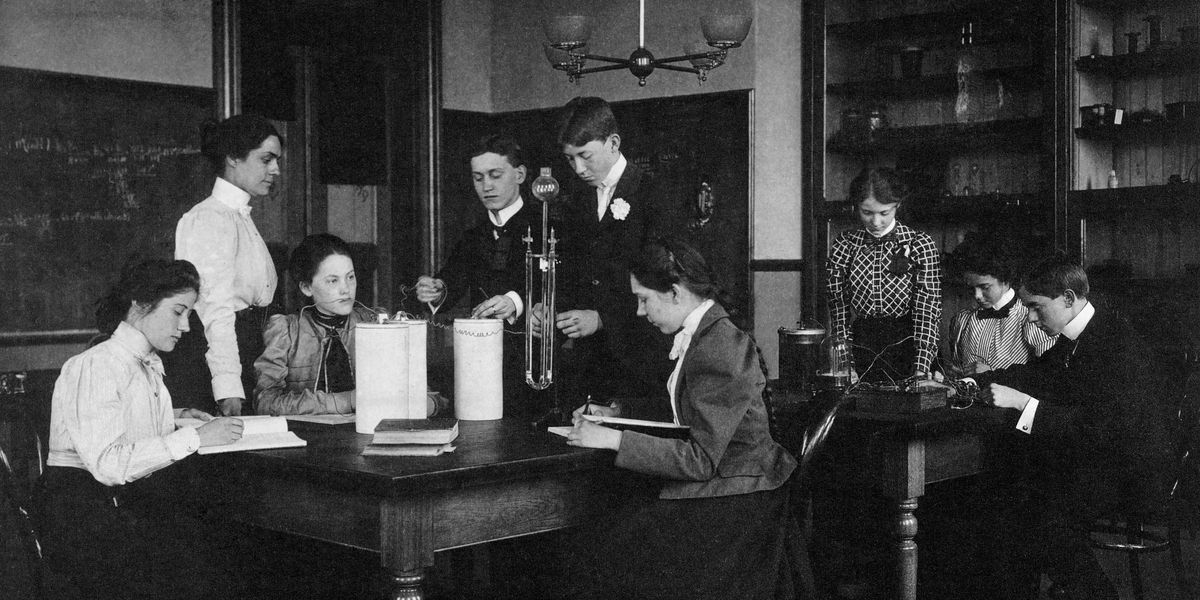
Since last September, I’ve been spending seven hours a day, five days a week happily researching the history of women in electrical engineering. So far I’ve uncovered the names of more than 200 women who contributed to electrical engineering, the first step in an eventual book project. No disrespect to Ada Lovelace, Grace Hopper, or Katherine Johnson, but there are many other women in engineering you should know about.
I’m doing my research at the Linda Hall Library of Science, Engineering, and Technology, in Kansas City, Mo., and I’m currently working through the unpublished papers of the American Institute of Electrical Engineers (a predecessor of today’s IEEE). These papers consist of conference presentations and keynote addresses that weren’t included in the society’s journals. They take up about 14 shelves in the closed stacks at the Linda Hall. Most of the content is unavailable on the Internet or anywhere else. No amount of Googling or prompting ChatGPT will reveal this history. The only way to discover it is to go to the library in person and leaf through the papers. This is what history research looks like. It is time intensive and can’t be easily replaced by AI (at least not yet).
Up until 2 April, my research was funded through a fellowship with the National Endowment for the Humanities. My fellowship was supposed to run through mid-June, but the grant was terminated early. Maybe you don’t care about my research, but I’m not alone. Almost all NEH grants were similarly cut, as were thousands of research grants from the National Science Foundation, the National Institutes of Health, the Institute of Museum and Library Services, and the National Endowment for the Arts. Drastic research cuts have also been made or are expected at the Departments of Defense, Energy, Commerce, and Education. I could keep going.
This is what history research looks like.
There’s been plenty of outrage all around, but as an engineer turned historian who now studies engineers of the past, I have a particular plea: Engineers and computer scientists, please defend humanities research just as loudly as you might defend research in STEM fields. Why? Because if you take a moment to reflect on your training, conduct, and professional identity, you may realize that you owe much of this to the humanities.
Historians can show how the past has shaped your profession; philosophers can help you think through the social implications of your technical choices; artists can inspire you to design beautiful products; literature can offer ideas on how to communicate. And, as I have discovered while combing through those unpublished papers, it turns out that the bygone engineers of the 20th century recognized this strong bond to the humanities.
Engineering’s historical ties to the humanities
Granted, the humanities have a few thousand years on engineering when it comes to formal study. Plato and Aristotle were mainly into philosophy, even when they were chatting about science-y stuff. Formal technical education in the United States didn’t begin until the founding of the U.S. Military Academy, in West Point, N.Y., in 1802. Two decades later came what is now Rensselaer Polytechnic Institute. Dedicated to “the application of science to the common purposes of life,” Rensselaer was the first school in the English-speaking world established to teach engineering—in this case, civil engineering.
Electrical engineering, my undergraduate field of study, didn’t really get going as an academic discipline until the late 19th century. Even then, most electrical training took the form of technical apprenticeships.
One consistent trend throughout the 20th century is the high level of anxiety over what it means to be an engineer.
In addition to looking at the unpublished papers, I’ve been paging through the entire run of journals from the AIEE, the Institute of Radio Engineers, and the IEEE. And so I have a good sense of the evolution of the profession. One consistent, yet surprising, trend throughout the 20th century is the high level of anxiety over what it means to be an engineer. Who exactly are we?
Early on, electrical engineers looked to the medical and legal fields to see how to organize, form professional societies, and create codes of ethics. They debated the difference between training for a technician versus an engineer. They worried about being too high-minded, but also being seen as getting their hands dirty in the machine shop. During the Great Depression and other times of economic downturn, there were lengthy discussions on organizing into unions.
To cement their status as legitimate professionals, engineers decided to make the case that they, the engineers, are the keystone of civilization. A bold claim, and I don’t necessarily disagree, but what’s interesting is that they linked engineering firmly to the humanities. To be an engineer, they argued, meant to accept responsibility for the full weight of human values that underlie every engineering problem. And to be a responsible member of society, an engineer needed formal training in the humanities, so that he (and it was always he) could discover himself, identify his place within the community, and act accordingly.
Thomas L. Martin, Jr., dean of engineering at the University of Arizona, endorsed this engineering curriculum, in which the humanities accounted for 24 of 89 credits. AIEE
What an engineering education should be
Here’s what that meant in practice. In 1909, none other than Charles Proteus Steinmetz advocated for including the classics in engineering education. An education too focused on empirical science and engineering was “liable to make the man one sided.” Indeed, he contended, “this neglect of the classics is one of the most serious mistakes of modern education.”
In the 1930s, William Wickenden, president of the Case School of Applied Science at Case Western Reserve University, wrote an influential report on engineering education, in which he argued that at least one-fifth of an engineering curriculum should be devoted to the study of the humanities and social sciences.
After World War II and the deployment of the atomic bomb, the start of the cold war, and the U.S. entry into the Vietnam War, the study of the humanities within engineering seemed even more pressing.
In 1961, C.R. Vail, a professor at Duke University, railed against “culturally semiliterate engineering graduates who…could be immediately useful in routine engineering activity, but who were incapable of creatively applying fundamental physical concepts to the solution of problems imposed by emerging new technologies.” In his opinion, the inclusion of a full year of humanities coursework would stimulate the engineer’s aesthetic, ethical, intellectual, and spiritual growth. Thus prepared, future engineers would be able “to recognize the sociological consequences of their technological achievements and to feel a genuine concern toward the great dilemmas which confront mankind.”
In a similar vein, Thomas L. Martin, Jr., dean of engineering at the University of Arizona, proposed an engineering curriculum in which the humanities and social sciences accounted for 24 of the 89 credits.
Many engineers of that era thought it was their duty to stand up for their beliefs.
Engineers in industry also had opinions on the humanities. James Young, an engineer with General Electric, argued that engineers need “an awareness of the social forces, the humanities, and their relationship to his professional field, if he is to ascertain areas of potential impact or conflict.” He urged engineers to participate in society, whether in the affairs of the neighborhood or the nation. “As an educated man,” the engineer “has more than casual or average responsibility to protect this nation’s heritage of integrity and morality,” Young believed.
Indeed, many engineers of that era thought it was their duty to stand up for their beliefs. “Can the engineering student ignore the existence of moral issue?” asked the UCLA professors D. Rosenthal, A. B. Rosenstein, and M. Tribus in a 1962 paper. “We must answer, ‘he cannot’; at least not if we live in a democratic society.”
Of course, here in the United States, we still live in a democratic society, one that constitutionally protects the freedoms of speech, assembly, and petitioning the government for a redress of grievances. And yet, anecdotally, I’ve observed that engineers today are more reticent than others to engage in public discourse or protest.
Will that change? Since the Eisenhower era, U.S. universities have relied on the federal funding of research, but in the past few weeks and months, that relationship has been upended. I wonder if today’s engineers will take a cue from their predecessors and decide to take a stand. Or perhaps industry will choose to reinvest in fundamental and long term R&D the way they used to in the 20th century. Or maybe private foundations and billionaire philanthropists will step up.
Nobody can say what will happen next, but I’d like to think this will be one of those times when the past is prologue. And so I’ll repeat my plea to my engineering colleagues: Please don’t turn your back on the humanities. Embrace the moral center that your professional forebears believed all engineers should foster throughout their careers. Stand up for both engineering and the humanities. They are not separate and separable enterprises. They are beautifully entangled and dependent on each other. Both are needed for civilization to flourish. Both are needed for a better tomorrow.
From Your Site Articles
Related Articles Around the Web
