


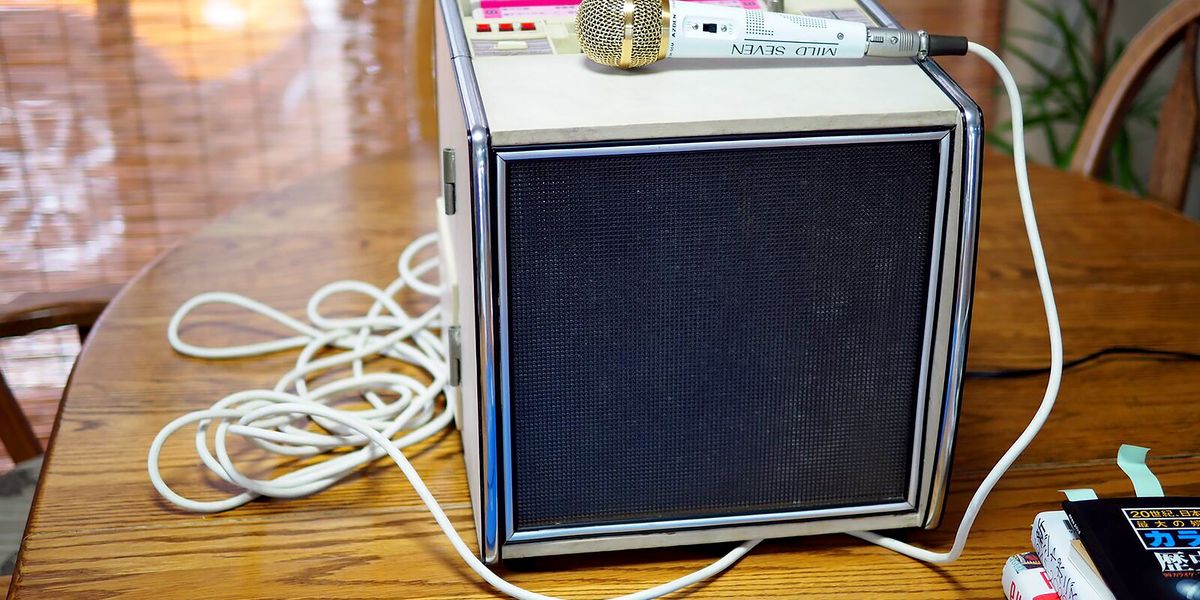
Belting your favorite song over prerecorded music into a microphone in front of friends and strangers at karaoke is a popular way for people around the world to destress after work or celebrate a friend’s birthday. The idea for the karaoke machine didn’t come from a singer or a large entertainment company but from Nichiden Kogyo, a small electronics assembly company in Tokyo.
The company’s founder, Shigeichi Negishi, was singing to himself at work one day in 1967 when an employee jokingly told him he was out of tune. Figuring that singing along to music would help him stay on pitch, Negishi began thinking about how to make that possible. He had the idea to turn one of the 8-track tape decks his company manufactured into what is now known as the karaoke machine.
Later that year, he built what would become the first such machine, which he called the Music Box. The 30-centimeter cube housed an 8-track player for four tapes of instrumental recordings and included a microphone to sing into.
He sold his machine in 1967 to a Japanese trading company, which then sold it to restaurants, bars, and hotel banquet halls, where they used it as entertainment.
The machine was coined karaoke in the 1970s to describe the act of singing along to prerecorded music. The term is a combination of two Japanese words: kara, meaning empty, and okesutora, meaning orchestra.
In a few years, dedicated establishments known as karaoke bars began to open across Japan. Today the country has more than 8,000, according to Statista.
The karaoke machine has been commemorated as an IEEE Milestone. The dedication ceremony was held in June in the area that houses karaoke booths connected to the Shinagawa Prince Hotel in Tokyo. Negishi’s family attended the event along with IEEE leaders. Negishi died last year at the age of 100.
He was grateful that people enjoy karaoke around the world, his son, Akihiro Negishia, said at the ceremony, “though he didn’t imagine it to spread globally when he created it.”
Accidentally inventing one of the world’s favorite pastimes
Shigeichi Negishi grew up in Tokyo, where his mother ran a tobacco store and his father oversaw regional elections as a government official. After earning a bachelor’s degree in economics from Hosei University in Tokyo, he was drafted into the Imperial Japanese Army during World War II. He became a prisoner of war and spent two years in Singapore before being released in 1947.
He returned to Tokyo and sold cameras for electrical parts manufacturer Olympus Corp. In 1956 he started Nichiden Kogyo, which manufactured and assembled portable radios for the home and car, according to the Engineering and Technology History Wiki entry about the karaoke machine.
Negishi would start each morning singing along to the “Pop Songs Without Lyrics” radio show, according to a Forbes article. He typically didn’t sing in the office, but one fateful day he did. Negishi was inspired to engineer one of the 8-track tape decks his company manufactured into what is now known as the karaoke machine
An 8-track tape deck can play and record audio using magnetic tape cartridges. Nichiden Kogyo’s Music Box was a 30-centimeter cube with slots to insert four 8-track tapes on the top panel, with control buttons to play, stop, or skip to the next song.
Inside each 13-centimeter-long rectangular 8-track cartridge is a loop of almost 1 cm-wide magnetic tape that is coiled around a circular reel, as explained in an EverPresent blog post on the technology. A small motor inside each cartridge pulls the tape across an audio head inside the player, which reads the magnetic patterns and translates them into sound. Each tape had a metal sensing strip that notified a solenoid coil located in the player when a song had ended or if a person pressed the button to switch to the next song, according to an Autodesk Instribules blog post. The coil created a magnetic field when electricity passed through it—which rotated the spindle on which the audio head was mounted to move to the next track on the tape. Each tape could hold about eight songs.
Negishi added a microphone amplifier to the player’s top panel, as well as a mixing circuit. The user could adjust the volume of the music and the microphone.
He also recorded 20 of his favorite songs onto the tapes and printed out the lyrics on cardstock. He tested the machine by singing a popular ballad, “Mujo no Yume” (“The Heartless Dream”).
“It works! That’s all I was thinking,” Negishi told reporter Matt Alt years later, when asked what his thoughts were the first time he tested the Music Box. Alt wrote Pure Invention: How Japan Made the Modern World.
In 1969 engineers at Tokyo-based trading company Kokusai Shohin added a coin acceptor to the machine, renaming the Music Box the Sparko Box.Dr. Tomohiro Hase
The fees to file a patent were too expensive, according to the ETHW entry, so in 1967 Negishi sold the rights to the machine to Mitsuyoshi Hamasu, a salesman at Kokusai Shohin. The Tokyo-based trading company began selling and leasing the machines by the end of the year.
In 1969 engineers at Kokusai Shohin added a coin acceptor to the machine. The company renamed the Music Box the Sparko Box. In six years, about 8,000 units were sold, Hamasu said in an interview about the rise of karaoke.
Karaoke became so popular that in the 1980s, venues and bars specializing in soundproofed rooms known as karaoke boxes emerged. Groups could rent the rooms by the hour.
Negishi’s family owns the first Music Box he made. It still works.
The Milestone plaque recognizing the karaoke machine is on display in front of the former headquarters of Nichiden Kogyo, which Negishi turned into a tobacco shop after he retired. The shop is now owned by his daughter. The plaque reads:
“The first karaoke machine was created in 1967 by mixing live vocals with prerecorded accompaniment for public entertainment, leading to its worldwide popularity. Created by Shigeichi Negishi of Nichiden Kogyo, and originally called Music Box (later Sparko Box), it included a mixer, microphone, and 8-track tape player, with a coin payment system to charge the singer. An early operational machine has been displayed at the original company site in Tokyo.”
Administered by the IEEE History Center and supported by donors, the Milestone program recognizes outstanding technical developments around the world. The IEEE Tokyo Section sponsored the nomination.
From Your Site Articles
Related Articles Around the Web
