


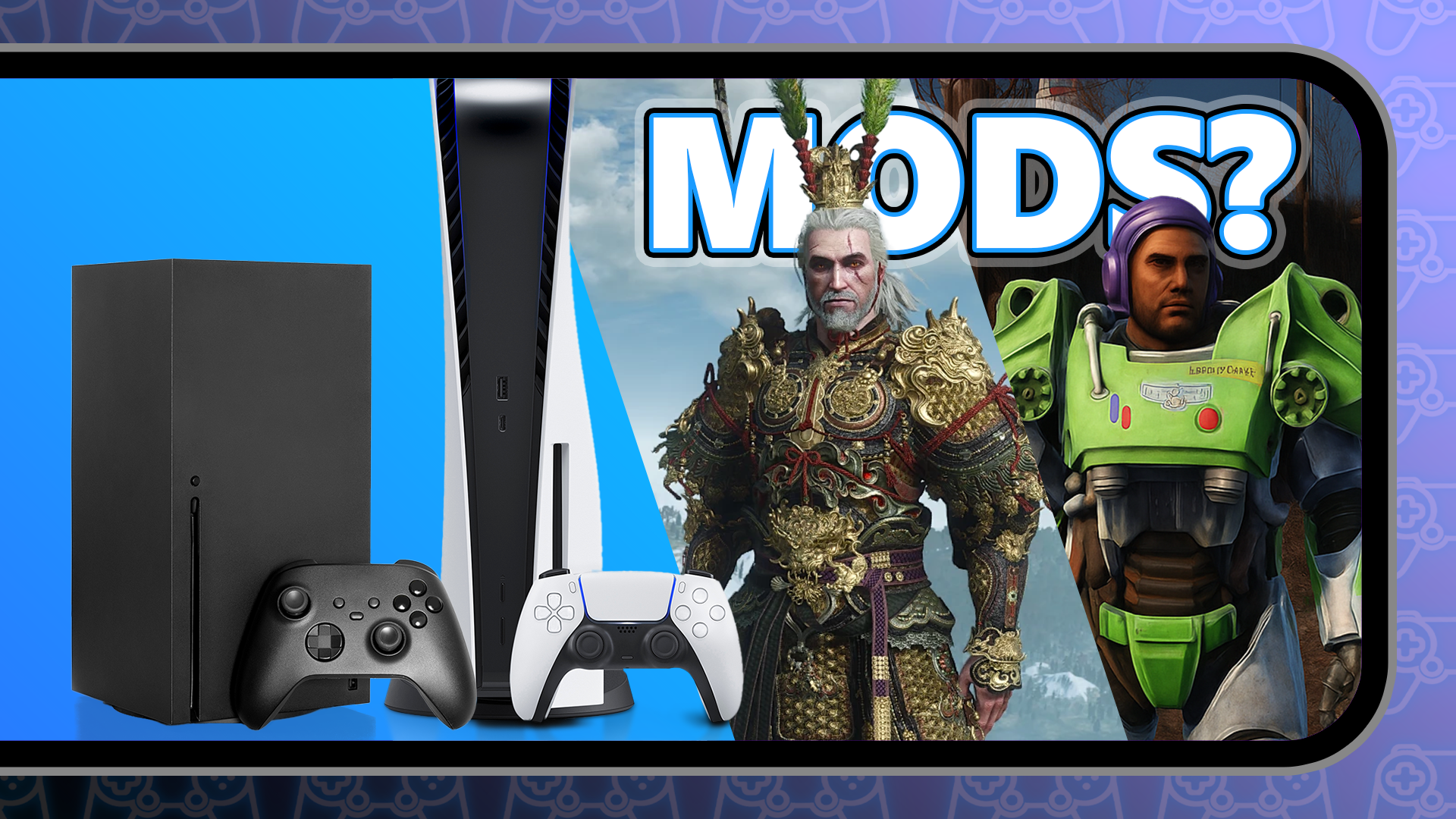
You might not have noticed, but mods are slowly becoming more common in console games. They’re still not available for most console releases, but the recent wave of new console games with mod support is a promising sign for future releases.
Even older titles are retroactively receiving their own mod support, with The Witcher 3 soon to join the list of mod-friendly console games in an upcoming update. Despite all the progress made in recent years, console modding still has a long way to go before it can become a new standard for console gaming.
Modding Isn’t Easy on Consoles
Trainwiz and friends
On PCs, the tools and resources needed to mod a game are always readily available. You can easily access the files for most games on PC, allowing you to modify their code, individual assets, and—in some cases—make changes to the game engine to handle features it wasn’t originally built for. Obviously, some of these mods are more complicated than others, but the point is that PC modding can encompass anything from simple asset swaps to massive gameplay overhauls.
Plenty of modern releases include official modding tools at launch or eventually add mod support through later updates. Even when that’s not the case, you can still rely on the PC modding community to crack open a game and discover how to mod it to their heart’s content.
Unfortunately, game consoles aren’t the same. Most consoles are considered closed platforms, meaning they only allow you to install and run software that has received official approval from the console manufacturer. This restriction primarily serves as a security measure, as it prevents console owners from downloading third-party programs that may run pirated games, alter the console’s performance, or possibly infect the system with malware. However, the nature of closed platforms also blocks you from accessing game files on consoles, making it impossible to directly mod games—at least not without jailbreaking your console.
Even for games with official mod support, you won’t find official modding tools on consoles. Instead, mods have to be developed on PC first, then ported onto consoles. Aside from the addition of multiple extra steps, there are a few other reasons why this process makes console modding even more difficult than on PC.
The hardware differences between consoles and PCs prevent modders from being able to test the functionality or optimization of a console mod until after it has been ported to its intended platform. Over the years, members of the modding communities for games like The Elder Scrolls V: Skyrim and Fallout 4 have uploaded guides explaining how to develop mods for their console versions, which has made the modding process slightly more accessible for inexperienced creators.
However, developing any mod for consoles can still be a challenge due to the buggy nature of official modding tools like Bethesda’s Creation Kit, as well as any of the other complications that can (and probably will) arise when creating mods.
Consoles Have More Modding Limitations than PCs
DC Studio/Shutterstock.com | Miguel Lagoa/Shutterstock.com
On top of hardware limitations, console games are also held back by the tight restrictions placed on officially supported mods. This is usually the case for mods or mod dependencies that allow for significant alterations to a game’s code.
For example, one of the most popular Skyrim modding tools, the Skyrim Script Extender (SKSE), hasn’t appeared on the game’s console versions for this reason. Although plenty of popular mods require the SKSE to function properly, its ability to modify the game’s code presents a potential security risk on consoles. Even if that wasn’t a concern, the PC version of the SKSE functions as a separate executable rather than a traditional mod, so it would have to be completely redesigned to run on consoles.
Every console game handles mods differently—at least, among the few that already support mods—and some are more restrictive than others. The console version of Skyrim may seem limited compared to most PC games, but it still boasts one of the most open-ended modding experiences on consoles. Some games don’t allow any gameplay mods on consoles, limiting their mod selection to just custom assets and other visual-only changes.
As an example, Cities: Skylines is infamously restrictive with its modding selection on consoles, lacking all the PC mods that improved the game with much-needed fixes and entirely new features.
Console games have to deal with the challenge of distributing mods through official platforms. Unlike PC players, console owners can’t download their mods from any regular mod site; their mods need to be available to download from the console itself. As with everything else involved in console game modding, this is more complicated than it sounds. There’s a host of challenges that come with hosting mods on consoles, and even the largest studios haven’t found a solution to all of these problems.
Since console games can’t rely on traditional modding sites, some developers create their own platforms for sharing and downloading mods on consoles. One of the most popular console modding platforms is Bethesda.net, which supports the mods across numerous Bethesda games, including Skyrim, Fallout 4, Starfield, and the DOOM + DOOM II collection.
GIANTS Software’s Farming Simulator series also features its own modding platform on consoles, allowing players to share custom maps, farming equipment, and substantial gameplay mods.
Bethesda Softworks
These platforms are still limited by their console hardware, which prevents many of the best PC mods from ever appearing in their libraries. You won’t see any game-changing combat overhauls for Skyrim, and even the DOOM + DOOM II collection only supports WADs—meaning we won’t be seeing Brutal Doom or any other must-play mods on the Xbox.
Despite these limits, the ability for users to freely submit mods has given these games an extensive selection of amazing mods to play through. Whether you want to become the emperor of Skyrim or gun down demons in DOOM as Homer Simpson, there’s still enough variety to make console modding worth your time.
Unfortunately, not every developer has the resources to create its own modding platform. For starters, allowing players to share and download content involves maintaining online servers, requiring time and resources to keep the mod platform running. More importantly, these platforms also require heavy moderation, both for security reasons and to block uploads of any content that falls outside of a game’s age rating.
Because console modding platforms have to be accessible from within their respective games to function, their content has to adhere to the rating assigned by the ESRB—or an equivalent ratings board. If a developer allows anything and everything to be uploaded to their official mod platforms, they run the risk of repeating Grand Theft Auto‘s “hot coffee” controversy.
Even AAA studios struggle to keep up with the challenges of maintaining their own modding platforms. If you’ve ever used the console mod support in any Bethesda game, you’ve probably seen these issues for yourself. Across every game that uses Bethesda.net, the mod browser is prone to constant freezes, sudden crashes, and extremely lax quality control that allows multiple users to reupload the same exact mods. If a massive studio like Bethesda has a hard time maintaining its own mod support, it’s no surprise that most games from smaller studios haven’t bothered to add similar features to their own console ports.
Some games may officially add a small handful of popular community mods to their console versions through free DLC—as was the case for Teardown and Cities: Skylines—instead of allowing players to freely upload their own mods. While this makes sense for developers without the means to support their own console modding platforms, it doesn’t count as true mod support.
Thankfully, these aren’t the only means of bringing mod support to consoles, and console modding has grown more common in recent years thanks to cross-platform modding tools like mod.io. Unlike similar platforms such as Nexus Mods and Steam Workshop, mod.io supports console integration and has already been included in console ports for games such as Baldur’s Gate 3, Totally Accurate Battle Simulator, and the S.T.A.L.K.E.R. series.
Mod.io functions much like the custom modding platforms featured in Bethesda and GIANTS Software’s games, but it removes much of the strain of server-hosting and content moderation from the developers. With services like mod.io simplifying the console modding process, we’re likely to see even more console games adding mod support in the future…or that’s what I would say if it wasn’t for one other obstacle that continues to hinder the console modding community.
Console Games Need Permission to Add Mod Support
Bethesda
Regardless of whether a developer is willing and able to include mod support in its games, it’s ultimately up to the console manufacturer to decide whether a game is allowed to bring mods onto consoles. Without permission from Microsoft, Sony, or Nintendo, developers can’t bring any form of mod support to their console releases. Even if the developer receives a manufacturer’s approval, this approval may come with a list of console-specific restrictions.
Each console manufacturer has its own policies on mods, some of which are more lenient than others. On Xbox consoles, most mods are fair game, as long as they don’t include explicit adult content or script modifications. In contrast, Sony is infamously restrictive with the mod support on PlayStation games, banning any mods that feature licensed content or ripped assets. Back in 2016, these strict guidelines almost led Bethesda to cancel its mod support for the PS4 version of Fallout 4, though the feature was eventually added after Bethesda agreed to enforce tighter limitations on the console’s modding community.
Although console manufacturers are starting to warm up to console modding—with even Nintendo allowing mods for certain Switch games—their restrictive guidelines and uncertain approval process are still the largest barriers to bringing mod support to more console games. For some developers, console modding is more trouble than it’s worth.
No matter how much effort is put into providing extensive modding tools, the restrictions enforced by manufacturers and the hardware itself prevent console games from ever matching the modding potential of PC gaming. Combined with the fact that developers aren’t guaranteed to get the manufacturer’s approval, it comes as no surprise that most console devs prefer to skip the hassle and ignore mods entirely.
More Console Games Need Mods
The current state of console modding is far from perfect, especially on PlayStation systems, but it’s better than nothing. Even basic mods can fix a game’s roughest issues, revitalize it with fresh content, or radically transform it with brand-new features. For many beloved games, mods are a crucial part of the experience, and it’s time for developers to let console players join the fun.
