


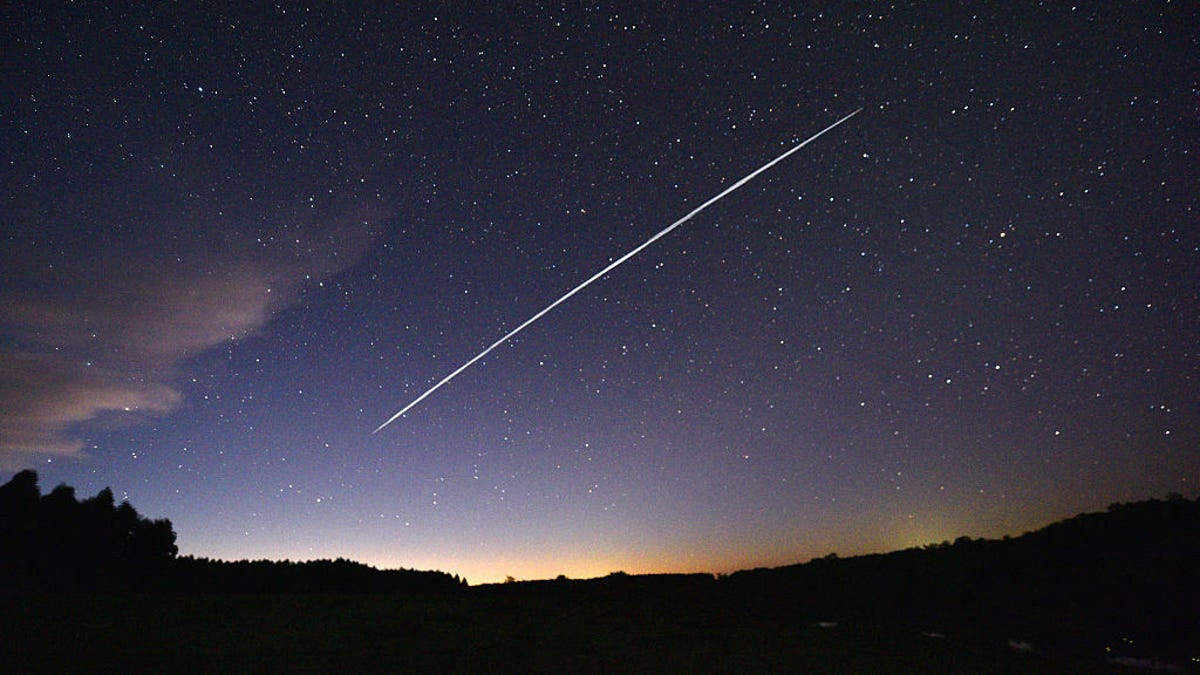
According to a filing with the Federal Communications Commission on Tuesday, 472 Starlink satellites burned up in the atmosphere between December 2024 and May 2025, as SpaceX deorbited around 6% of its active fleet.
Starlink satellites are built to last around five years. After that, they’re steered into the Earth’s atmosphere to burn up. SpaceX, the rocket company owned by Tesla and X CEO Elon Musk, launched the first Starlink satellites in 2019, which means we’re now seeing its first full-scale deorbiting. More than 1.4 million homes use Starlink’s internet service in the US, and in many rural areas, the technology has been an absolute gamechanger.
But scientists have raised concerns about the unintended consequences that come with such an unprecedented rise in the number of satellites in the sky. Of the roughly 10,000 active objects in low-Earth orbit — around 1,200 miles from the Earth’s surface or closer — more than 7,750 belong to Starlink, according to data collected by Jonathan McDowell, an astrophysicist who tracks satellite launches.
SpaceX submits voluntary reports to the FCC twice a year on the state of its satellite constellation. At the December check-in, only 73 satellites had been deorbited in the previous six-month period. That massive increase could have serious impacts here on Earth.
Scientists have increasingly found metals from spacecraft in the stratosphere, and on rare occasions, space debris has even made it to the ground. SpaceX revealed last summer (PDF) that a 5.5-pound piece of aluminum from a Starlink satellite was found on a farm in Saskatchewan, Canada.
“As usual, humanity is doing a new experiment with our environment. We’re doing something that nature hasn’t done before,” McDowell told CNET.
SpaceX insists the deorbiting process is safe, putting the risk of a human casualty (PDF) at “less than 1 in 100 million” for its current V2 satellites.
“SpaceX satellites exceed industry standards for demisability, with no calculable risk to life on the ground, coupled with targeted reentry of satellites over unpopulated regions of the globe,” says SpaceX’s filing.
Representatives for SpaceX did not immediately respond to a request for comment.
Climate scientists concerned about burning satellites
With Starlink’s first satellite launches only recently deorbiting in significant numbers, we’re still in uncharted territory when it comes to mapping the climate impacts.
SpaceX already has permission from the FCC to launch 12,000 satellites and has as many as 42,000 planned in the future, according to Space.com.
One study funded by NASA and published in Geophysical Research Letters in June last year found that a 550-pound satellite releases about 66 pounds of aluminum oxide nanoparticles when it burns up in the atmosphere. These nanoparticles have increased eightfold from 2016 to 2022, and the current Starlink satellites weigh 1,760 pounds each.
Separate samples taken by the National Oceanic and Atmospheric Administration found “aluminum and exotic metals” in 10% of particle debris in the stratosphere. They projected that figure could grow to 50% “based on the number of satellites being launched into low-Earth orbit.” But what effect these metals will have is still an open question.
“My impression from talking to the various groups that are doing this kind of research is that if you had to bet, you might bet that the research will come out saying that we’re still at least an order of magnitude below what would cause a big problem,” McDowell said.
It is concerning enough, however, that a group of scientists wrote an open letter to the FCC (PDF) in October last year asking it to pause new satellite launches due to “damaging gasses and metals in our atmosphere.”
There are currently over 12,000 active satellites in orbit, 7,751 of which belong to Starlink. But we’re likely just at the beginning of the satellite race — a 2020 article published in Nature predicted that 100,000 satellites in the sky by 2030 is “not just feasible but quite likely.”
“This is part of the bigger story of how space activity has increased to the point that we are having an impact that we haven’t had before on the environment,” McDowell said. “We’re at a stage where a lot of things that it used to be completely valid to just ignore and go, ‘Too small to worry about’ — now they’re big enough that we need to look at them.”
