


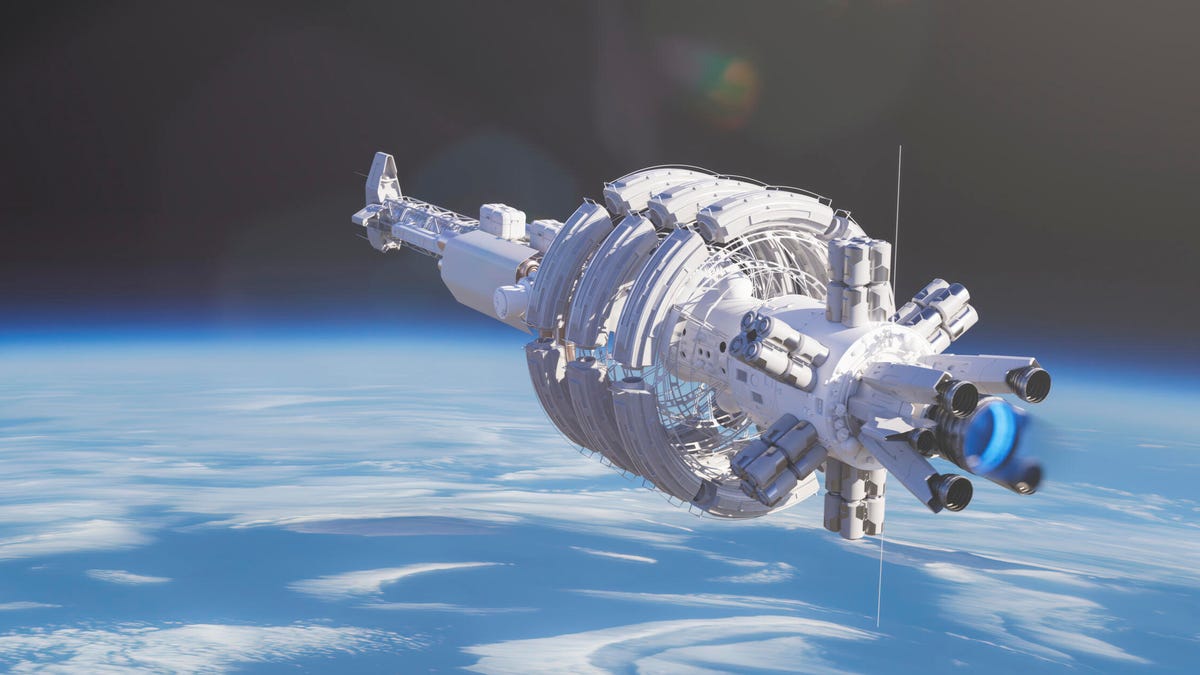
Ignatiev/Getty Images
Sci-fi authors and screenwriters have long envisioned AI companions helping humans as they explore the cosmos. Sometimes things go well (Commander Data was a friendly and reliable Starfleet officer), other times not so much (“I’m afraid I can’t do that, Dave”).
Now, AI-assisted spacefaring — like so many other concepts that, not so long ago, seemed utterly far-fetched — could soon become a practical reality.
Also: How VR is helping astronauts stay grounded in space: Life inside the ISS
In a paper posted to the preprint server site arXiv in May, three AI researchers showed how large language models (LLMs) could be deployed to help humans on the ground pilot a spacecraft. Researchers harnessed OpenAI’s GPT-3.5 and Meta’s LLaMA “to develop an intelligent agent capable of controlling a spacecraft in real time,” they wrote in the paper.
Successful space navigation — whether you’re remotely piloting a satellite or internally controlling a vessel — requires a vast amount of telemetry, or a collection of disparate data points coming from a multitude of sources, to determine and control for critical metrics like velocity and attitude.
The paper suggests LLMs could help humans accumulate this data, similar to how the algorithms behind self-driving cars continuously react to obstacles in the environment and adjust their course accordingly.
How AI could help drive spaceships
The authors’ use of LLMs means that their system is entirely operable through natural language prompts. A human pilot on the ground, for example, might instruct the system not to “apply rotation throttles” in the event that the vessel is determined to be properly positioned; if it isn’t, then an alternative prompt instructs the system to use the thrusters to make the required correction.
Also: How I used ChatGPT to quickly fix a critical plugin – without touching a line of code
“The LLM then processes the prompt and replies with an action that will be plugged in KSDPG to control the spacecraft,” the authors explained in their report.
Automation in spaceflight isn’t new: many routine procedures, like tracking the trajectories of potentially hazardous space debris and controlling deep space orbiters, have long been handed over to machines. But this paper marks what could become a new frontier for aeronautics and space travel: using the systems behind popular AI chatbots like ChatGPT, Gemini, and Claude as automated copilots, with whom humans can interact through relatively simple text prompts.
“To the best of our knowledge, this work pioneers the integration of LLM agents into space research,” the authors wrote.
Also: Your Netflix just got a free NASA upgrade – beaming spacewalks straight to your living room
The paper was submitted to the Kerbal Space Program Differential Game, a competition hosted by the Massachusetts Institute of Technology (MIT) that challenges engineers to test and propose novel methods for autonomous spacefaring. The competition’s entry programs are run on the Kerbal Space Program’s proprietary game engine and judged by their ability to perform various real-world tasks, like chasing down a stealth satellite.
The LLM-based solution won second place in the competition; the top prize was awarded to a system built upon algorithms that model the flight dynamics of actual spacecraft.
While all of the applications that it outlines remain hypothetical, the paper offers a glimpse of a perhaps not-so-distant future in which satellites and crewed space vessels are piloted by both humans and LLMs.
