


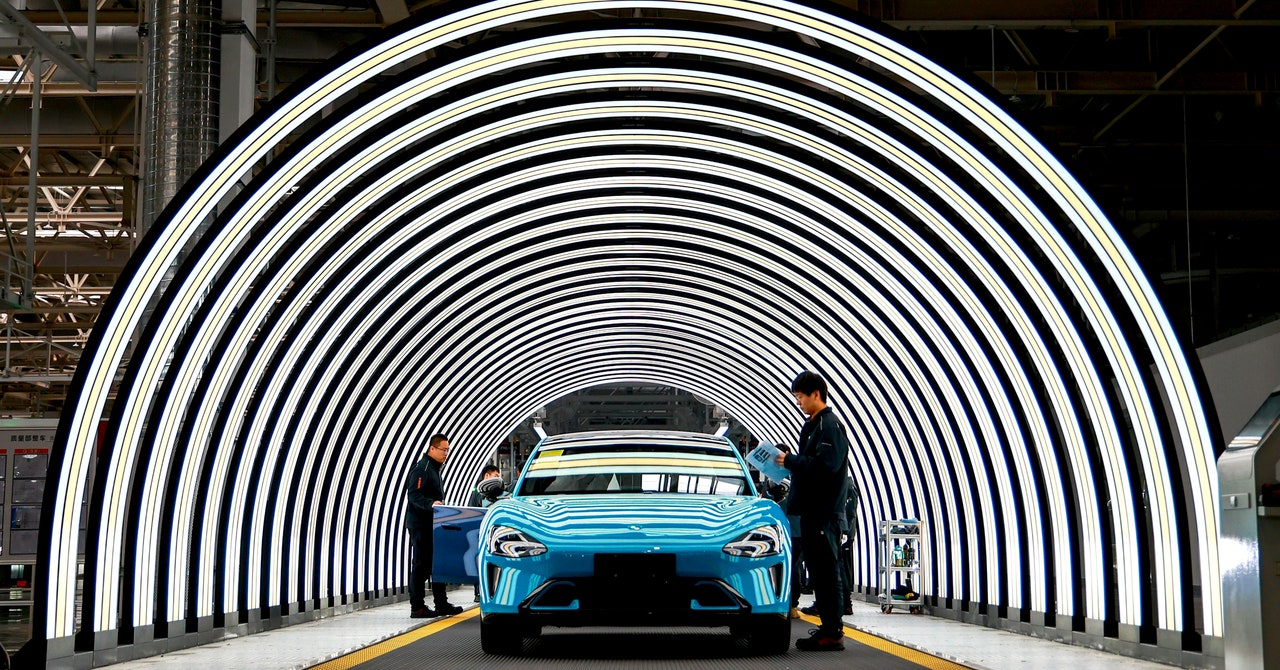
Xiaomi released its first EV model, the SU7, in early 2024. By the end of the year, foreign diplomats, investors, and guests from other Chinese companies had already started arriving at the company’s factory in Beijing to participate in one-off tours, but the company didn’t create a standardized experience for the public until the start of 2025. At first, Xiaomi offered just three tours with 20 participants each per month.
But the excursion proved incredibly popular, and Xiaomi quickly began scheduling significantly more slots. In July, the company said it will offer one tour every weekday and six tours most weekends, accommodating more than 1,100 visitors in total. When July registration opened, however, over 27,000 applications flooded in overnight, according to the Xiaomi app—so the chances of snagging a ticket remain slim.
Those lucky enough to secure a spot can expect to first be taken to an exhibit hall to learn about notable innovations in Xiaomi’s electric cars. The visitors then hop on a shuttle and go into three working production lines out of six total to observe the workers and robots in action.
Afterwards, they can test ride a model Xiaomi SU7 on a racecourse, where a trained racecar driver demonstrates how the car can accelerate from 0 to 60 mph in just a few seconds. “It felt awesome—takes off really fast, with an instant kick,” Zhao tells WIRED. Recently, Xiaomi also started selling affordable meals at the factory and souvenirs to complete the experience.
Another visitor notes that the shuttle will temporarily stop if it gets in the way of a robot, which is programmed to do its job on a strictly timed schedule and is thus less flexible than a human worker. Yuanyuan recalls that after the tour ended, her daughter remarked: “I need to study harder, otherwise I won’t be able to find a job in the future. It’ll be robots doing all the work.”
Xiaomi’s factory is a prime example of how Chinese companies are quickly evolving from labor-intensive manufacturing to highly automated manufacturing, thanks to new advancements in robotics and artificial intelligence. In recent years, the Chinese government has been heavily promoting the idea of “lights-out factories” that require no human labor, meaning the machines can toil away in the darkness without anyone needing to turn the lights on. Companies that have managed to achieve this high level of automation, from Foxconn to home appliance giants, have turned their factories into marketing opportunities, inviting humans to marvel at the technology rather than do work.
Nio, another leading EV maker in China, has been publicly showcasing one of its highly automated factories since late 2023. In 2024, over 130,000 people visited the factory, where certain production lines like the body shop have achieved 100 percent automation, according to a statement sent by the company. Zhang says when her latest tour group visited Nio’s factory in the city of Hefei last month, the participants were able to view three out of the four production lines. (The car painting process, however, was excluded from public visits.)
