


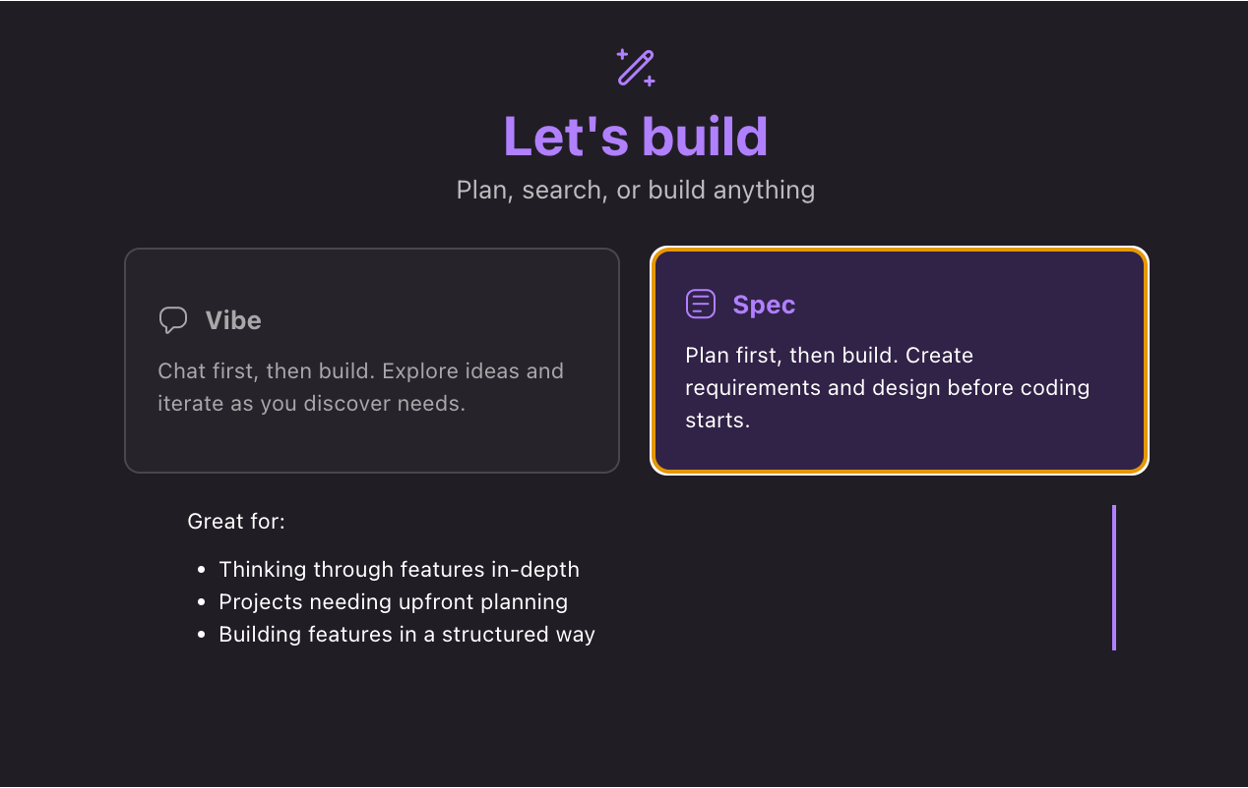
New Kiro projects can leverage vibe or spec-based coding.
AWS
Over the past 12 months we have seen more activity in developer tools than in the previous 15 years. This is largely due to generative AI and its ability to automate application development at all levels. The innovation has been rampant, with AI usage evolving from coding assistants led by GitHub Copilot to next-gen vibe coding tools like Cursor and Windsurf (all, coincidentally, built on top of Microsoft’s open source VSCode IDE).
Interestingly, AWS has not gained much momentum among developers for its contributions to the AI development movement. And that’s too bad, since AWS was the first company to adopt a multi-model strategy with its Bedrock API; it was one of the first to adopt MCP; and it even had agentic coding functionality before GitHub Copilot did, as I covered in May. Probably needless to say, the AWS team was frustrated by this; they recognized that maybe a new and more aggressive developer strategy was required. Which brings me to its new release — Kiro — which is arguably the biggest shift in developer strategy for AWS in years.
(Note: AWS is an advisory client of my firm, Moor Insights & Strategy.)
What Is Kiro?
Kiro is a new IDE built upon a fork of VSCode and, like a lot of other IDEs, it’s vibe-friendly. But that definition is too limited when we consider the grounding assumptions that led to the development of Kiro.
- Kiro is not an AWS-branded product — AWS has realized that for a tool to get adoption it has to be cloud- and service-neutral. So, while Kiro is being developed by AWS employees, it’s not branded as AWS or Amazon, which is a first for any AWS product. You get Kiro from its own website. It does not even require an AWS ID to work. (I have been using my Google account while I have tried out pre-release builds.) It leverages VSCode’s native plug-ins so you can use and push code wherever you like. This is distinct from other AWS developer tools like Q Developer that are tightly coupled to AWS services.
- Kiro is not model-neutral — AWS has Bedrock and a very broad range of models to work with (including its own Nova models). But Kiro is starting out by working only with Anthropic Claude Sonnet 3.7 or 4.0; according to the developers, more models will be added based upon demand.
- Kiro is a full IDE — AWS seems to have learned a lot from its own Q experience as well as by watching GitHub and Cursor. The big conclusion is that the best innovation comes from the IDE framework versus supplying plug-ins (as AWS does with Q Developer).
- Kiro is focused on the enterprise developer — While Kiro is a departure for AWS, this is not an abandonment of its target user or overall value proposition. The enterprise developer remains the target user and, while there is a belief that vibe coding has a role to play in the enterprise, AWS sees some aspects of vibe in a different light.
Pre-release build of Kiro welcome screen
AWS
Does The World Really Need Another IDE?
I was approached in April to join a small group of non-AWS people to learn about and try Kiro before it went into preview mode. To be honest, my first reaction was “Why do we need yet another IDE?” — and it took me a while to figure out my answer. After using Kiro and having further discussions with the team, I realized that Kiro does have a place and a perspective deserving of consideration from the enterprise. My rationale is as follows.
Making Vibe Viable
When I speak with devs today about vibe coding, I hear two conclusions. First is that vibe is great for building demos and MVPs, but the technology and tools aren’t yet robust enough for scalable production code. Second is that the leading tool vendors of the vibe movement are startups that may ultimately end up being acquired by companies without enterprise credentials.
Clearly, AWS has the scale and enterprise experience to address both of those concerns. And AWS’s experiences with AI development suggest that enterprise-grade vibe is a worthy and achievable goal. But the true mark of success will be enabling next-generation AI apps to be built with higher quality and bigger scale. Scale will come from better tools and access to services, which the Kiro team is suggesting they can achieve. Quality may require a different approach to vibe.
A Fresh Take On Vibe
When I met with the Kiro team, I complained about the overemphasis on a single developer working with basic prompts. High-quality applications that get real-world adoption are the product of many stakeholders that provide very solid requirements for building not just code but also test plans. The fact is that when considering an enterprise app, a developer needs a mountain of different artifacts to shape the work and the app itself. In other words, the idea of someone just whipping up an app in a vibe-fueled vacuum is out of step with reality.
The team agreed, and that is why spec-driven development is more central to the Kiro experience. When you start a new folder, you can choose to work off of a spec or the prompt. And you can easily upload a wide range of artifacts to create the spec. I also was impressed with the Kiro team’s take on using vibe to work with existing codebases. All too often, we see vibe in the light of starting at a Day 0 prompt, but again, in reality most developers spend most of their time working with code that is already established.
New IDE-Level Features
Having its own IDE opens up the Kiro team to have a lot more influence on the overall experience. Kiro includes: new windows for agent development such as accessing MCP servers; Agent Hooks, which are triggers to invoke agents or code; and agent steering, which is a way to globally inject context and scope into agents. These types of features were not available when limited to the plug-in-only model. Or a different way to look at this is that Kiro may be a vibe-oriented AI IDE, but you can still do all of your other work on it the way you’d like — as opposed to using a suite of different tools for different projects.
Kiro Has Real Potential
There’s a lot to like about Kiro, especially if you are an enterprise developer. Yes, other vibe tools have a lot of similar capabilities, but I think the combination of vibe’s ease of use combined with enterprise-class services is powerful. That said, this is a preview product and, as I have written before, preview products are in preview for a reason. So, after a few hours of testing and meeting with the team, here’s what I would like to see next from them.
- Be patient — This is a big shift, and IDE adoption typically takes a long time and a lot of effort. Also, IDEs tend not to generate a lot of direct revenue, but are key for developing adjacent revenue streams. How AWS measures success — and the length of its investment horizon — may need to be different than with traditional AWS services.
- Focus the narrative on solving real issues — I very much like the idea of Kiro being agnostic and focused on the enterprise developer. Again, vibe coding is accessible and fun. But an enterprise focus will unlock a lot of value in terms of the quality and collaboration around current and future AI applications.
- Really work on building a Kiro community — Like I said earlier, AWS may not be getting enough credit for all its developer innovation these days. And I think Kiro suggests an openness to trying a different approach. But on the developer community side of things, AWS may need to get back to basics. AWS is doing a decent job of online ambassadorship, but Kiro may need to do more in terms of local events, education and user endorsements.
- Find a great partner — I respect that AWS realized it needed a cloud-neutral IDE and a new approach to creating and marketing products. But I am not convinced that AWS alone can shape this market, especially given the level of competition for developer mindshare. If Kiro wants to be a serious threat to the potent combination of Microsoft and GitHub, it may need at least one strong partner. What’s tricky about this is that many of the big names in AI are already competitors (Anthropic, Google, OpenAI/Microsoft) or not enterprise-focused (Meta, Perplexity). AWS may have to consider more traditional enterprise plays that lack a strong developer engagement strategy (e.g., IBM or global system integrators).
While I was initially skeptical, I am impressed by what I have seen so far with Kiro. I also am impressed that AWS was able to deeply consider where it wanted to go with developers and divorce itself from some long-held assumptions. There is a long path ahead, but I am excited to hear more about how Kiro matures and especially look forward to seeing what we learn at the AWS re:Invent show later this year.
Moor Insights & Strategy provides or has provided paid services to technology companies, like all tech industry research and analyst firms. These services include research, analysis, advising, consulting, benchmarking, acquisition matchmaking and video and speaking sponsorships. Of the companies mentioned in this article, Moor Insights & Strategy currently has (or has had) a paid business relationship with AWS, Google, IBM, Meta and Microsoft.
