


If you’re shopping for a new air purifier or vacuum cleaner, you’ll likely come across the term ‘HEPA filter’. HEPA stands for ‘high efficiency particulate air’ [filter], and it’s a standard for filter effectiveness.
To be called a HEPA filter, a filter must meet stringent standards in terms of what it can capture from the air that passes through it. This type of pleated, mechanical filter can be effective against a wide variety of airborne pollutants, including dust and dirt, pollen, and even viruses.
In this guide we’ll look at exactly what a HEPA filter is, what it can and can’t do, and the function it performs in household appliances like vacuum cleaners and portable air purifiers.
You may like
What defines a HEPA filter?
To carry the HEPA name, a filter should meet certain standards as to what it can capture from the air that passes through it. The requirements vary slightly depending on where you live.
The ISO standard used in Europe requires the filter to be able to capture 99.95% of particles with a diameter equal to 0.3 microns, while the ASME and US DOE standards require it to be able to capture 99.97% of particles of the same size. The filtration efficiency will increase for particles with a diameter more or less than 0.3 microns.
The ISO standard requires the filter to be able to capture 99.95% of particles with a diameter equal to 0.3 microns. This is the standard used in Europe. The ASME and US DOE standards require it to be able to capture 99.97% of particles of the same size. These are the standards used in the US.
The term HEPA has become so common that it’s sometimes used as a generic way to describe an efficient filter. To be sure of what you’re getting, look for terms like ‘true HEPA’, and avoid ‘HEPA-style’ or ‘HEPA-like’ filters. Either it’s a HEPA filter or it isn’t; there’s nothing in between.
You can also get H13 HEPA and H14 HEPA filters. These are specialized medical-grade HEPA filters that are designed to be able to capture even smaller particles. A H13 filter can capture 99.95% of particles as small as 0.2 microns, and a H14 filter can capture 99.995% of those particles.
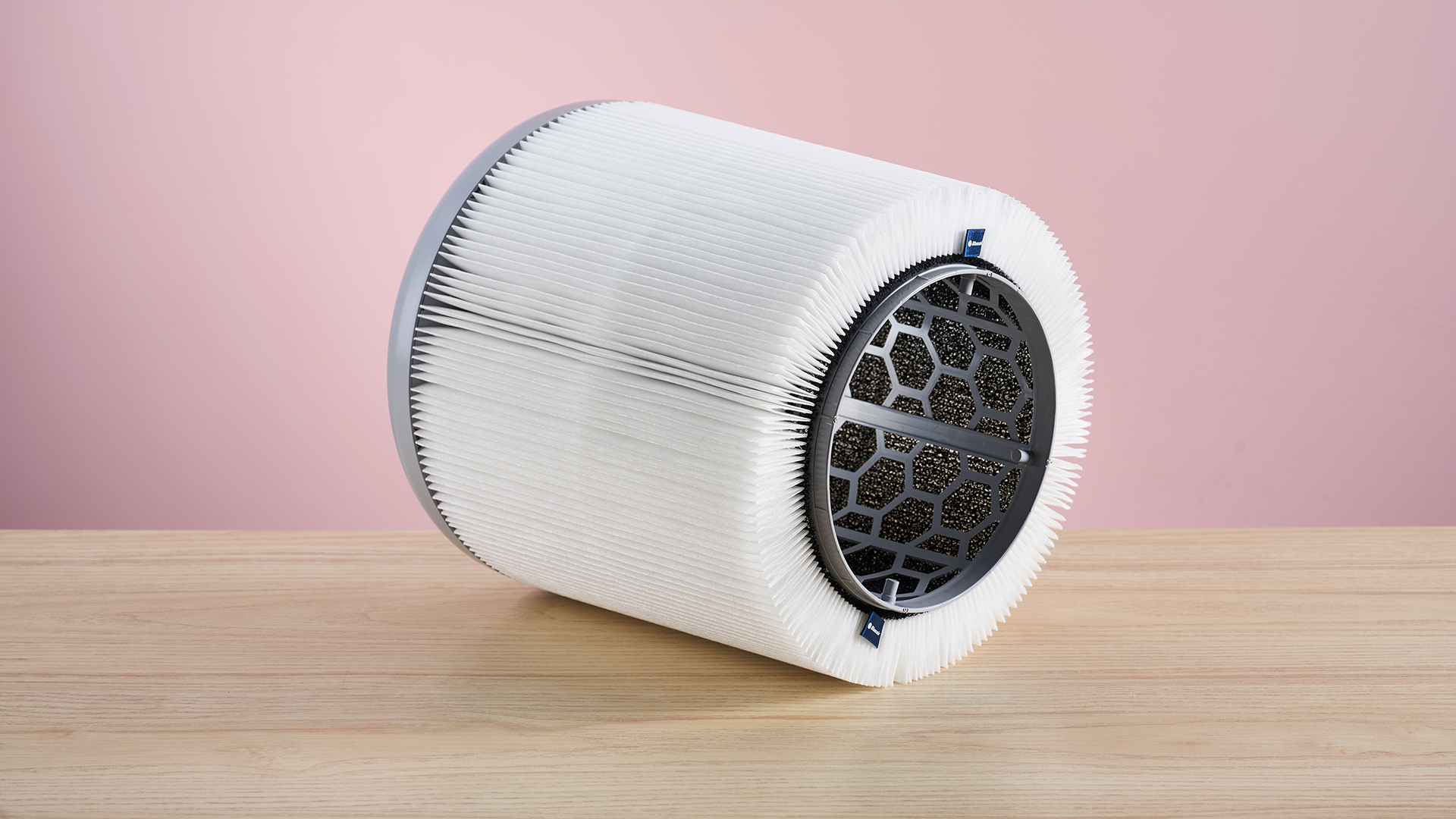
A filter must meet specific standards to be called a HEPA filter (Image credit: Future)
What does a HEPA filter look like?
A HEPA filter is made up of tightly woven microscopic fibers, often made from glass or plastic. It’s generally pleated, to increase the surface area. As air is pushed though the filter, the fibers trap all but the very smallest particles.
There is some maintenance required to ensure that the filter keeps working as it’s meant to. Some (but by no means all) HEPA filters are washable, in which case follow the manufacturer’s cleaning instructions. Generally, HEPA filters will need replacing completely every 6 to 12 months, depending on how they’re being used. That represents an ongoing cost, and because HEPA filters aren’t biodegradable, there’s an environmental impact too.
What can a HEPA filter capture?
A HEPA filter can capture a wide range of airborne pollutants, including dirt and dust, pet dander, pollen, mold, and liquid aerosol. However, the particles need to be big enough to be trapped – some very tiny fragments of pollen or pet dander might make their way through the filter, for instance. They can also be effective against viruses, within reason.
There are limits to what a HEPA filter can do, though. It might be obvious, but the particles need to be pushed through the filter in order to be captured. If the filter isn’t airtight (an aspect that’s not included in HEPA testing), particles may leak through around the sides. And a HEPA filter won’t do anything for particles stuck to surfaces in your home, either.
HEPA filters can’t capture all airborne pollutants. Air purifier brand Molekule explains that they’re limited in their effectiveness against VOCs (airborne chemicals that often come from off-gassing from building materials, common household products, and furnishings) because they “tend to bounce off the fiber media” in a filter. They can also struggle to capture ozone, which doesn’t stick to HEPA fibers. Your air purifier might still be effective against these types of particles, though, using other filtration methods.
What does a HEPA filter do in an air purifier?
Most of today’s best air purifiers will include a HEPA filter. A purifier’s main function is to remove harmful particles and improve air quality, and a HEPA filter will play a key role in that. Sometimes it’ll be combined with other types of filter to enable it to tackle a wider range of pollutants – for example, there might also be a carbon filter to absorb gases and odors. Here’s more on how air purifiers work and what air purifiers can capture.
We’re talking about portable air purifiers here. It’s rare for a HEPA filter to be used as part of a general HVAC (heating, ventilation and air conditioning) system. That’s because it will restrict the airflow to a significant degree, meaning you’d need far more powerful fans to keep the air moving through the system.
Many portable air purifiers will use a HEPA filter (Image credit: Future)
What does a HEPA filter do in a vacuum cleaner?
Some of today’s best vacuum cleaners have a HEPA filter. It tends to be the final element the airflow passes through before making its way out through the vents. Most dust and debris will go straight into the dust cup, or get caught by a pre-filter that sits in front of the motor to stop that from getting clogged. The HEPA filter would follow, to capture the tiniest particles that have made it through, and prevent them being released back into the air.
In order to be effective, however, the system needs to be sealed. If it’s not airtight, the particles will leak out of any gaps that exist before the airflow reaches the exhaust port. Consider too that even if a vacuum is sealed when new, gaps can appear over time (as this Wirecutter writer found when he tested his with a smoke machine).
In vacuums, a HEPA filter will usually be positioned before the exhaust port (Image credit: Future)
It’s also worth being aware that it’s not just the exhaust air being emitted from your vacuum that you need to consider. This 2008 study found that the action of pushing a vacuum cleaner (with or without a HEPA filter) across a carpet is enough to kick a significant volume of particles up into the air – that’s true even if it’s switched off, but especially if it’s switched on. So if you suffer from allergies, it’s best to stay out of the way while vacuuming is happening, where possible.
Just because a vacuum has a HEPA filter that doesn’t necessarily mean it’s a good vacuum, either. A less efficient filter will be plenty effective enough for many people, especially when used in an air-sealed system.
What is a MERV rating?
Another related term you might come across when looking at appliances with filters is a MERV rating. MERV stands for ‘Minimum Efficiency Reporting Values’, and it’s a measure of a filter’s efficiency at capturing larger particles between 0.3 and 10 microns.
The higher the MERV rating, the better the filter is at trapping specific types of particles. So a MERV 1-4 filter can trap around 20% of particles between 3 and 10 microns in size, while a MERV 13-16 filter can be effective against particles as small as 0.3 microns. The scale goes up to MERV 20, and a filter that’s MERV 17 or above is considered a true HEPA filter.
The main difference between a higher-rated MERV filter and a HEPA filter is that the latter is better at capturing tiny particles. Both will be effective against larger airborne particles.
