


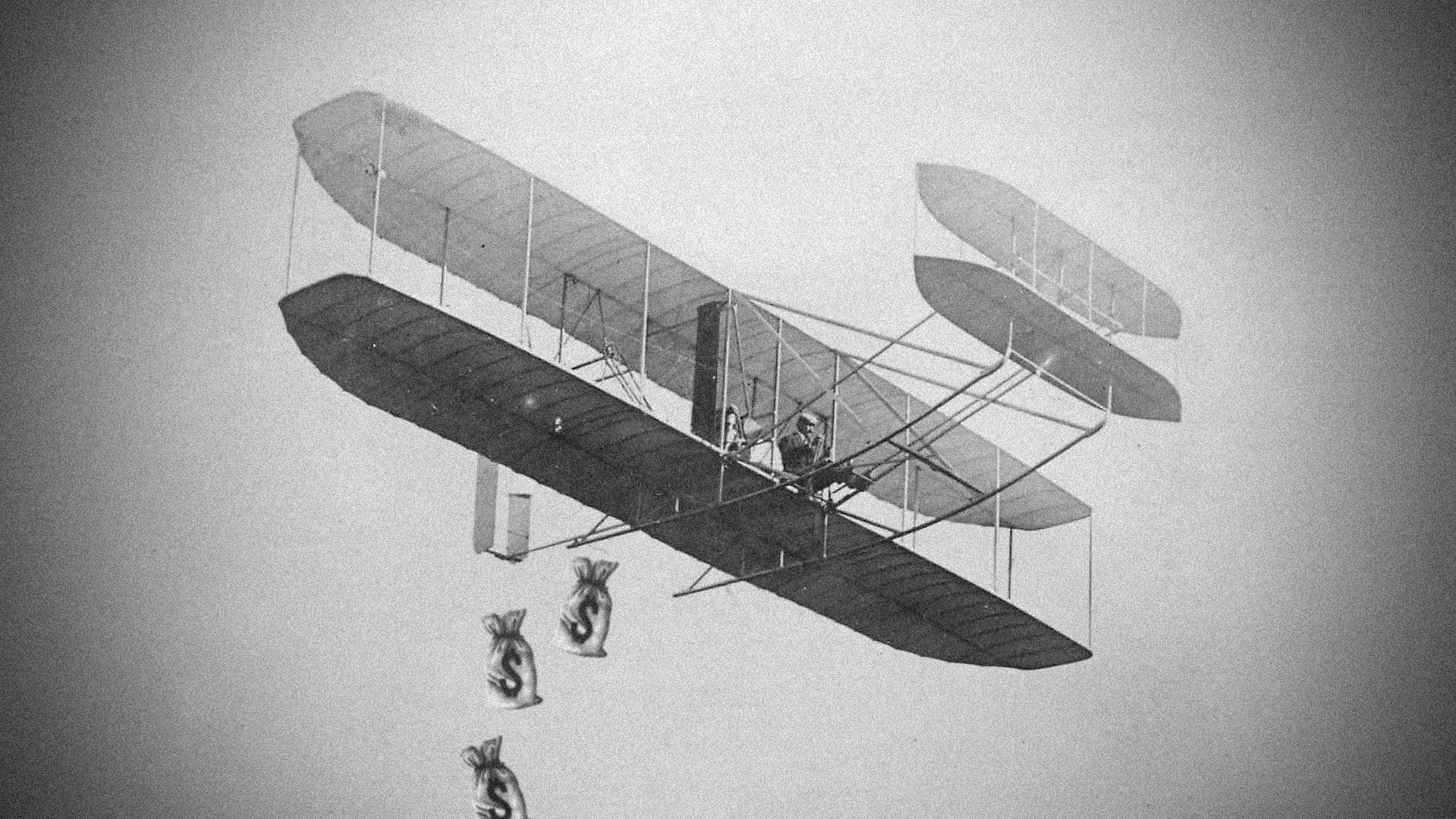
What happens when venture capital and government pull back from science entrepreneurs at the same time? Many scientists think we’re about to find out, and are looking at how we can preserve our country’s innovative leadership. While others are pulling back, at Activate we’re leaning in and asking, “What should we teach the scientist founders we support so they can find the opportunity in this crisis?”
History lesson
History has a lesson for us: the U.S. saw a boom in “deep-tech” between 1870 and 1920 even though neither venture capital nor government grants existed at that time. Moreover, much of that technology was commercialized by teams of fewer than 10 people. Consider, for example, a particularly famous startup founded by two brothers.
In 1892, some of America’s most famous science entrepreneurs, Orville and Wilbur Wright, capitalized on a growing craze for bicycles in the U.S. by opening a bicycle shop in Dayton, Ohio. In 1896, the U.S. Government’s War Department allocated $50,000 (about $1.9M in 2025 USD) to the Smithsonian Institution, the closest thing to a national lab at that time, to develop a powered flying machine. In 1899, in response to this very public market signal and to growing competition in the bicycle industry, the Wrights began to pivot toward developing an airplane. In their historic moment, they demonstrated powered flight in November 1903 and went on to earn their first revenue (totaling about $3.8M in 2025 USD) in late 1908 and early 1909.
Financing deep tech
Commercializing deep tech took the same decade then that it does now. This makes sense: we can make much more complex technologies today, but the core loop of design-prototype-test-revise continues to move at the speed of human thought and observation. Without grants or venture investment, financing deep tech then was very different, but it was not impossible. The Wrights continued to own and operate their bicycle business (with substantial assistance from their sister Katherine) over their entire entrepreneurship journey, only divesting in 1908 once the airplane was sure to pay the bills.
From bicycle to airplane
The bicycle shop provided the funds, skills, team, and facilities needed to develop the airplane.
- Funds: The bicycle shop was consistently profitable, allowing the Wrights to support themselves and invest in their airplane research.
- Skills: The Wrights started by selling and repairing bicycles from a variety of brands, graduated to assembling bicycles from components and selling them under their own “Van Cleve” and “St. Clair” brands, and eventually invented components (such as improved wheel hubs) for their cycles.
- Team: Charlie Taylor, whose many contributions to the first airplane include designing and building its aluminum engine, began working with the Wright Cycle Co. as a contract machinist in 1898 before joining full-time in 1901.
- Facility: The workshop and tools in the bicycle shop doubled as the laboratory for testing and building prototypes for the first airplane. When the Wrights finally closed the bicycle shop, it was to fully convert it to a workshop for their airplane business.
Today’s science entrepreneurs have a lot they can learn from this model. For one, even when venture capital investment is available, opening a bicycle shop before developing an airplane is often the way to go. We’re advising our Activate fellows to find products and services that customers will buy today and that build the team, skills, and assets they need to bring their transformative technologies to market. The genius of the Wright brothers wasn’t just in being first in flight, but also in seeing how the airplane could grow out of their bicycle business.
Three questions
In my job as managing director of Activate’s Boston community, I have long-term coaching relationships with 20 science entrepreneurs. Right now I’m telling them to ask themselves three questions:
- How do I grow the long-term value of my airplane?
- How do I grow the short-term value of my bicycle shop?
- How do I tighten the connection between the two?
In an uncertain economy, supporting science entrepreneurs is more important than ever. They have the skills needed to build “bicycle shops” that deliver unglamorous but critical products and services for the millions of deeply technical niche markets that underpin our modern world. They also have the creativity and tenacity to leverage their day-to-day work to invent entirely new industries that meet our country’s most pressing needs. We need to publicly recommit to these often unsung science heroes so that we can set them—and our country—up for success.
