


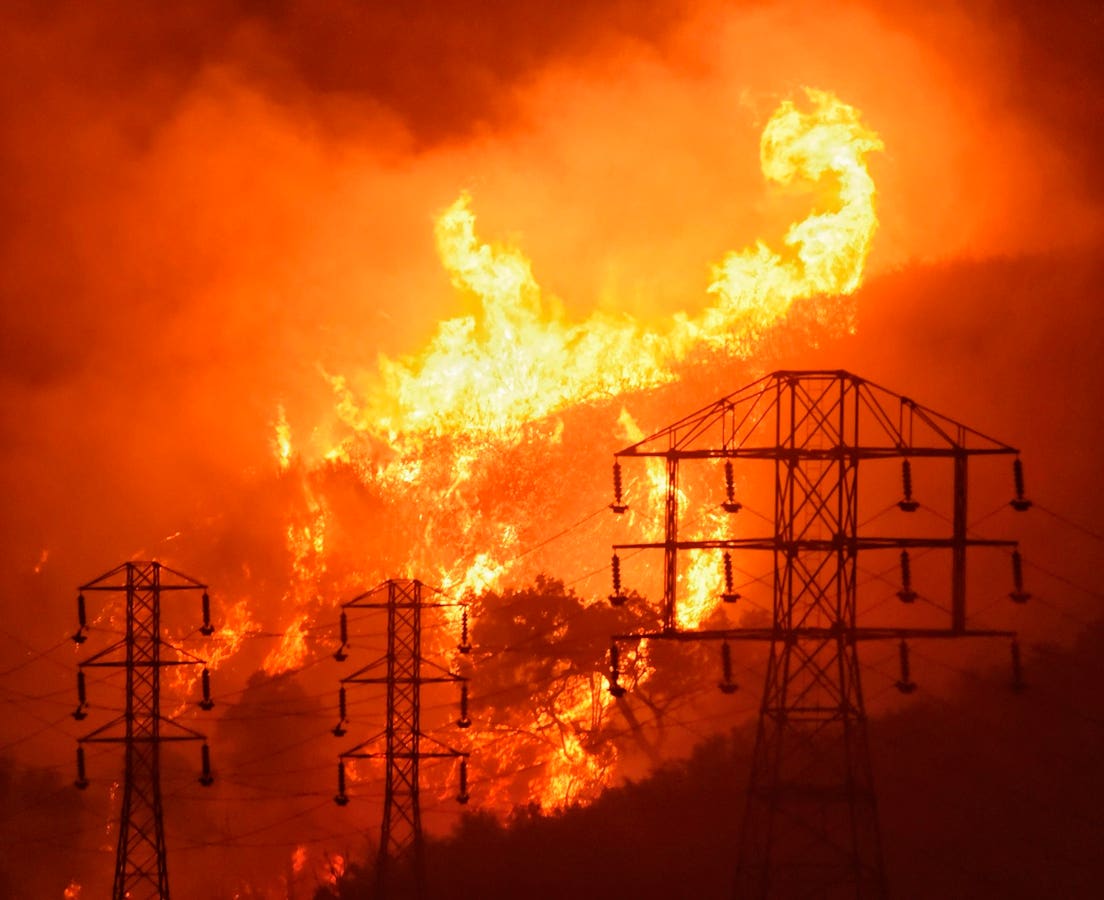
Flames burn near power lines in California.
Associated Press
An arm of the U.S. Department of Energy has unveiled an online public database with 400 wildfire mitigation plans from electric utility companies in 19 states to increase wildfire resilience at a time when utilities in some other states may be unprepared.
Pacific Northwest National Laboratory has released the database as a tool for state lawmakers and regulators as well as electric utility officials to better develop ways to mitigate the destruction caused by ever-increasing wildfires and better withstand these extreme events.
“Wildfires are no longer a seasonal threat—they’re a year-round, national challenge with many areas in the country experiencing a new emerging risk,” André Coleman, PNNL chief scientist, noted in a June 10 public announcement. “This database empowers decision-makers at every level to see the different approaches being used, understand what’s working and where gaps exist, aid in new plan development, and collaborate on more effective mitigation strategies.”
Based in Richland, Wash., PNNL says the public release of the Wildfire Mitigation Plans Database “comes at a time when wildfires are becoming more frequent and severe, posing increasing threats to power infrastructure, public safety, and taxpayer dollars.”
The effort was funded by DOE’s Grid Deployment Office, which was founded in 2022 to fund projects that support critical power generation and make the national electricity grid more resilient. Another focus areas is to bolster electric transmission and distribution systems.
“Our vision is to share a complete archive of all publicly available utility wildfire plans to see what the extended community of wildfire stakeholders wants to know. This open data enables conversations and analysis beyond the doors of the laboratory while giving us keen insight into proposed and potential industry solutions and trends,” said Rebecca O’Neil, PNNL advisor of electricity infrastructure. “We will continue to update the database and to offer wayfinding tools, through short topic-based analyses and a tool to search plans intelligently. Most of all, though, we want to hear from the user community what they are doing with the information and what more we can make possible.”
Transmission Improvements Could Improve Power Reliability in Extreme Events
High-voltage towers in the forest.
getty
The Grid Deployment Office released a 294-page “National Transmission Needs Study” in October 2023. The report addressed the importance of improving wildfire reliability and resilience in the California and the western part of the United States. It noted that the Northwest and Southwest regions were at “risk of load curtailment during extreme weather events and wildfires,” especially as those areas rely more “on variable energy resources to meet peak demand. Additional transmission upgrades would reduce risks to electricity reliability from extreme events.”
PNNL stated that the U.S. Congress Joint Economic Committee estimated that wildfires nationally incur annual costs ranging from $394 and $893 billion, with as much as $202 billion from electricity losses. “On average, in the United States, wildfires caused by power utilities represent about 10% of wildfire starts, though they account for roughly 19% of the annual average national burn area,” PNNL says.
Wildfire Plans Lacking for Midwest, Eastern and Southern Electric Utilities
States with electric utility wildfire mitigation plans in PNNL’s database.
Pacific Northwest National Laboratory
Of interest in the PNNL database is the lack of wildlife mitigation plans for much of the Eastern part of the United States. The database is searchable by location, by year/range of years, and by utility or type.
The state with the most wildlife mitigation plans was California (224 utility plans), followed by Oregon (87), Washington (53), Utah (19), Idaho (18) and Colorado (16).
New Stanford University Report Finds Many Electric Utilities Unprepared for Wildfires Despite Risks
In June, Stanford University’s Stanford Climate and Energy Policy Program published a 34-page report called “Wildfire: An Updated Look at Utility Risk and Mitigation.” It was written by Eric Macomber, I. Avery Bick, Michael Wara and Michael Mastrandrea.
The report underscored the dangers of wildfires ignited by electric utility infrastructure in the United States. It discussed California wildfires as well as a greater awareness there and regulatory framework regarding risks of wildfires started by electric utility infrastructure. Consequently, Western states such California, Nevada, Oregon and Utah have more developed wildfire utility mitigation plans particularly by investor-owned utilities.
At the same time, the study noted that the likelihood of catastrophic wildfires is much higher today in areas where it had not been a concern.
“Wildfire risk has continued to increase across North America as a result of a number of interrelated trends, the report noted. “These include shifting weather conditions linked to climate change, which can cause fires to burn at higher intensity and spread more quickly across the landscape; historical fire suppression practices, which have caused flammable dead and dry vegetation to build up in many forested areas, increasing fire intensity; and development and land use patterns that have led vulnerable structures to be located in or near areas where fires are likely to occur, increasing the risk of catastrophic fires that spread from structure to structure and destroy entire communities.”
Specifically investor-owned utilities in the Gulf Coast, Southeast and Upper Midwest in large part have not devised such mitigation plans even though they may be located in areas with great risk for wildfires.
Advice for Utilities
Midwestern new homes next to power lines.
getty
Stanford researchers acknowledged challenges by some utilities (like rural electric cooperatives and those owned by the public) may face in devising wildfire mitigation plans. However electric utility officials and regulators should take measures to safeguard power supplies and minimize the likelihood of their infrastructure sparking a wildfire. For instance, deactivated transmission infrastructure could ignite a wildfire.
The report suggested than “an approach to wildfire mitigation which reduces the likelihood of electric infrastructure igniting catastrophic fires is key not only to protecting the safety of homes and communities threatened by fires, but also to the future development of the energy system. Because the costs that utilities incur as a result of both wildfire liability and infrastructure projects like mitigation plans are ultimately passed on to their customers in rates, it is important that mitigation programs are conducted in a manner that is not only practical and timely, but also efficient and cost-effective.”
