


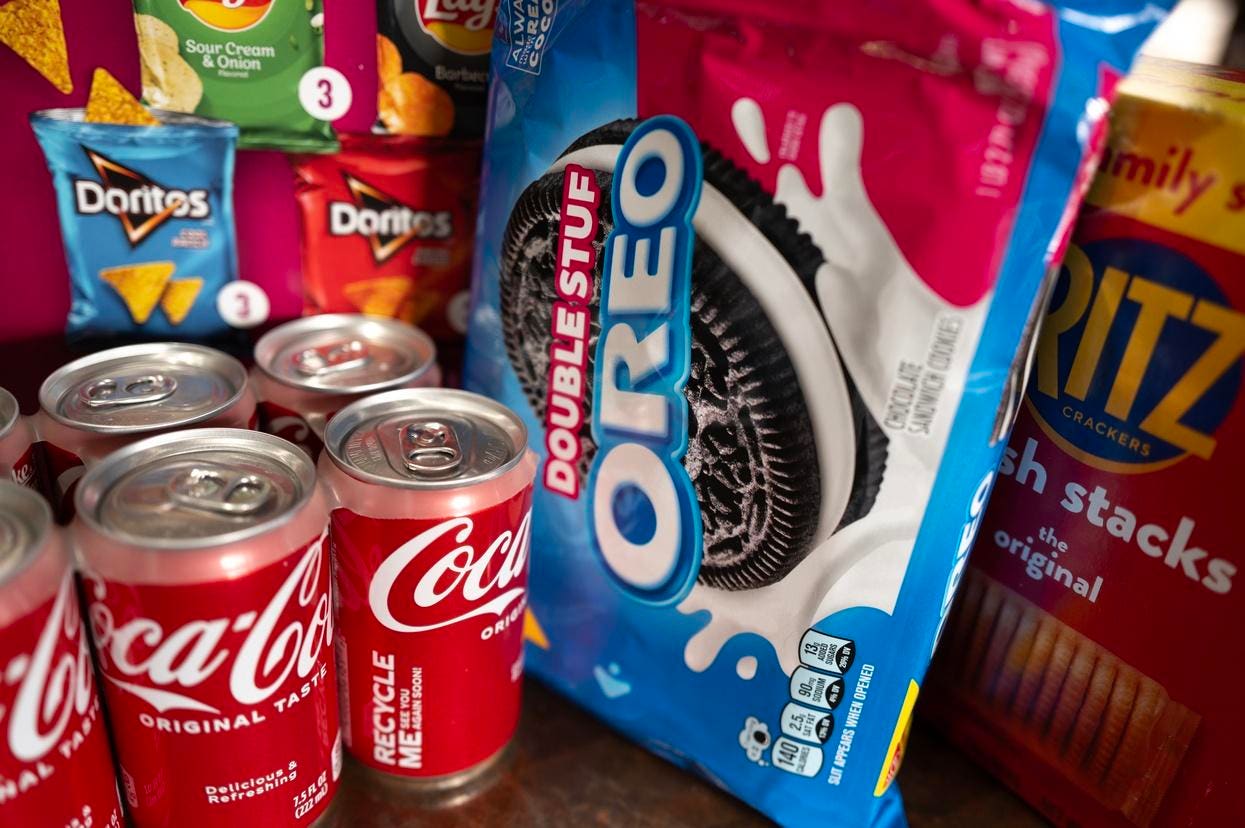
CHICAGO, ILLINOIS – DECEMBER 11: In this photo illustration, food products manufactured by Mondelez and Coca-Cola are shown on December 11, 2024 in Chicago, Illinois. Both companies are among those named in a lawsuit that accuses major food companies of marketing ultra-processed and addictive foods to children. (Photo Illustration by Scott Olson/Getty Images)
Getty Images
In the age of misinformation, food literacy isn’t just about health – it’s a strategic imperative for business, climate, and public trust. Misinformation is eroding public health, distorting climate-smart food strategies, and warping market behavior. This isn’t just an information problem but a business risk and investment threat.
Nutrition Misinformation in the Digital Age, a report from the Rooted Research Collective and the Freedom Food Alliance, identifies 53 nutrition super-spreader influencers on social media, who reach tens of millions with misleading, and often dangerous, advice. According to the research, up to 24 million people are at risk of making harmful decisions based on extreme, profit-driven dietary advice.
For businesses operating in food, health, wellness, and sustainability, this isn’t just a fringe issue but a growing strategic risk to product credibility, policy compliance, consumer safety, and long-term brand value.
Wellness or Risk? Inside The Misinformation Economy
The report identifies a familiar pattern: influencers promoting restrictive diets like carnivore, keto, or raw milk, often in direct contradiction to medical guidance. Of the 53 influencers analyzed, 87% have no medical qualifications, and 96% have clear financial incentives.
“Nutrition is complex, but it doesn’t have to be confusing,” says Alice Millbank, co-founder and chief scientific officer at Rooted Research. “Super-spreaders exploit that confusion by offering dangerously simple answers dressed up as hacks, often driven by profit, not science.”
These influencers use aesthetics, emotional triggers, and pseudo-authority, especially fake or exaggerated doctor titles, to convert trust into clicks, purchases, and coaching clients. The report says, “”Only a small number (7 out of 53) were verified medical doctors (those with an MD or equivalent and clinical training) and, of these, just one was identified as an internist, a specialty with direct relevance to NCDs. Other represented fields included psychiatry, orthopaedics, neurosurgery and fertility.”
Matt Cooper, co-founder of Exceptional Ventures, an investor in evidence-based health startups, calls this out as a fundamental business failure saying in an interview, “The rise in the size and success of the wellness market has attracted a host of bad actors telling outright lies in exchange for a piece of the pie.”
Food Literacy: A Casualty of Convenience Culture
So what exactly is food literacy? In an interview Marlana Malerich, co-founder and chief development officer of the Rooted Research Collective, explained that it’s more than knowing a carb from a calorie. “It’s an individual’s ability to understand food systems, make healthy food choices, and also how their choices impact broader cultural, economic, and sustainability environments,” she said.
Yet that literacy is plummeting. Only 0.1% of a representative sample of the UK population follow the Eatwell Guide, the UK government’s official model for a healthy, balanced diet. Part of the problem is the growing prevalence of ultra-processed convenience foods. As they have become cheaper, faster, and more aggressively marketed, they’ve also become more nutritionally barren.
The Carnivore-Climate Disconnect
Perhaps most troubling for sustainability advocates is the rise of dietary fads that actively undermine climate-friendly food systems. The report highlights a surge in carnivore content, diets centered on red and organ meats, that ridicule plant-based eating as “unnatural” or “deficient.”
“These diets aren’t just nutritionally risky,” says Millbank. “They’re environmentally unsustainable. Yet they’re marketed with a veneer of rugged naturalism that appeals to identity politics more than science.”
Misinformation thrives in simplicity. “In a world where people feel overwhelmed and exhausted,” adds Malerich, “extreme diets offer clarity and control. Do this diet, look like me. Do this, and your health problems go away. It’s not evidence-based, it’s emotionally engineered.”
Follow the Money: How Misinformation Became a Business Model
These influencers are not anomalies, they’re often successful entrepreneurs. Some earn six-figure monthly incomes through supplement sales, affiliate marketing, and ticketed events. Behind the scenes, the wellness market has ballooned into a $2 trillion industry with low regulatory oversight and high consumer vulnerability.
“Misinformation often thrives not despite the market but because of it,” says Cooper. He warns that monetizing fear and distrust without scientific backing is not just unethical, it’s unsustainable. In fact, for investors, pseudo-authority should be an early warning that the product or service may not stand up to real scrutiny.
The consequences extend beyond financial risk. When influencers denigrate plant-based diets and promote red meat and unpasteurized milk, they also undercut climate-aligned food strategies. As Millbank notes: “The prevalence of the carnivore diet in these narratives suggests that sustainability is not a primary concern.”
Platforms, Pseudo-Authority, and the Problem of Trust
Part of the problem, says Millbank, is that the people who should be influencing public health simply aren’t where the influence happens. Over a third of Gen Z say they trust TikTok influencers more than their doctors. “We live in a fast-paced world, strained healthcare systems, and a commercialized food environment,” said Malerich. “Super-spreaders weave partial truths into emotionally resonant narratives that tap into real frustrations.”
The result: evidence-based voices are drowned out, and climate-forward eating becomes politically and culturally toxic. Businesses aligned with sustainable food risk getting caught in the crossfire.
A Systems Strategy For Market Resilience
The authors of the report argue that fighting this wave of misinformation will require far more than just fact-checking, which has already been rolled back on several major platforms. Instead, they propose a systems-level approach.
It starts with education. Teaching food and digital literacy from an early age (how to cook nutritious meals, understand labels, and critically evaluate online claims) can lay the foundation for a more informed public. But education alone isn’t enough. To shift the balance of influence, credible experts need to meet people where they are. That means training and supporting qualified professionals to build trust and visibility on the same platforms where misinformation spreads.
Finally, they call for higher ethical standards across the digital health landscape. This includes regulating the use of medical titles online, enforcing transparency in health and nutrition claims, and holding platforms accountable when profit-driven content endangers public health.
Public health messaging often fails by being too dry, too complex, or reduced to watered-down science buried in outdated formats. To cut through the noise and connect with real people, Millbank says, “We need a new model, one that understands how influence, trust, and identity actually work.”
How Investors Can Lead And Why They Must
The report also calls on investors to raise their standards. Cooper agrees. “We have no interest in backing companies that are only in it for financial gain,” he says. “Beyond capital, we see it as our responsibility to shape the conversation. That means educating the public, lobbying for smarter regulation, and giving a microphone to the good actors. We want Exceptional Ventures to be a signal in the noise: a place where credibility matters and where real science wins.”
He believes companies that build real credibility will win in the long term. “Financial success does not have to come at the expense of honesty and science; products and services that are proven to be scientifically legitimate are the ones that will succeed in the long term. As long as the business is run correctly and with integrity, the financial success will take care of itself.”
Food, Trust And The Future Of Resilience
Food is no longer just about nutrition – it’s about trust, identity, and the future we’re building. Misinformation is already reshaping markets, but the businesses and leaders that thrive will be those who restore credibility, resist shortcuts, and meet people with honesty, online, in stores, and on the plate.
In a year when the World Economic Forum ranked misinformation above war and extreme weather, this is no longer a wellness issue. It’s a systems issue, and food literacy is the foundation of any meaningful solution. As Cooper puts it, “In a market full of noise, we believe being rigorous is the right and smartest thing to do.”
The task now is clear: invest in education, demand higher standards, and rebuild trust from the ground up – because the future of health, sustainability, and society may well be dependent on it.
